
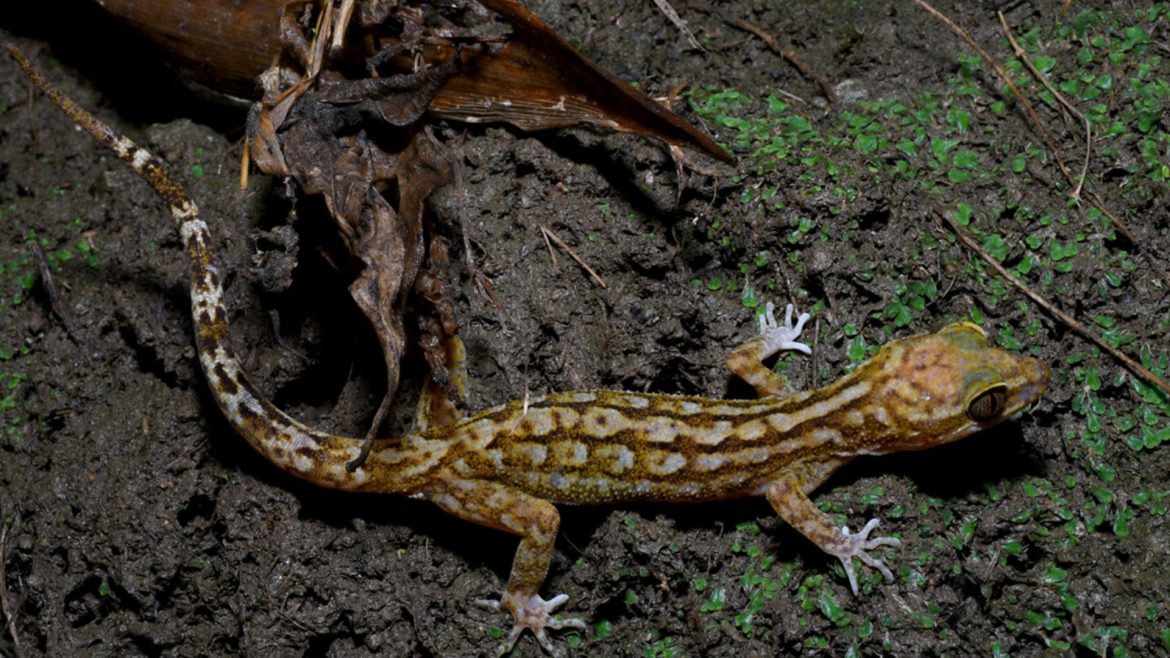
A bent-toed gecko species has been discovered in the mist-laden mountains of Darjeeling. Found during a recent wildlife survey by researchers from the Zoological Survey of India, Fakir Mohan University and the Human and Environment Alliance League, the small reptile, officially named Cyrtodactylus nebulicola, was discovered clinging to rock crevices and house walls in the village of Latpanchar in Darjeeling. By combining physical examinations with genetic testing, the team proved this gecko is a distinct species, highlighting the rich biodiversity still waiting to be uncovered in India’s misty mountainous forests. Research Matters had reported the discovery of another bent-toed gecko species from Assam in recent times.
The researchers were exploring the Kurseong division of the Darjeeling district, an area just outside the Mahananda Wildlife Sanctuary. While collecting reptiles for their survey, they spotted these uniquely patterned lizards living alongside human settlements near dense, mixed-wet forests. Suspecting they had found something new, the team collected specimens to study their physical traits and extract DNA. Their genetic analysis revealed a significant evolutionary gap, showing a genetic difference of roughly 12% to 20% from its closest known relatives, firmly establishing it as a new branch on the gecko family tree.
The Latpanchar bent-toed gecko is similar to other geckos with its pale brown back, dark marbling, and banded tail, but it has several unique physical traits that set it apart. The researchers noted specific scale patterns, including 15 to 22 fairly regular rows of small, bumpy scales—called tubercles—running down its back. Crucially, unlike some of its closest evolutionary cousins, the female of these geckos possesses specialised femoral pores on their hind legs, a feature typically missing or differing in similar species. It also features a specific count of lamellae, which are the tiny, specialised scales under its toes that help geckos grip and climb, further distinguishing it from neighbouring species like C. gubernatoris and C. bhupathyi.
The species name, nebulicola, is inspired by the cool, high-altitude environment where the lizard makes its home. Nebulicola is a combination of the Latin words ‘nebula, meaning mist or cloud, and ‘cola,’ meaning dweller or inhabitant. Together, the name translates to “dweller of the mist,” capturing the essence of the cloud-forest habitat of Latpanchar. However, the researchers warn that this misty home is under threat. While local communities have historically helped protect wildlife, a recent boom in unregulated tourism, wildlife photography, and habitat degradation could pose serious risks to this narrowly distributed creature, emphasising the urgent need for community-based conservation in the region.
