
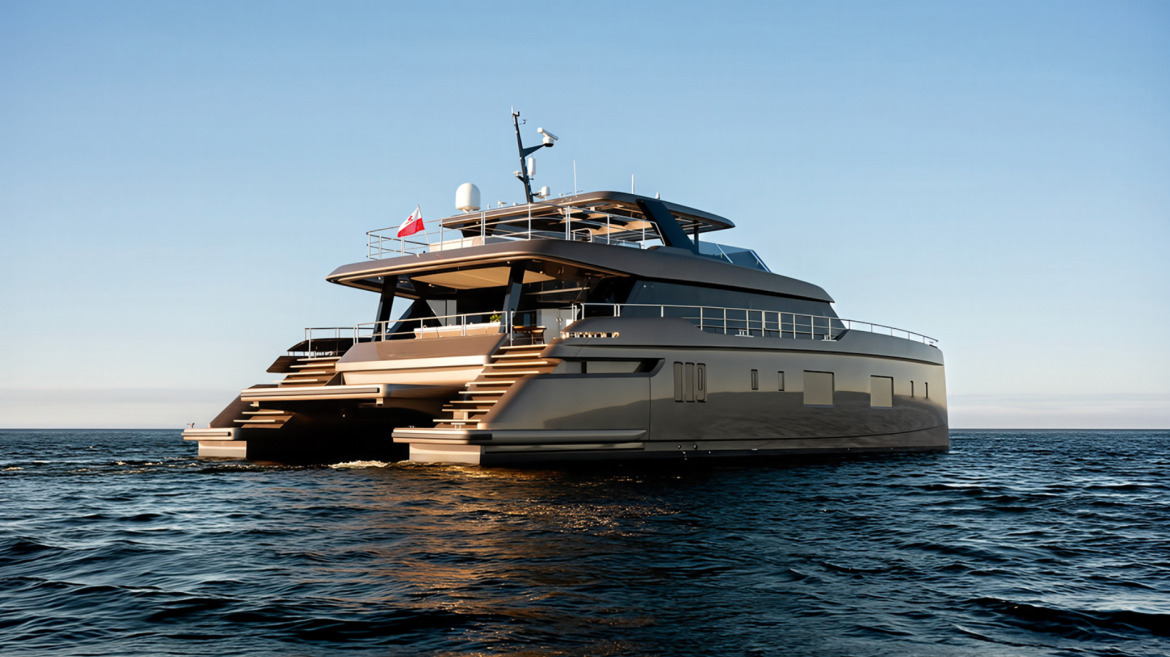
From power 100’s to full-carbon high-tech catamarans, BOAT selects five of the best catamarans for sale, showcasing the very best of today’s multihull market – whether you’re seeking speed, space or serious design pedigree.
This Is It
LOA: 43.5m
Beam: 14.5m
Draught: 2.22m
Price: €46,000,000
Delivered in 2024, the Tecnomar catamaran feels like a villa on sea, with a sculptural silhouette, flowing open stern, two-deck owner’s suite and more than 600 square metres of glass. Constructed in aluminium and designed throughout by the Italian shipyard and brand of The Italian Sea Group, This Is It’s radical, mind-bending profile was first unveiled to the industry at the 2023 Monaco Yacht Show. Shortly after, the catamaran joined the charter market with IYC, becoming the world’s largest motor catamaran for charter.
The yacht’s design, said to be “unlike anything the superyacht world has seen“, quickly drew attention for its asymmetric lines, 14.5-metre beam and 600 square metres of glass panelling, attracting celebrity charter guests including Rihanna and A$AP Rocky.
This Is It is listed for sale with IYC and Royal Yacht International.
Bonus fact
Tecnomar’s This Is It is the world’s largest motor catamaran for charter.
Hemisphere
LOA: 44.2m
Beam: 16.6m
Draught: 3.1m
Price: €38,500,000
This is the biggest cat in the jungle. The world’s largest sailing catamaran when she was launched, Hemisphere remains a powerful offshore platform ideal for far-flung exploration, with a 16.4-metre custom sportfishing tender for shore excursions and diving and fishing trips, and a host of water toys. Built in 2011 and refitted in 2023, the yacht sports a “sensational interior” by Michael Leach Design and was designed for “off-the-beaten-track exploration”. Her exterior and naval architecture are by renowned multihull designers Marc Van Peteghem and Vincent Lauriot Prévost (VPLP Design).
Hemisphere is listed for sale with Burgess.
Twilight
LOA: 28.6m
Beam: 13.5m
Draught: 2.1m
Price: $15,950,000
Just one year since delivery from the shipyard’s facilities in Poland, this pristine Sunreef Power 100 offers one of the highest volumes of all sub-30-metre yachts, with a spa pool on the flybridge and fold-down balconies in the beach club. Her 240 square metres of solar panels also generate up to 46kWp of renewable energy. The catamaran is the third hull from Sunreef Yachts‘ 100 Power series and was constructed in GRP with metallic exterior paint to a complete in-house design.Twilight is built to MCA commercial compliance and, according to the broker, presents a rare opportunity for the buyer, seeing as there are currently “no other Power 100s on the charter market”.
Twilight is listed for sale with Edmiston.
Read More/Scroll-stopping: The most Instagram-worthy superyachts
Sitara
Credit: Ocean Independence
LOA: 25m
Beam: 9.9m
Draught: 1.2m
Price: €4,900,000
Crafted from lightweight aluminium, this VisionF 82 is a full-custom 25-metre with all the tech required for liveaboard use, including an AI system for object detection and a considerable battery bank and electric energy management system for self-sufficiency at sea. Crafted from lightweight, durable aluminium, this VisionF 82 is meticulously refined and fitted with every upgrade imaginable to honour its name, Sitar, “star” in ancient Persian.
Sitara is listed for sale with Ocean Independence.
Allures
LOA: 30.5m
Beam: 13m
Draught: 4.1m
Price: €3,800,000
This full-carbon high-tech catamaran from Compositeworks blends blistering 27-knot speeds under sail with the elegance of a mahogany and fig wood interior, accommodating up to eight guests, and the convenience of
an extra-large tender. The Bureau Veritas-classed yacht was built from carbon fibre in 2006 by Compositeworks and Technicomposit in France, subsequently undergoing refits in 2022.
A somewhat neutral-toned interior by Allures Design (the owner’s wife, a talented interior designer) is offset by rich mahogany and fig woods and complemented by dark leather fittings. This is predominantly seen in the spacious main saloon with U-shaped seating and the forward-facing dining area, both of which showcase the mix of traditional and modern motifs.
Allures is listed for sale with Fraser.
Read More/Seven of the finest classic Feadship superyachts for sale
