
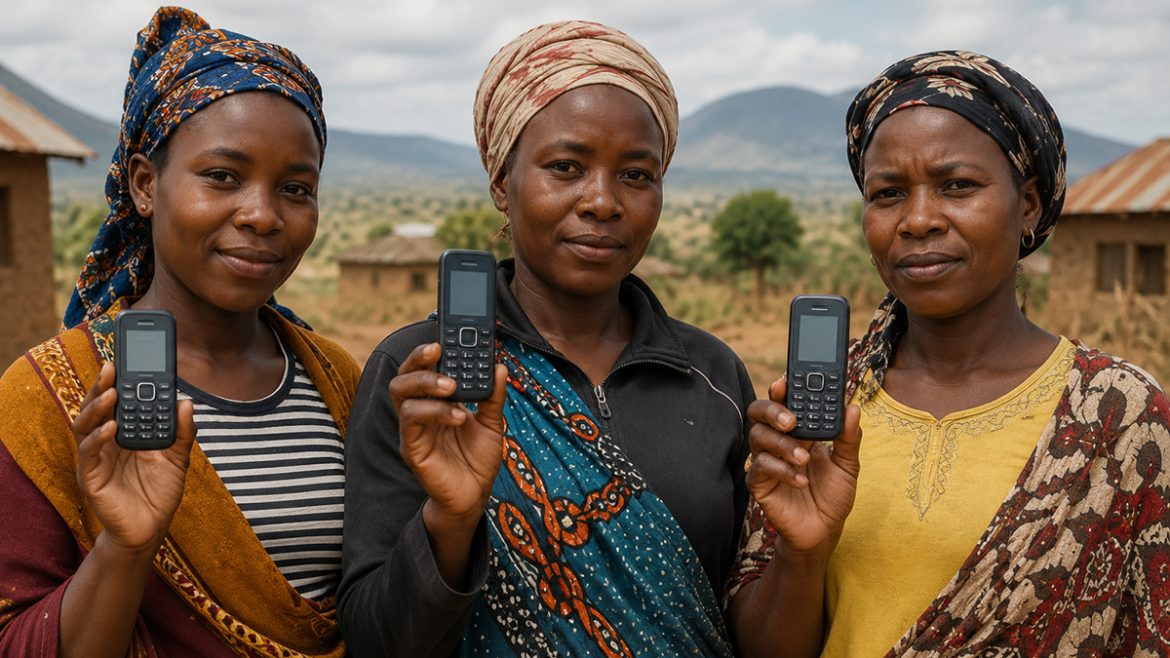

Africa’s rural communities face the largest disparities, with mobile internet gender gaps significantly wider outside urban centres. (Image created using ChatGPT)
More than 810 million women across low- and middle-income countries (LMICs) remain offline, with Sub-Saharan Africa recording one of the world’s widest mobile internet gender gaps.
According to the GSM Association’s (GSMA’s) Mobile Gender Gap Report 2026, released this week, women in LMICs are still 12% less likely to use mobile internet than men, leaving an estimated 200 million fewer women connected than their male counterparts.
This is despite mobile internet becoming the primary gateway to the digital economy, according to new research from the GSMA.
The report reveals that of the 810 million women who remain offline globally, more than two-thirds live in Sub-Saharan Africa and South Asia −regions that continue to experience the widest disparities in digital access.
The findings highlight significant implications for Africa, and the challenges facing governments, mobile operators and development agencies seeking to expand digital inclusion.
See also

The report notes that Sub-Saharan Africa’s mobile internet gender gap stands at 26%, second only to South Asia’s 25%. The divide becomes even more pronounced outside major cities.
“In LMICs, the gender gap in mobile internet adoption tends to be two to three times wider in rural areas than urban areas. In 2025, across all LMICs, the gender gap in mobile internet adoption was more than three times wider in rural areas than in urban areas.
“There is also a difference at the regional level, where the gender gap in mobile internet adoption is wider in rural than urban areas of LMICs in every region except Europe and Central Asia.”
For Africa, the rural challenge is particularly severe, the report warns.
The GSMA found that the gender gap in mobile internet adoption reaches 34% in rural areas of Sub-Saharan Africa, compared to 21% in urban centres.
Smartphone ownership remains a major obstacle to digital inclusion. The report found that women across LMICs are 13% less likely to own a smartphone than men, representing approximately 210 million fewer women with access to internet-enabled devices.
Across Sub-Saharan Africa, only 34% of women own smartphones, with the region recording a smartphone ownership gender gap of 22%, with access to internet-enabled devices remaining one of the most important factors influencing whether women eventually adopt mobile internet services.
“The type of mobile device a person owns matters, as it typically affects whether and how they use the internet. Once someone owns a smartphone, they are much more likely to be aware of mobile internet, adopt it and use it regularly and in a variety of ways. In fact, once women own a smartphone, these metrics more closely resemble those of men,” notes the report.
Despite growing awareness of mobile internet and its benefits, women continue to face multiple barriers to meaningful participation in the digital economy.
The report identifies affordability, literacy and digital skills as the leading barriers preventing women from getting online.
Even after gaining access, women frequently report safety and security concerns, data costs and connectivity quality as obstacles to broader internet use.
The report notes: “Addressing rural gender gaps is essential to advancing digital inclusion for women overall. In particular, women who live in rural areas tend to have limited physical access to essential services and may have the most to gain from better access to mobile and mobile internet.
“Addressing gender gaps in mobile ownership, particularly of smartphones, and in mobile internet use can help women in rural areas benefit from these digital technologies to the same extent as men.”
Claire Sibthorpe, head of digital inclusion at the GSMA, warns that progress is not happening quickly enough and emerging technologies such as artificial intelligence risk creating new forms of digital exclusion.
“While there has been a slow narrowing of the mobile gender gap since 2022, much more is needed to address the persistent and significant gender gaps in mobile internet adoption and use.
“We live in an increasingly digital world and the proliferation of technologies such as AI are creating greater digital divides and inequities, elevating the need to ensure digital inclusion for all.”
