
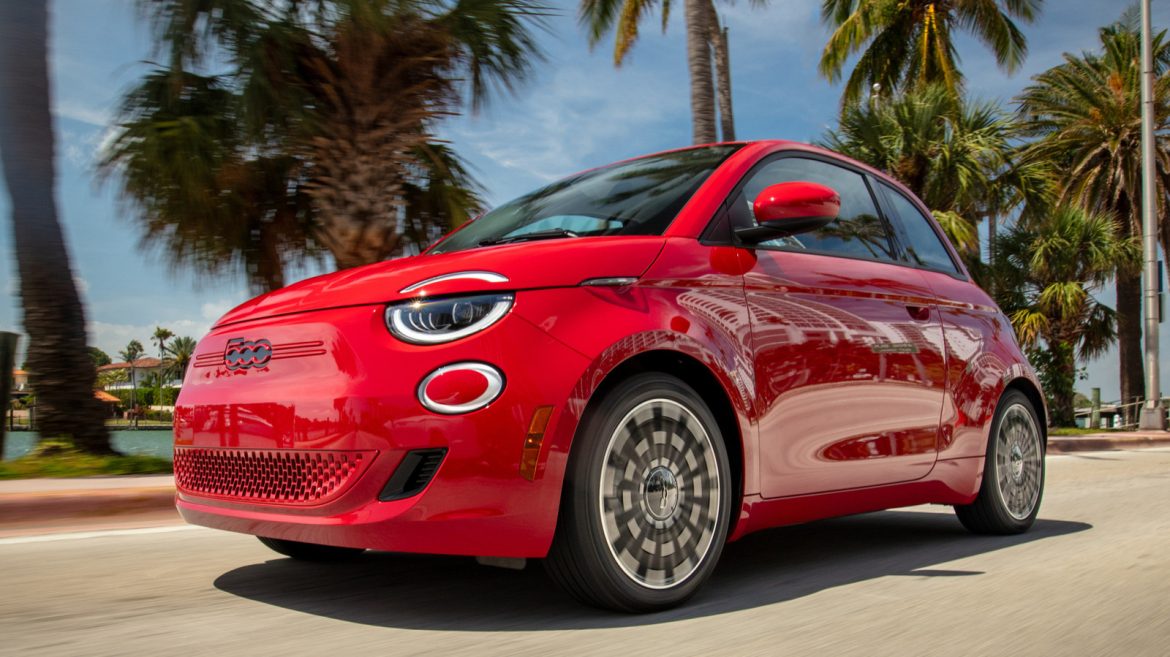
So you just bought an electric vehicle. Or maybe you’re about to, and you haven’t quite pulled the trigger yet. Alternatively, maybe your partner decided to become an EV owner, and you aren’t quite ready for divorce. Well, it’s too late now. Might as well make the best of it. The good news is, you have me as your guide — the only person brave enough to road trip a 2024 Fiat 500e despite its 141-mile range and one of the few willing to warn you that fast-charger cables can be unexpectedly heavy.
A little over a year ago, I leased a 2024 Fiat 500e for two reasons: The $159 pre-tax lease offer, and it had a spec sheet that could best be described as “uncompetitive,” since it has the shortest range and the slowest charging speed of any new EV on sale. A long-range, fast-charging EV would have been more convenient, but aside from the part where I couldn’t afford those leases, I figured there wouldn’t be much to learn. After all, what’s an EV with 400 miles of range and ultra-fast charging speeds going to teach me about EV ownership? That’s playing on easy mode.
To make things even more interesting, during my entry into EV ownership, I broke up with my homeowner girlfriend and moved into an apartment with no on-site charging. There are certainly more rural places than where I live now, but it’s a two-hour hike to the nearest bar, so trust me when I say this part of Georgia is not one of those dense, coastal cities that the 500e was meant to be driven in. But by making EV ownership as hard on myself as possible, I’d argue I’m now in the best position to walk you through everything you’ll need to know about getting used to owning a car that doesn’t need gas.
Take a deep breath
For starters, you can relax. It’s just a car. Sure, it might feel like a big change, but whether you bought a Chevrolet Equinox EV, a Rivian R1T, or a Lucid Air Sapphire, they’re all just cars. Cars without starters, alternators, timing belts, accessory belts, head gaskets, valve cover gaskets, spark plugs, or a lot of the other stuff gas cars force you to replace down the line, but they aren’t toys that will break if you look at them wrong. They’re all just cars.
Switching from gas to electric power probably feels like a big change, but I promise you it really isn’t. You get in, you drive, you go places. Maybe you charge here or there. Maybe you don’t. But as exciting and nerve-wracking as the first week or two will probably be, your brain should adjust pretty fast. After all, no matter the source of propulsion, you’re still just driving from point A to point B.
As a result, some of the best advice I can give you is to read the manual. This can be especially helpful if you don’t regularly drive new cars and may be unfamiliar with the modern controls and menus. Heck, even if you lease a new car every two or three years, you should still read the manual. That’s where the automakers hide all the secrets they don’t want you to know, like how to change the clock.
Reading the manual can be a little annoying, and you can skip sections as you please, but it will give you the opportunity to adjust all the settings exactly the way you like them and then save them if your car has memory seats. You know, just like a regular car.
Locate local chargers
If you’ve purchased a new EV, statistically, you probably have the ability to charge at home. And the ability to charge at home should cover the overwhelming majority of your needs. If you drive more than 50 miles a day, installing a Level 2 charger is a good idea, but if you drive less than that, you might be able to get by just charging your car from a standard 110-volt outlet. I never needed faster charging at my ex’s house, but I have pretty limited transportation needs.
Still, it’s worth getting familiar with the local public chargers. With few exceptions, you don’t have to worry about public chargers on a daily or even weekly basis. Those are almost exclusively reserved for road trips or me, the guy intentionally living the EV life on hard mode. But it never hurts to learn the locations of the most convenient fast chargers, just in case you need to top up.
When you first pull up a local map of charging locations, you may be surprised how many more chargers exist. But you’ll want to refine your search. You aren’t looking for just any fast chargers with a charging speed greater than 50 kW. You’ll also want to look near the places you regularly go. My local grocery store has six fast chargers installed toward the back. I can also charge at a few more shopping centers, one movie theater, or across the street from a Shake Shack I frequent. It’s all about doubling up on charging and getting other things done.
Thankfully, card readers are far more common than they used to be, so you may not need an app. But just in case, go ahead and set up the apps for ChargePoint, Electrify America, EVGo, EV Connect, and Blink. Those are the most popular non-Tesla charging networks, and it’s better to have the apps installed and ready to go before you show up to charge, rather than rushing to set up an account when you desperately need to charge.
Take it easy at first
If you really wanted to, you could probably show up at the dealership with a weekend bag, sign all the proper paperwork, and set off on a cross-country road trip in an EV with zero issues. Probably. All you really have to do is put your destination in the onboard nav, stop at the recommended chargers, and (assuming they all work) you’ll be at Cain’s Ballroom (with charging at the corner of 4th and Main) before you know it. Still, I don’t recommend it.
You won’t hurt your car if you immediately set out to get a photo in front of what remains of the now-shuttered Crystal Palace, but you’re probably better off getting a little bit more comfortable with your new car and EV ownership in general before you head off on a multi-day road trip. Like all new cars, EVs have warranties, but it never hurts to give it a few weeks to make sure everything works correctly.
This is especially important with EVs because on the rare occasion modern EV batteries fail, they tend to fail early — kind of like some of those V6s in the new Tundras. Again, everything should work correctly right out of the box, but if you do get unlucky and encounter battery or charging issues, being close to home when you notice the problem should minimize the headache.
To be clear, I’m not saying it’s likely that your car’s battery will fail, or that the chargeport won’t work right, or that there’s a high chance you end up with a lemon. Your new car will likely work just fine. It just makes more sense to work out any potential issues at home, in a more familiar environment.
Watch that right foot
Unless you ride motorcycles regularly, there’s a good chance your new EV is significantly quicker than your previous form of transportation. Even moderately-powered EVs have quick acceleration thanks to the zero-rpm torque provided by electric motors and batteries. And unless you choose to turn on fake engine noises, EV powertrains are also nearly silent, which means your ears won’t get the same “Hey, you’re accelerating pretty fast” notifications you’re used to.
Combine those two things, and it’s super easy to drive faster than normal in an EV. It can be fun, but as is the case with any car, excessive speeding can get costly in a hurry, and so can crashes. The car itself won’t ever make you drive fast, but EV acceleration is addicting, which makes it my job to be the Debbie Downer who reminds you not to speed or crash.
That said, you’ll also notice pretty quickly that accelerating hard and driving fast zaps your range. Your expected range on the dashboard will drop if you’ve got a heavy right foot, and your charging bills will go up in a hurry, too. Gas cars behave the same way if you’re constantly mashing the throttle, so it isn’t something unique to EVs, but with the addictive nature of from-zero EV acceleration, it’ll become noticeable early in your driving experience.
It might get a little weird
As a new EV owner, you know your car’s a real car, and the battery comes with a long warranty. You’ll learn quickly that a fast charger can fill your car from 10% to 80% in less time than it takes you to walk into a fast food restaurant, go to the bathroom, order some food to go, and leave. A quick look at the map shows you a dozen fast-charging options within 10 miles, and you’ll rarely, if ever, need to use them as long as you plug in every time you get home.
Sadly, if you buy an EV, you’re pretty much guaranteed to encounter all sorts of people spouting strong, wildly incorrect opinions about EVs that have no basis in reality. Sometimes they’re just misinformed, and when you show them a few studies that contradict their beliefs, they’ll realize they were wrong. What’s especially frustrating, though, is how many people are straight-up ideologically opposed to EVs in general. Facts don’t work on those people because they don’t care about facts. They’re on Team Oil, anyone who drives an EV is Team Oil’s enemy, and they’re going to keep moving the goalpost until you’re finally exasperated enough for them to declare victory.
It’ll take time to figure out who’s actually worth taking seriously and who’s an ideological hack who found “Thank You For Smoking” inspirational. It’ll also probably be annoying, since normal people don’t usually start trashing your new car to your face. Whether the people in your life ever change their minds on EVs, who can say, but if you run into a few weirdos at first, I promise you’ll get some peace soon. The longer you drive an EV, live with it, and get to all the same places as your gasoline-powered friends, the more they’ll realize your new EV is just a regular car, too.
