
The energy management concept set to redefine ocean navigation
by Ferrari Hypersail 5 Jul 23:01 BST
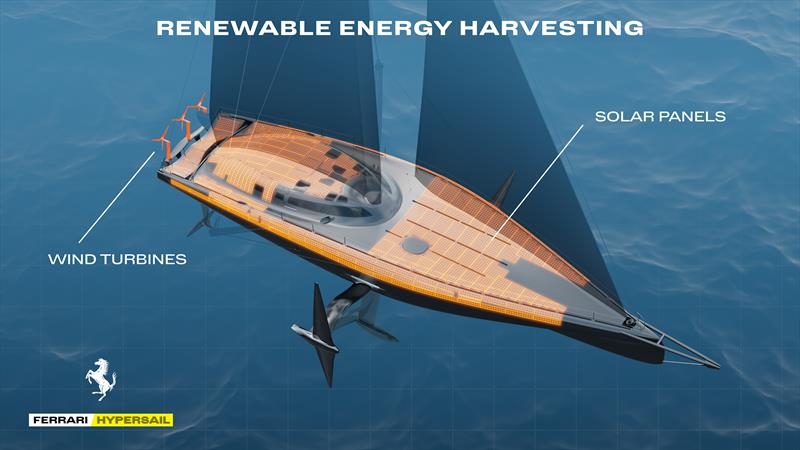
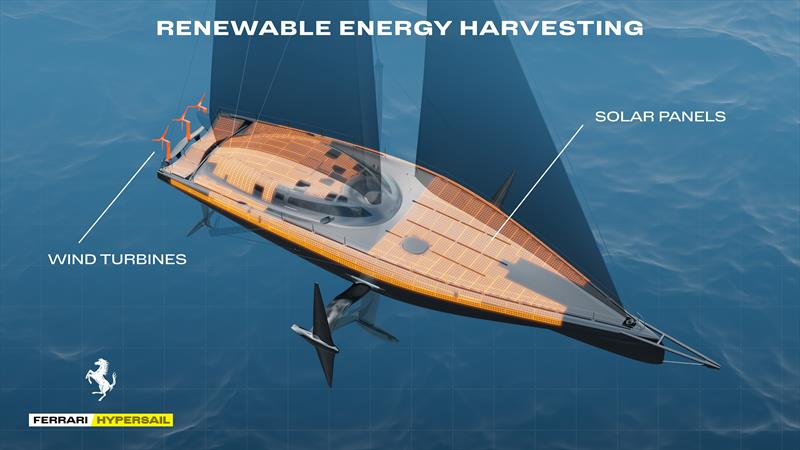
Renewable Energy Harvesting © Ferrari Hypersail


An energy system engineered for complete self-sufficiency, powered by renewable sources and crew-generated energy. Ferrari Hypersail, the innovative 100-foot flying monohull designed to challenge the oceans, today unveils its onboard energy concept. This system is part of a project that, rooted in open innovation, has transferred the Prancing Horse’s know-how beyond the racetrack and the asphalt, opening up unprecedented technological solutions in the world of offshore sailing.
Developed by the Hypersail Tech Team in Maranello, the Energy Management system was conceived with the dual objective of ensuring maximum efficiency and the total integration of the various onboard architectures. The choice of an electric solution, arising from the need to guarantee energy self-sufficiency during the long-distance sailing the vessel will face, led to the development of a system capable of harvesting energy as efficiently as possible from the surrounding environment, including solar and wind power.
Above-deck movements, such as sail trimming, see the direct transformation of human-generated power through the innovative Winch by Wire system. Below-deck movements, such as the operation of the appendages required to ensure active flight control, are instead managed through energy recovered from renewable sources, with high-voltage batteries installed to manage the dynamics of energy flows.
“Hypersail is the first foiling monohull for ocean racing to achieve complete energy autonomy,” states Marco Guglielmo Ribigini, Technical Team Leader of Ferrari Hypersail. “Thanks to an electrical system that ensures the ideal balance between efficiency and performance, alongside innovative solutions such as Winch-by-Wire, all on-board adjustments are powered entirely by energy generated while under way.”
Above Deck: Crew Action and Winch by Wire
Hypersail reimagines traditional winch systems by introducing an innovative solution: Winch by Wire. With it, the power generated by the crew’s muscular strength does not directly drive traditional mechanical transmissions and hydraulic circuits, but is instantly converted into electrical power, which is centralized and dynamically redistributed to the various functions of the boat’s sail plan.
For grinders, the primary advantage is the ability to maintain a constant and efficient cranking cadence. In conventional systems, as resistance increases, movements inevitably become slower and more strenuous. The technology developed by Hypersail mitigates this escalation in effort, ensuring a consistent power output by operating at the peak point of both the system’s electromechanical efficiency and human metabolic performance. This system enables a single crew member to manage extraordinary loads of up to 9 tonnes, far surpassing the inherent limitations of traditional mechanical or hydraulic architectures.
The electricity generated via the pedestals, utilizing the exact same electric motors found in the active suspension systems of the Ferrari Purosangue and Ferrari F80, is channeled into the onboard grid and distributed in real time. This power drives the winches regulating sail, or operates the hydraulic pump that executes on-deck adjustments.
Hypersail’s winch solution stems from the same by-wire philosophy introduced on the new Ferrari 12Cilindri Manuale, where the physical nature of the mechanical action is converted into an electronic signal while fully preserving an authentic, analog feel.
Below Deck: Appendage Operation and Flight Management
The installed systems represent the technological core of the vessel, responsible for managing the electronics, control stability, and ride height on the foils. The reliability of this ecosystem is guaranteed by applying testing processes borrowed from the automotive sector, thanks to a platform of electronic control units (ECUs) and sensors, and four different voltage levels ranging between 12V and 800V.
To govern and adjust the appendages, Hypersail engineers developed an active Flight Controller system that manages hydraulic flow across two surface operating modes: Slow Movements and Fast Movements. The former represent the macro-adjustments of the foil arms and canting keel, powered by the 800V rear e-axle from the Ferrari Luce. The latter are the rapid and continuous movements of the control surfaces, the flaps, which are entrusted to two smaller pumps driven by 48V electric motors. This separation ensures outstanding performance, maximum energy efficiency and the required levels of redundancy in maritime environments.
The electronic and hydraulic systems are indeed powered exclusively by renewable sources through the implementation of an unprecedented solar and wind harvesting system. Furthermore, rather than being dissipated, surplus energy is stored and managed in two identical 800V batteries, ready to distribute power based on the dynamic requirements of the monohull.
The solar panels, which are walkable and feature a specific grip, are integrated into the deck and topsides, covering an area of 100 square meters. Their application is the result of complex simulations that, by mapping solar exposure across different latitudes and potential routes, directed the installation only to high-yield zones. This minimized the weight penalty on the vessel, eliminating any unproductive mass in favor of the best power-to-weight ratio.
Wind integration is implemented at the stern, where wind turbines are housed, which can be configured and removed according to sailing needs. The engineering objective was a meticulous study of the intake angle in order to identify the optimal balance between maximum power generation efficiency and minimal aerodynamic drag at high speeds, ensuring optimal performance across diverse ocean scenarios.