
Commercial aviation will forever be affected by complex financial dynamics that remain entirely hidden from the average passenger. At the center of this world sits the Airbus A350-1000, a premier widebody aircraft designed to conquer high-capacity international routes. The public sticker price suggests an astronomical financial barrier for many airlines that wish to operate it, but a closer look at current market transactions shows a completely different reality where massive discounts are standard. This guide focuses on the truths about widebody acquisition costs and explains why the ultimate transaction values look nothing like the official numbers.
Global travel demand is putting pressure on international capacity, meaning that selecting the right twin-aisle platform can determine whether a network carrier remains profitable over the next two decades. The gap between advertised rates and real-world deals can be very wide, often completely changing what is worth investing in and what is not.
No One Pays Full Price

The published sticker price of a commercial airliner rarely reflects operational reality. For the flagship A350-1000, the official list price sits at an imposing $366 million at current market estimates. The headline figure is more of a financial baseline than a binding transaction value, meaning that almost no airline actually pays this staggering amount when acquiring new aircraft.
In practice, list prices function primarily as a marketing tool and a starting point for complex corporate negotiations, with the aim of agreeing on prices on a case-by-case basis. Manufacturers utilize these high sticker prices to anchor the perceived value of their top-tier products before offering tailored discounts. These adjustments depend heavily on factors such as order volume, contract timing, and the relationship between the carrier and the manufacturer.
Consequently, the public valuation numbers create a massive divergence between public perception and corporate reality. Industry insiders understand that analyzing list prices alone provides a skewed perspective on airline capital expenditure and never really shows the full picture. Actually, seeing the real transaction prices provides insight into a highly competitive ecosystem where multi-million-dollar discounts are standard operating procedure and somewhat expected.
The More Realistic Spend

To get to the actual financial commitments required to secure a modern widebody, the list price has to be almost ignored. Real-world transaction data from 2026 indicates that actual market prices for the A350-1000 typically sit between $180 million and $230 million. This represents a steep drop from the advertised $366 million, slashing the acquisition cost by nearly half for strategic buyers, but this is a far more realistic spend for an airline, especially if a bulk order is being placed.
This pricing structure scales across the entire twin-aisle family to accommodate different range and capacity needs. Generally, the standard A350-900 commands a slightly lower price point, and the larger variant represents the peak of modern efficiency with its stretched fuselage measuring 242 feet (73.78 meters). Airlines tend to go for the larger variant to maximize revenue on high-density international routes and keep a lighter carbon footprint.
In addition to the raw purchase price, the final financial equation includes the cost of interior customization and premium seating configurations, which are often large expenditures for an airline. Installing modern business class suites can easily add tens of millions of dollars to the final delivery cost of a single airframe. These capital allocations are heavily weighed against long-term fuel-efficiency gains, as the type offers a substantial reduction in fuel burn compared to older aircraft.
Why Such Substantial Discounts?

Massive discounts are not random acts of generosity by Airbus, and airlines do not get preferential treatment deals. Discounts from manufacturers, by nature, are designed to secure market dominance and stabilize production lines. When an airline commits to a substantial fleet renewal program, the manufacturer gains long-term visibility for its factory output over the next ten years. The stability allows suppliers to run their operations more efficiently, reducing the overall cost of manufacturing across the program.
Airbus signing on a marquee customer also creates a powerful network effect that influences other global carriers. For instance, when a prominent global network carrier places a major commitment, it validates the operational capabilities of the aircraft family under demanding conditions. To win these high-profile battles against competing platforms, manufacturers are willing to compress their profit margins significantly on the initial airframe sales, with the view that down the road, this decision will allow more benefits to come and revenue to be generated.
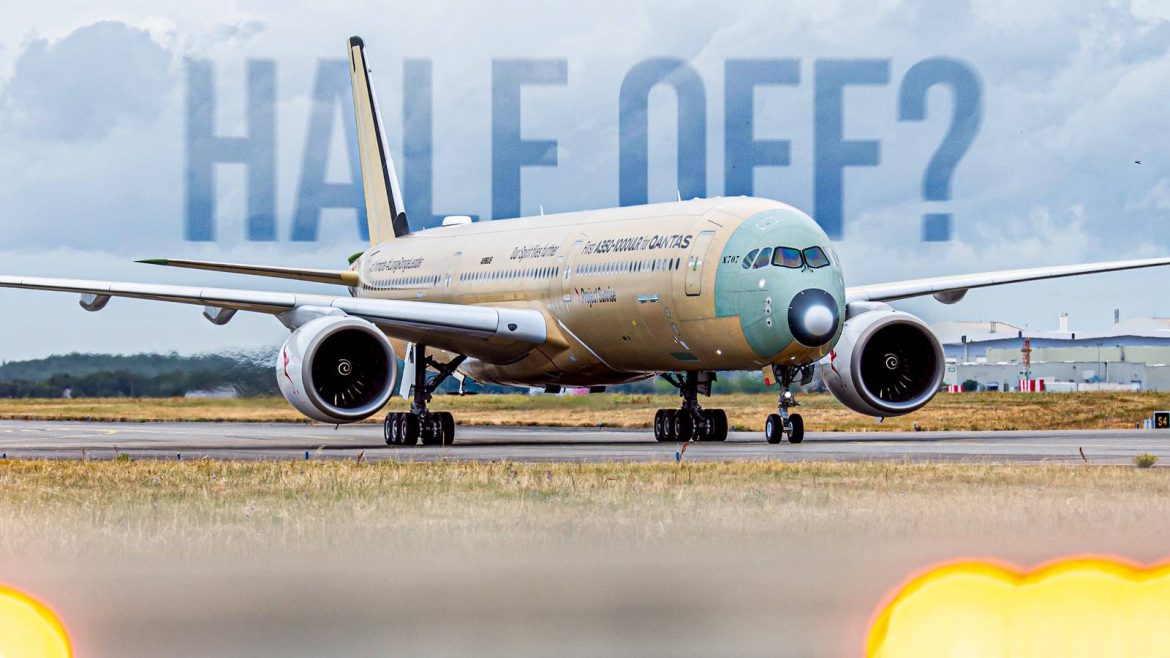
Looking closely at the aerodynamic profile of the A350-1000 specifically shows just why airlines fight for these steep discounts to modernize their operations. The carbon-composite construction and highly efficient engines visible on the flying airframe drastically lower trip costs compared to older four-engine models. Offering nearly half off the list price, the manufacturer is able to position its premier aircraft as an undeniable economic upgrade for global fleets, one that is too good to miss out on.
The Airlines Banking On The A350-1000

These aggressive pricing structures directly shape the multi-billion-dollar fleet choices made by global legacy carriers and can easily sway a carrier toward one manufacturer if the discounts are deemed attractive enough. When airlines look to retire aging long-haul fleets, the real transaction price becomes the ultimate deciding factor. The massive gap between list and discount values creates an environment in which carriers can fully modernize their networks without overextending their balance sheets.
A clear example of this dynamic appears in the recent fleet strategies of  Delta Air Lines and
  Air Canada. Delta has completed a firm order for 20 A350-1000 airframes, with deliveries starting between late 2026 and early 2027, to phase out its aging passenger Boeing 767-300ER fleet. Meanwhile, Air Canada has committed to eight of the larger variants to act as a high-capacity successor to its heavy Boeing 777-300ER fleet, using the aircraft’s 8,700-nautical-mile (16,100 km) maximum range to aid the carrier’s international growth, with those deliveries scheduled to begin in 2030.
|
Carrier |
Ordered Frames |
Target Replacement Fleet |
Scheduled Delivery Window |
|
Delta Air Lines |
20 |
Boeing 767-300ER |
Late 2026 – 2027 |
|
Air Canada |
8 |
Boeing 777-300ER / 777-200LR |
2030 onward |
These major commitments highlight how price flexibility allows the European manufacturer to capture critical market share during carrier renewal phases, when carriers are most open to negotiations. Offering tailored pricing to marquee airlines, the assembly lines remain fully booked well into the next decade. Having a back-order security like this helps protect the program from sudden shifts in the global economy, ensuring steady factory output.
Catch what other flight trackers miss
Emergency squawks, holds, NOTAMs — live signals, no signup.
Open tracker
Catch what other flight trackers miss
Emergency squawks, holds, NOTAMs — live signals, no signup.
Open tracker
Owning Outright Not The Only Option

Outright purchasing is one method of adding to fleets, but many airlines opt for leasing contracts instead. Direct ownership maximizes the benefits of negotiated discounts, though it requires a massive initial allocation of capital. Leasing offers a flexible alternative that shifts the long-term asset value risks directly onto third-party leasing firms and takes away the inherent complexities this entails.
Between the two active long-haul variants in the A350 family, there is a clear hierarchy in leasing fees. Current market benchmarks for a new A350-1000 place monthly operating lease rates between $1.2 million and $1.4 million. In comparison, the smaller A350-900 has a monthly rate between $900,000 and $1.2 million, allowing airlines to carefully align their fixed monthly expenses with specific route yields.
Opting for a lease structure allows a carrier to preserve liquid capital while also maintaining an incredibly modern and fuel-efficient fleet profile. Lessors shoulder the risk of the aircraft’s eventual decline in residual value, thereby protecting the airline if market demand shifts rapidly. This flexibility explains why massive leasing groups hold a significant percentage of the global twin-aisle orderbook and will continue to do so as long as the airline industry remains volatile.
More Discounts To Come

The widening spread between advertised list prices and actual market transactions highlights how the global widebody duopoly is beginning to change. Supply chain constraints and manufacturing bottlenecks continue to impact aerospace production, and airlines hold unprecedented leverage at the negotiating table. The ability to demand heavy discounts shows that buyer power dictates the final terms of high-capacity aircraft deals.
List prices will only continue to lose their relevance as analytical tools for fleet valuation over the coming years. Financial analysts at airlines will focus strictly on estimated transaction values and secondary market lease performance to gauge the health of an aircraft program. Carriers that negotiate effectively during these production cycles can gain a structural cost advantage that lasts for decades as opposed to just a good deal in the short term.
Looking toward the future, the sustainability of this deep-discounting model will depend on the long-term profitability of the aftermarket service network. If third-party maintenance packages fail to deliver high-margin revenue, manufacturers may be forced to push back against aggressive airline pricing demands.
