
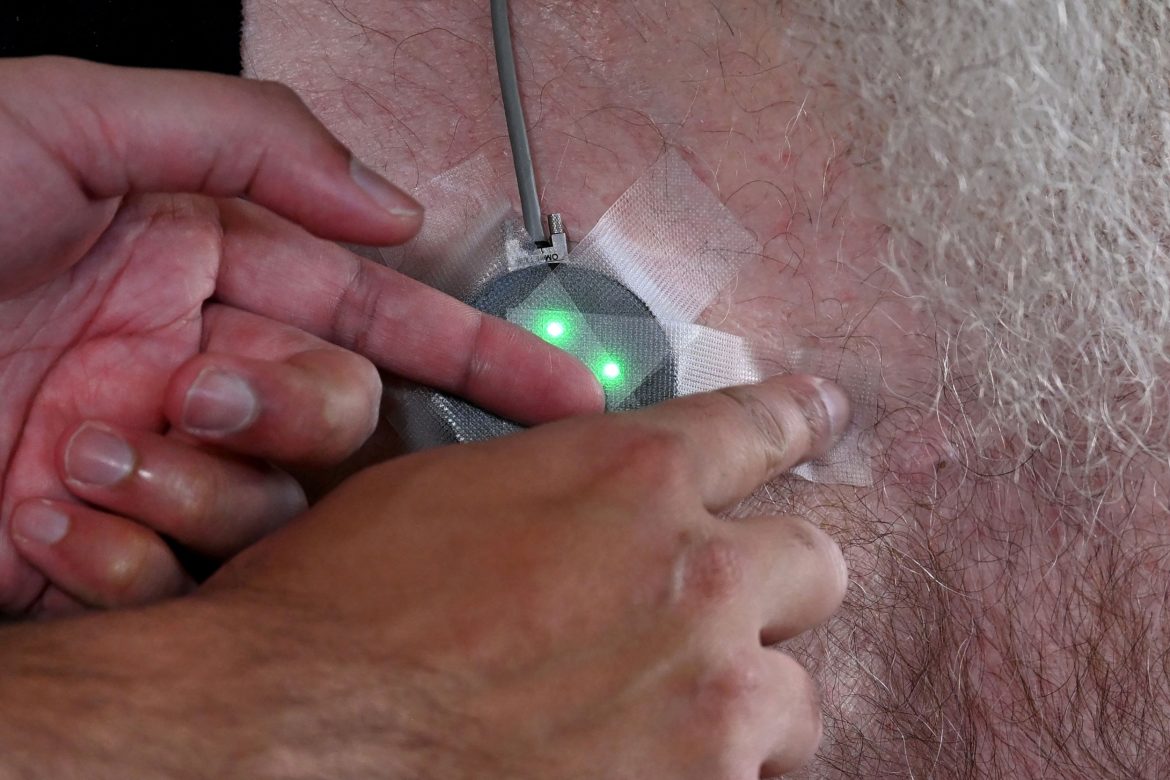
Researchers at the University of Texas at Austin report that a soft, skin-attached patch combining focused ultrasound with brain-activity sensors helped participants reach REM sleep an average of 43 minutes sooner and stay in it about 16 minutes longer.
The study, published in Nature Communications in June, involved 28 people. That number is the most important context in the story, and it belongs alongside the effect size rather than buried below it.
The device, called NEUSLeeP, is a research prototype tested under a registered clinical protocol. It is not available for purchase and has not been tested in the larger trials that would be required to establish clinical usefulness.
Inside the Device and the Effects Researchers Measured
NEUSLeeP is a flexible bioadhesive patch that integrates a tunable concentric-ring ultrasound array with hydrogel electrodes on a soft substrate designed for stable overnight wear. It weighs about 103 grams. The ultrasound component delivers transcranial focused stimulation aimed at the subthalamic nucleus, a deep brain structure within circuits that regulate sleep, while the electrodes record electrical brain activity in real time.
The dual capability is what the researchers present as novel. Kai Wing “Kevin” Tang, who led the work as a doctoral student in biomedical engineering, said it is “the first time we’ve been able to noninvasively target deep brain regions” involved in REM sleep while simultaneously monitoring brain activity. Huiliang Wang, the assistant professor who supervised the project, said the patch opens possibilities for studying sleep and treating sleep disorders in home settings.
Participants slept one night with sham stimulation and one night with active stimulation. Across the 26 people whose sleep recordings were usable, REM sleep rose from 16.3 percent to 20.9 percent of total sleep, an increase of 4.6 percentage points or roughly 16 minutes, and the time to first REM fell from an average of 177 minutes to 135 minutes. Other sleep stages, the number of awakenings, and overall sleep efficiency were not significantly changed.
The cohort included 16 people who slept well and 12 with mild sleep difficulty, defined by a standard sleep quality questionnaire. Both groups showed a significant increase in REM duration. The reduction in time to REM was significant in the group of good sleepers but not in the group with sleep difficulty.
Among healthy participants, stimulation was also associated with increased heart rate variability, a common indicator of how flexibly the body responds to stress. That difference did not appear in the group with sleep difficulty. A separate imaging study in 16 healthy adults found changes in basal ganglia and midbrain activity during an emotional face-matching task. Vital signs did not change significantly during stimulation, and skin testing showed negligible irritation over eight hours of wear.
REM Latency Is a Real Measure, Not a Wellness Metric
REM sleep is the stage most associated with vivid dreaming, and it has documented roles in emotional processing and memory consolidation. REM latency, the time from falling asleep to the first REM episode, is a standard measurement in sleep medicine.
It also has clinical meaning in specific conditions. Shortened REM latency has been observed in major depressive disorder, and REM abnormalities appear in narcolepsy and in post-traumatic stress disorder. That is why a device capable of modulating REM is scientifically interesting beyond general sleep quality, and the team has said it plans to explore applications in PTSD, depression and chronic insomnia.
It is also why the direction of benefit is not universal. More REM, or faster REM onset, is not automatically better for every person or every condition. In some circumstances, treatments deliberately suppress REM. A device that reliably shifts REM architecture would need careful study in defined patient populations before anyone could say who should use it.
The Limitations Are Substantial and Should Be Stated First
Twenty-eight participants is a small sample by any standard, and small studies frequently report effect sizes that shrink or vanish in larger replications.
The design carries a bigger caveat, and the authors state it themselves. Every participant received the sham condition on the first night and stimulation on the second, in a fixed order rather than a randomized one. The study was single-blinded rather than double-blinded and had no parallel control group. The authors write that without randomized, counterbalanced conditions and full masking, placebo and order effects cannot be ruled out, and they call for double-blind, sham-controlled trials with pre-registered outcomes. That is an unusually candid limitations section, and it is the reason these results establish feasibility rather than clinical benefit.
Several questions the research does not answer matter more to patients than the headline numbers. It does not show whether people felt better rested, whether daytime function improved, whether mood or memory changed in a meaningful way, or whether any effect persists with repeated use over weeks or months. Changes in heart rate variability and imaging measures are mechanistic findings, not outcomes.
The device is also a laboratory-grade system, not a consumer product. The research team is working with the university’s commercialization unit and has filed a patent application, which means the path forward runs through further development, regulatory review, and larger trials. That process typically takes years, and many devices do not complete it.
Practical Perspective for People Who Sleep Badly
The realistic takeaway is that nothing available to consumers changed this week, as coverage of the findings makes clear.
Anyone struggling with sleep has better-supported options right now. Cognitive behavioral therapy for insomnia remains the first-line treatment recommended by major medical organizations, is available through trained clinicians and validated digital programs, and has evidence that far exceeds anything a prototype device can claim. Untreated obstructive sleep apnea is common and frequently missed, and home sleep testing has expanded access to diagnosis substantially.
People should be skeptical of consumer products marketed with claims resembling this research. Devices sold today that promise REM enhancement through sound, light or vibration are not the technology described in this study and generally lack comparable evidence.
Persistent difficulty falling or staying asleep, loud snoring with witnessed pauses in breathing, or daytime sleepiness that interferes with driving or work warrants evaluation by a clinician. Insurance coverage for sleep studies varies, and home sleep apnea tests are typically less expensive than in-laboratory studies for appropriate candidates.
The next developments to watch are larger controlled trials in defined patient groups, any regulatory submission, and independent replication by researchers unaffiliated with the developers. Until then, the confirmed fact is a small feasibility study showing measurable short-term changes in REM timing. The group eventually most affected would be people with REM-related sleep and mood disorders, not the general public. The reasonable action for poor sleepers is pursuing established treatment. The central uncertainty is whether these effects hold up under a rigorous trial design.
Key Questions Answered
What did the study actually find? In 28 participants, a wearable ultrasound and electrode patch shortened the time to reach REM sleep by about 43 minutes and extended REM duration by about 16 minutes compared with sham stimulation, with REM rising from 16.3 percent to 20.9 percent of total sleep.
Can anyone buy this device? No. NEUSLeeP is a research prototype and is not commercially available. The team has filed a patent application and is pursuing commercialization.
Why does the sample size matter so much? Twenty-eight participants is small, and sleep metrics were analyzed for 26. Effects observed in small studies often shrink or disappear in larger trials, so this work establishes feasibility rather than clinical benefit.
How strong was the study design? Not strong enough to be conclusive. Every participant received sham stimulation first and active stimulation second, the study was single-blinded, and there was no parallel control group. The authors say placebo and order effects cannot be ruled out.
Is more REM sleep always better? No. REM abnormalities appear in several conditions and the clinically desirable direction differs among them. Some treatments deliberately reduce REM. Any device altering REM would need study in specific patient groups.
Did participants report feeling better? The study measured sleep architecture, heart rate variability and brain imaging changes. It did not establish improvements in daytime function, mood or memory, and did not test durability over weeks or months.
What should someone with poor sleep do now? Cognitive behavioral therapy for insomnia is the recommended first-line treatment and is far better supported than any prototype device. Loud snoring with breathing pauses or significant daytime sleepiness should be evaluated for sleep apnea.
