
Different buyers choose their smartwatches based on different traits. Some want in-depth health features, others need a way to control their phone from their wrist, and some prefer a cheap and dumb smartwatch.
For me, I prefer a good running watch. I want something that’s durable, tracks GPS accurately, and offers a long battery life. I don’t need to manage my life or count my steps from my wrist. I just want data from my expeditions.
However, I broke my watch in the same way that I damaged the two before it. And it’s taught me something: A good smartwatch is only as good as its strap, and spending money on a worthwhile band will pay off big time.
 Quiz
QuizSmartwatches and their history
Trivia challenge
From early digital wristbands to today’s health hubs — how well do you know the smartwatch story?
HistoryBrandsTechnologyFirstsDesign
Which company released what is widely considered the first commercially available smartwatch in 1994?
Correct! Seiko released the Ruputer in Japan in 1998, but its earlier wrist-computer efforts began in 1994 with the MessageWatch. Seiko has long been a pioneer in blending computing with wearable timepieces.
Not quite — it was Seiko. While Casio made impressive calculator watches, Seiko was the brand pushing wrist-worn computing into commercial territory in the early 1990s, ahead of most competitors.
The Pebble smartwatch became a landmark product partly because of how it was funded. How much did its 2012 Kickstarter campaign ultimately raise?
Correct! Pebble’s 2012 Kickstarter raised over $10 million, smashing its original $100,000 goal and becoming one of the most successful crowdfunding campaigns of its era. It proved there was real consumer appetite for smartwatches.
Not quite — Pebble raised over $10 million on Kickstarter in 2012. That staggering sum, against a $100,000 goal, signaled to the entire tech industry that the smartwatch market was real and ready to explode.
Apple Watch was first announced in September 2014, but when did it officially go on sale to consumers?
Correct! Apple Watch went on sale on April 24, 2015, nearly seven months after its announcement. The gap allowed Apple to refine the software and manufacturing before its highly anticipated launch.
Not quite — Apple Watch launched on April 24, 2015. Apple announced it in late 2014 but held off on release to polish the experience, a strategy that helped it debut to enormous demand and critical attention.
Which operating system powers the majority of Samsung’s modern Galaxy Watch lineup?
Correct! Starting with the Galaxy Watch 4 in 2021, Samsung switched from its own Tizen OS to Wear OS, developed in partnership with Google. This marked a major shift in Samsung’s wearable strategy.
Not quite — Samsung’s modern Galaxy Watch lineup runs Wear OS. Samsung used its own Tizen platform for years, but switched to Wear OS with the Galaxy Watch 4 in 2021 after a collaboration with Google was announced at Google I/O.
IBM and Citizen collaborated on an early smartwatch concept in the late 1990s. What was this wearable prototype called?
Correct! IBM and Citizen developed the WatchPad around 2000, a wrist-worn device that ran Linux and included features like a fingerprint scanner. It was a remarkable proof-of-concept decades ahead of mainstream smartwatches.
Not quite — it was the WatchPad. IBM and Citizen jointly developed this Linux-powered wrist device around 2000, complete with a fingerprint reader. It never reached mass production but showed remarkable ambition for its time.
The original Apple Watch was offered in multiple ‘Editions’ at launch. What material was the ultra-premium Apple Watch Edition casing made from?
Correct! The first-generation Apple Watch Edition featured an 18-karat gold case and was priced at up to $17,000. It was Apple’s bold statement that smartwatches could compete in the luxury fashion market.
Not quite — the original Apple Watch Edition used 18-karat gold. Priced as high as $17,000, it was Apple’s attempt to position the smartwatch as a luxury fashion item, not just a tech gadget. Titanium and ceramic came in later generations.
Fitbit is best known for fitness trackers, but it did release a full smartwatch. What was the name of its first true smartwatch, launched in 2017?
Correct! The Fitbit Ionic, released in 2017, was Fitbit’s first proper smartwatch, featuring onboard GPS, music storage, and third-party apps. It was an ambitious step up from Fitbit’s tracker roots, though it was later recalled due to a battery issue.
Not quite — Fitbit’s first true smartwatch was the Ionic, launched in 2017. While the Surge was a GPS fitness ‘superwatch,’ the Ionic was the first to support third-party apps and music. It was later recalled in 2022 over overheating concerns.
Which health-monitoring feature did Apple add to the Apple Watch Series 4, making it a milestone for the wearable health industry?
Correct! Apple Watch Series 4 introduced ECG capability in 2018, allowing users to take a single-lead electrocardiogram directly from their wrist. It was the first FDA-cleared ECG product available directly to consumers over the counter.
Not quite — it was ECG capability. Apple Watch Series 4 became the first consumer smartwatch cleared by the FDA to take an electrocardiogram reading in 2018. Blood oxygen monitoring came later with Series 6 in 2020, and blood glucose tracking remains unavailable.
Your Score
/ 8
Thanks for playing!
How a frantic tennis match broke my smartwatch
I hit the wrong kind of wall

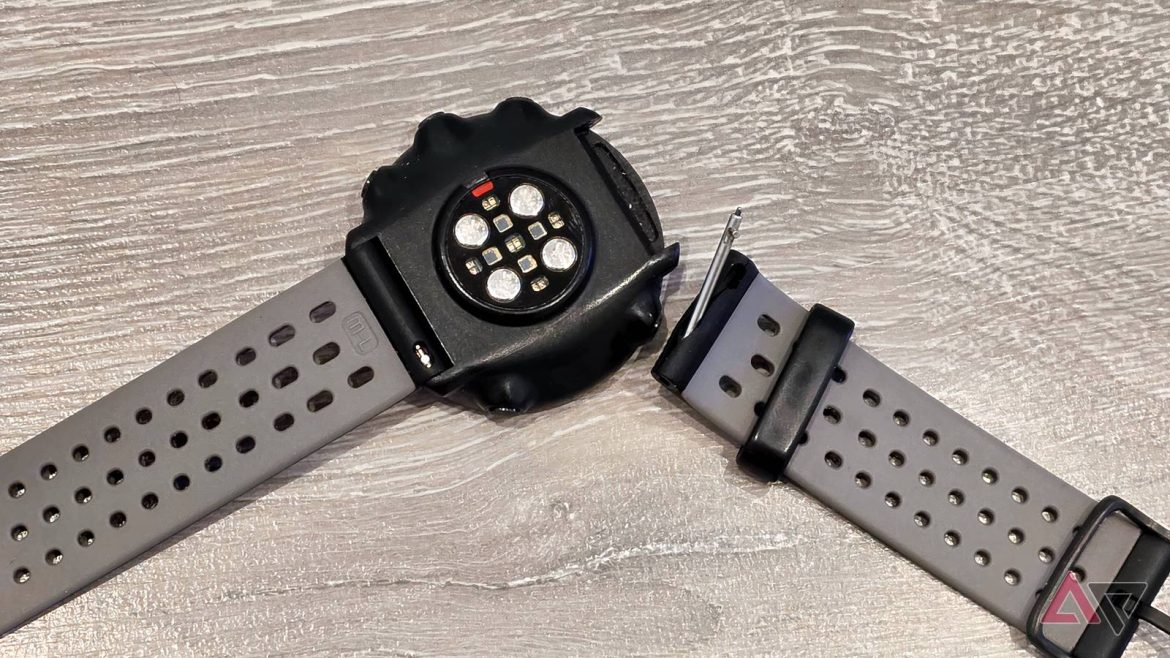
I use the Polar Vantage M2 to track my runs, cycles and, recently, tennis matches. However, when I recently used it for the latter, within 30 seconds of play beginning, I chased a stray ball into a wall.
I didn’t notice immediately, but I hit my wrist quite hard on the wall, and when I returned to the court, I was without my watch. It’d been knocked off my wrist in the impact, and I hadn’t immediately noticed.
Thankfully, the smartwatch wasn’t damaged, but the strap had been torn straight through. The small loop at the end housing the spring bar, which usually attaches to the watch, was torn. You can see what I mean in the pictures.
Despite the smartwatch working perfectly, the watch was unusable because I had no way to attach it to my person. I had to play an entire hour of tennis without tracking it: unthinkable.
Polar’s replacement straps are expensive, so I bought a cheap alternative on Amazon. I like its look, but it’s not very comfortable; that’s what I get for cheaping out. And looking back at my history, I’ll put more thought into my next purchase.
A history of broken smartwatches
The straps are a weak point
The Polar Vantage M2 isn’t the first smartwatch I’ve broken in this way, or even the second. I have a history of breaking the straps on watches I use.
While I haven’t done a survey, I imagine this is common. After all, watch bodies are often designed to be durable, with high IP ratings and a protective chassis. Some are built for climbing, diving, or contact sports: they survive.
However, watch straps are often thin strips of silicone or Thermoplastic Polyurethane (TPU). They’re meant to be lightweight and breathable, but that often means they’re frail and don’t hold up under pressure.
Whether they’re designed for fitness, fashion, or sleep ease, these bands aren’t built to last in the same way that the bodies are, which is why I find them so easy to break.
I’ve previously broken the straps of two wearables I’ve reviewed; one was a Wear OS watch, and the other a budget fitness tracker. In both cases, the device was still useable, but the in-box strap didn’t survive life’s little challenges.
I should note: these straps weren’t broken because of day-to-day use, but through accidents when using them to track exercises. In one case, I got too close to a wall while running and bumped it off, and in the other I fell off a bike.
So it’s not that the bands are so frail that they’re poor quality. But they’re not designed to withstand the accidents that sometimes befall our tech, that the watch bodies themselves would survive.
Buying a strap that’s designed to last
Materials and designs that work well

I’ve learned how to buy a watch strap that’s designed to last. These often come from the company that makes the device, as a premium extra, but sometimes other companies make them.
Some watch straps are made from titanium or stainless steel, but I find metal bands add unnecessary weight and offer too much friction when running. To me, these materials are for fashion watches, rather than fitness ones.
I wouldn’t consider a leather strap for a fitness watch. The salt from sweat destroys the material. They’re not breathable either, making them nasty for summer use.
Fluorocarbon Elastomer, or FKM rubber, is often mentioned as a reliable alternative to TPU and silicone, which feels similar but lasts longer. For swimming or water sports, it’s where I’d look.
But my personal preference is nylon. I find it the most natural-feeling strap material, yet it’s durable and stays tight on a wrist. When I started using nylon bands, I didn’t think they felt robust, but I’ve never had a problem with them.
Finding something you trust

Nylon isn’t always the cheapest smartwatch strap material, but it’s something I’d trust to keep my wearable on my wrist during an activity. I won’t spend an entire run worrying about my watch flying off.
That’s what you want in a strap. If you think TPU is the best material for you, be it due to the fit, feel, or a specific clasp type on a select strap, you’ll have more peace of mind using it.
Finding a reliable strap is, in my eyes, as important as finding the best smartwatch. If you have a good strap and know how to maintain a smartwatch, you have an unbeatable setup.
