
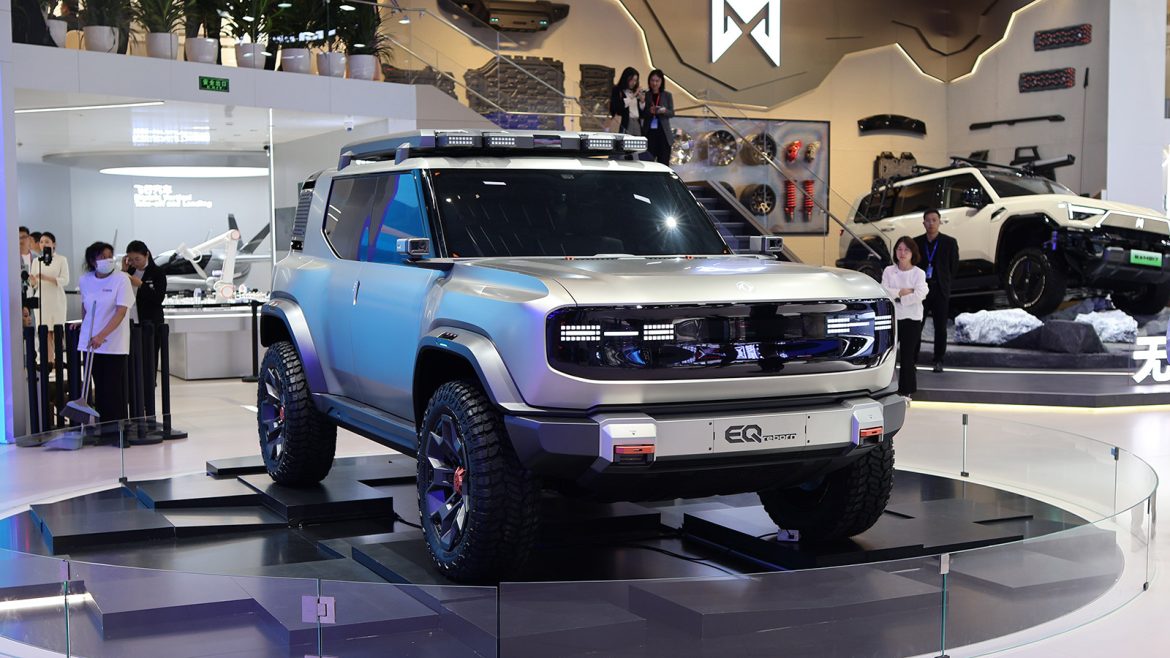

- MIIT said irrational competition remains a serious problem, with some aggressive designs installed in vehicles before adequate validation.
- MIIT said China will tighten market-entry reviews and testing and validation requirements for innovative vehicle designs.
China will tighten market-entry rules for auto products and bar products that have not undergone adequate testing and validation, as it seeks to address quality and autonomous-driving safety risks.
Ministry of Industry and Information Technology (MIIT) Vice Minister Xin Guobin announced the plan at a press conference held by China’s State Council Information Office on Wednesday.
Some aggressive design innovations have been installed in vehicles without adequate testing and validation, while incidents involving vehicle quality and autonomous-driving safety have drawn public attention, Xin said.
The problems cannot be ignored and must be addressed as China pursues higher-quality development of the intelligent connected new energy vehicle (NEV) industry during the Fifteenth Five-Year Plan period, he said.
MIIT will tighten market-entry reviews and testing and validation requirements for innovative vehicle designs, while stepping up conformity-of-production inspections.
Regulators will also reform the group-based management of automakers’ production qualifications and optimize the industry’s geographic footprint to protect consumers and bring greater order to market competition.
Irrational competition remains a major problem facing China’s auto industry. MIIT will strengthen planning guidance, capacity controls and price governance while promoting industry self-discipline to curb “involution-style” competition.
MIIT has drafted the Fifteenth Five-Year Plan for the Development of the Intelligent Connected New Energy Vehicle Industry (2026–2030), which will promote industry upgrades in areas including product quality, the usage environment, industry governance and international cooperation.
On the product side, regulators will support companies in improving the low-temperature performance and durability of power batteries, as well as the safety and reliability of autonomous-driving systems.
China will also steadily advance market-entry and road-testing pilots for intelligent connected vehicles, along with vehicle-road-cloud integration pilots. However, Xin emphasized that companies must uphold the bottom line on product quality.
Supporting measures include continuing vehicle trade-in programs and efforts to promote NEVs in rural areas, while addressing gaps in county-level charging and battery-swap infrastructure. The goal is to provide charging stations in every county and charging piles in every township.
MIIT also plans to improve rules governing vehicle modifications, optimize NEV insurance policies and lower repair costs to ease consumer concerns about buying and using NEVs.
China’s NEV industry has expanded from the 1 million-unit level to more than 10 million units, with annual sales rising from 1.367 million to 16.49 million during the Fourteenth Five-Year Plan period, Xin noted. NEVs’ share of new-vehicle sales increased from 5.4% to 47.9%.
China now accounts for more than 70% of global output of NEVs, power batteries and key materials, while Chinese NEVs are sold in more than 100 countries and regions.
MIIT said it will strengthen coordination on international standards and regulations, improve support for cross-border logistics, investment and financing, and expand the auto industry’s international trade and investment cooperation.

China’s draft revision to its road traffic safety law proposes that manufacturers handle traffic violations in fully autonomous driving mode.
