
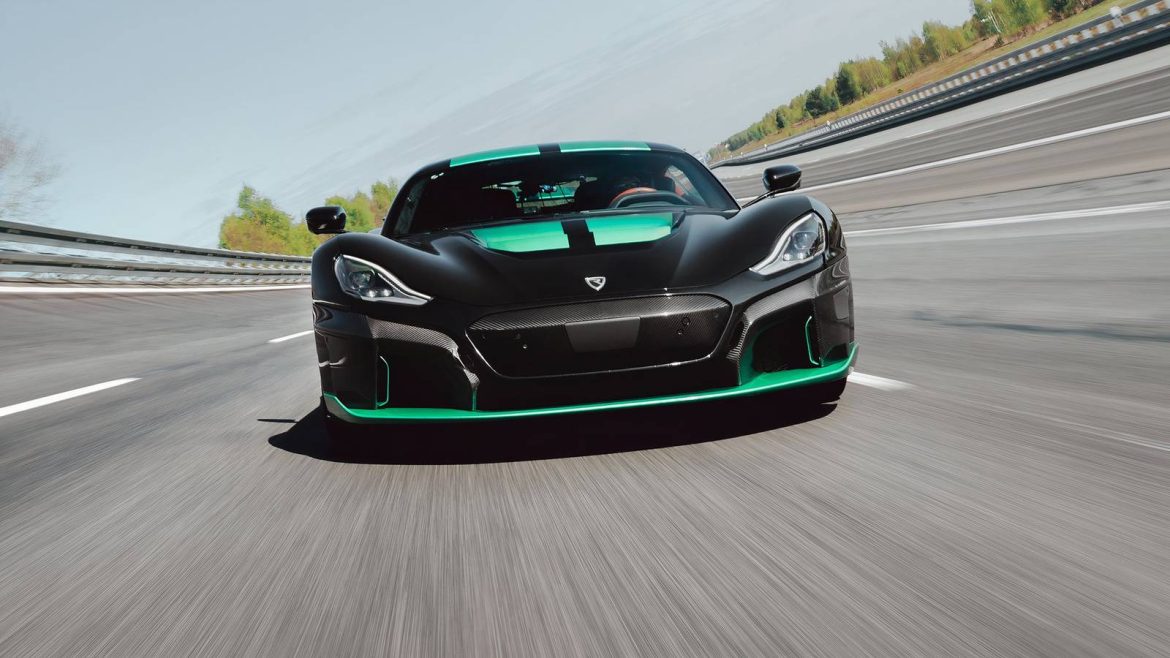
Mate Rimac built his reputation by proving electric motors could humiliate combustion supercars. His Nevera broke 23 performance records in a single day, hit 60 mph in 1.66 seconds, and lapped the Nürburgring in 7 minutes and 5 seconds. So when Rimac says gas-powered sports cars will stay dominant for decades, the statement lands differently than it would coming from anyone else.
Speaking to CNBC, the 38-year-old CEO of both Bugatti and Rimac Automobili drew a hard line between where electrification is headed and where it isn’t. “For normal cars, normal people, the vast majority will be electric,” he said. “The upper segment, like sports cars and upwards, are going to stay combustion for a very long time, exactly like watches.” From the man who arguably did more than anyone to prove EVs could compete at the top of the performance ladder, that’s about as credible an endorsement of combustion’s future as the supercar world is going to get.
The Swiss Watch Analogy That Reframes the Whole Debate

Rimac‘s argument isn’t sentimental — it’s structural. He compares the split between mainstream and supercar markets to the divide between smartwatches and Swiss mechanical timepieces. Digital watches do more, cost less, and keep better time. Yet Patek Philippe and Audemars Piguet aren’t going anywhere. “Only like 5% of watches are made in Switzerland, but that’s where 90% of profits are made,” Rimac told CNBC. “An Apple Watch or any kind of smartwatch can do so many more things. But no one will pay $200,000 for it.”
The parallel holds because the buying motivation is the same. Supercar customers at the very top aren’t cross-shopping a Bugatti against a Tesla on a spec sheet. They’re commissioning objects that reflect identity, craft, and mechanical drama — things a software update can’t replicate. Rimac says performance itself is becoming a weak differentiator: “You can get a car that’s faster than any performance car from 10 years ago for like $50,000 from China. Performance is really becoming secondary.” When a $50,000 EV from Xiaomi can match yesterday’s hypercar off the line, the hypercar has to offer something else entirely.
The Tourbillon Is the Proof of Concept

Bugatti’s Tourbillonisn’t just Rimac’s philosophical statement — it’s his evidence. When Rimac Group took control of Bugatti from Porsche and Volkswagen in 2021, the obvious move looked like an electric Chironsuccessor. Instead, Bugatti went the opposite direction: a naturally aspirated 8.3-liter V16 producing around 1,000 horsepower on its own, supplemented by three electric motors for a combined system output of 1,775 hp and 2,213 lb-ft of torque. It runs to 60 mph in 1.9 seconds and tops out at 236 mph — or 276 mph with the Speed Key.
All 250 units are sold out at a starting price of roughly $4.5 million. But that number barely tells the story. The average Tourbillon buyer adds another $600,000 to $700,000 in personalization — bespoke paint, leathers, stitching, and one-off details. Buyers at this level aren’t purchasing a car; they’re commissioning something with their name in its DNA. Rimac’s own words frame it well: “For these clients, they want something that’s really theirs, that’s connected with them. It tells their story, their personality, their preferences.”
Rimac is also on record saying a real manual transmission — not a simulated one like Ferrari’s 12Cilindri Manuale — is a genuine possibility for a future Bugatti. “Imagine a V-16 with a manual. Real manual,” he told Road & Track at Monterey Car Week. That instinct toward mechanical purity runs directly counter to where the mainstream market is heading.
The Irony Rimac Acknowledges Out Loud

Rimac doesn’t dodge the contradiction — he leans into it. At Bugatti Rimac’s facility in Croatia, the Nevera and the Tourbillon are built on the same production line. The world’s most powerful electric car sits next to one of the largest naturally aspirated combustion engines ever fitted to a production vehicle. “It’s kind of ironic that I’m now making the world’s biggest combustion engine,” he said. “Life is strange sometimes.”
That strangeness is actually what makes his position so hard to dismiss. This isn’t a legacy combustion executive defending his turf. Rimac spent 15 years proving EVs could dominate hypercars, then concluded the market at the very top doesn’t want what EVs are selling — at least not exclusively. Ferrarihas signaled gas engines haven’t peaked. Koenigsegg has made a similar case. Lamborghini‘s CEO brushed off Chinese EV competitors as irrelevant to what his buyers want. Rimac’s take isn’t contrarian anymore; it’s becoming the consensus view among the people actually building these cars. For V12 and V16 enthusiasts who’ve been watching electrification creep up the performance ladder, that’s the most reassuring signal the market has sent in years.
