
A tiger on a leather bag is not just decoration in this experiment. Its back and tail double as an energy-storing device.
That small visual twist sits at the center of a new study from Jilin University in China. In this work, researchers used a CO2 laser to write conductive patterns directly onto vegetable-tanned leather. As a result, they created a set of flexible microsupercapacitors. These are tiny energy devices that can store charge and help steady electrical signals in wearable electronics.
“Using a laser, we directly write conductive patterns onto vegetable tanned leather to create microsupercapacitors that can store energy and help smooth electrical signals so that wearable electronics run more reliably,” said research team leader Dong-Dong Han.
The work, published in Optics Letters, points to a simpler route for making wearable electronics with fewer chemical-heavy steps and less dependence on synthetic materials. Instead of building devices on plastic, the team used vegetable-tanned leather. This is a natural material processed with plant-based extracts and already valued for breathability, flexibility, biocompatibility and comfort against skin.
“Our method replaces plastic substrates with a renewable material, simplifies fabrication into a single laser step without chemicals or cleanroom processes, and combines energy storage with signal filtering in one device,” Han said.
Writing circuits onto leather
The process begins with vegetable-tanned leather, or VTL, which contains abundant organic compounds that support laser-induced carbonization. A CO2 laser with a wavelength of 10.6 μm is focused onto the leather surface, where the energy turns into heat. That localized high-temperature, high-pressure zone breaks chemical bonds and rearranges carbon atoms. As a result, the surface is converted into conductive carbon.
The researchers used the laser to create interdigital electrodes. They then added a LiCl-PVA electrolyte and sealed the device with a PDMS encapsulation layer. The whole approach avoids cleanroom fabrication and does not require masks or multistep chemical processing.
That matters because patterned electronics on leather have been hard to make with precision. Earlier efforts used methods such as conductive inks, vacuum filtration or polymer coatings, but the researchers noted that controlling how those materials penetrate leather remains difficult. Laser writing, by contrast, offered high spatial selectivity and a line width of about 500 μm.
Tests showed that the laser-treated surface became both conductive and porous. Under optimal conditions, the lowest sheet resistance reached 15.83 ± 2.89 at a laser power density of 30.6 kW/cm2 and a laser speed of 200 mm/s. The team found that laser settings changed the balance between porosity and conductivity. Too little energy led to partial pyrolysis and more disordered carbon. Too much caused excessive heat buildup, which densified the structure and introduced defects. Therefore, the best performance came from a middle ground.
There was also a practical downside. During carbonization, small amounts of carbon, sulfur and nitrogen-containing compounds escaped as gaseous oxides. This produced what the paper described as an unpleasant smell.
More than just energy storage
Microsupercapacitors are already attractive for wearable devices because they can charge and discharge quickly. In this study, the leather-based versions also acted as AC line filters. These are devices that help smooth ripples and noise in electrical signals.
That dual role is one of the more interesting parts of the work.
Filter supercapacitors are useful in systems such as biological signal monitoring, self-powered sensing and human-machine interaction, where stable operation matters. In tests, the leather devices worked at the standard 60 Hz frequency used in everyday electronics. The phase angle was -11.9° at 60 Hz, and the RC time constant was about 9.36 ms. In addition, the equivalent series resistance was 87.2 Ω.
The devices also converted 3 V peak-to-peak AC signals, including sinusoidal, triangular and square waves, into smoother DC output. The paper is careful here: the phase angle at 60 Hz still points to behavior that is mostly resistive, with limited ideal capacitive filtering capability. Even so, the researchers said the relatively low resistance and efficient ion transport allowed the device to buffer voltage fluctuations enough to produce observable smoothing.
As an energy-storage device, a single planar microsupercapacitor reached an areal-specific capacitance of 4.08 mF/cm² at 5 mV/s. Its energy density was 4.38 × 10⁻⁴ mWh/cm2, and its power density was 1.0 × 10⁻² mW/cm2. After 4,000 charge-discharge cycles, it retained 84% of its capacitance.
Patterns with a purpose
The team did not stop at standard shapes. They made patterned microsupercapacitors in forms including a tiger, a dragon and a rabbit, each built directly onto leather items.
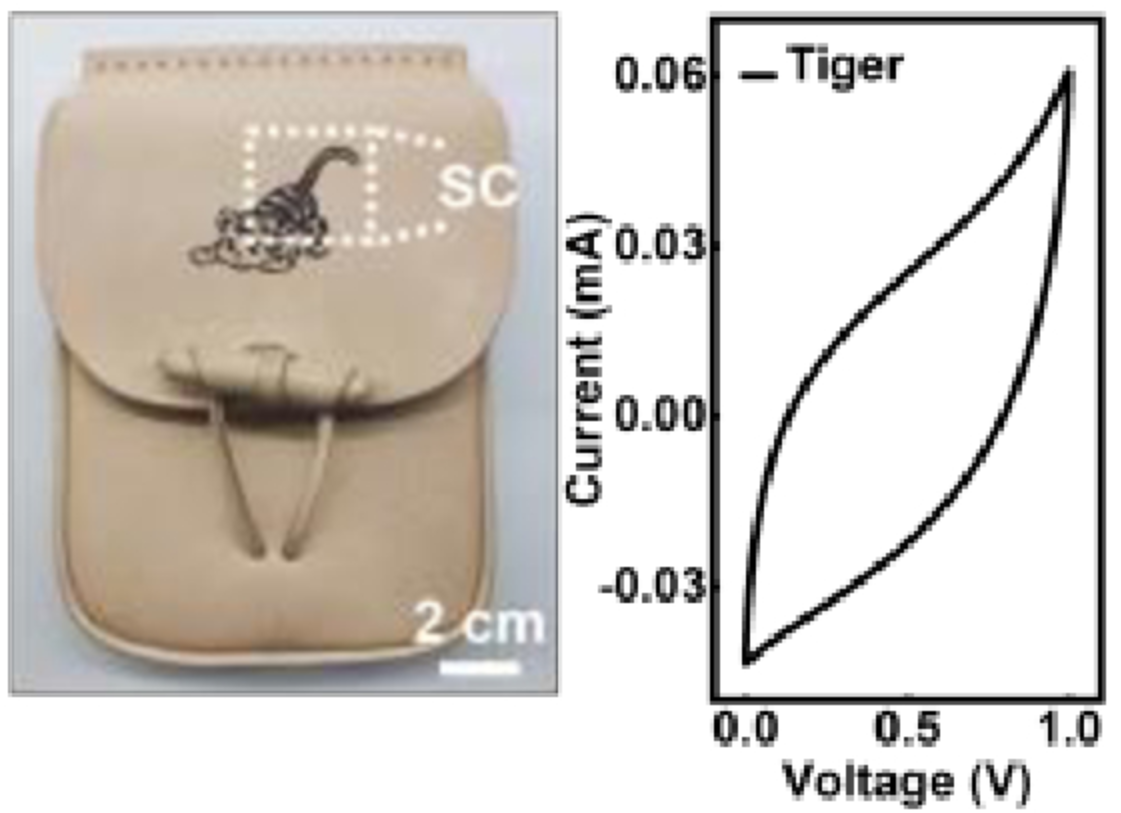
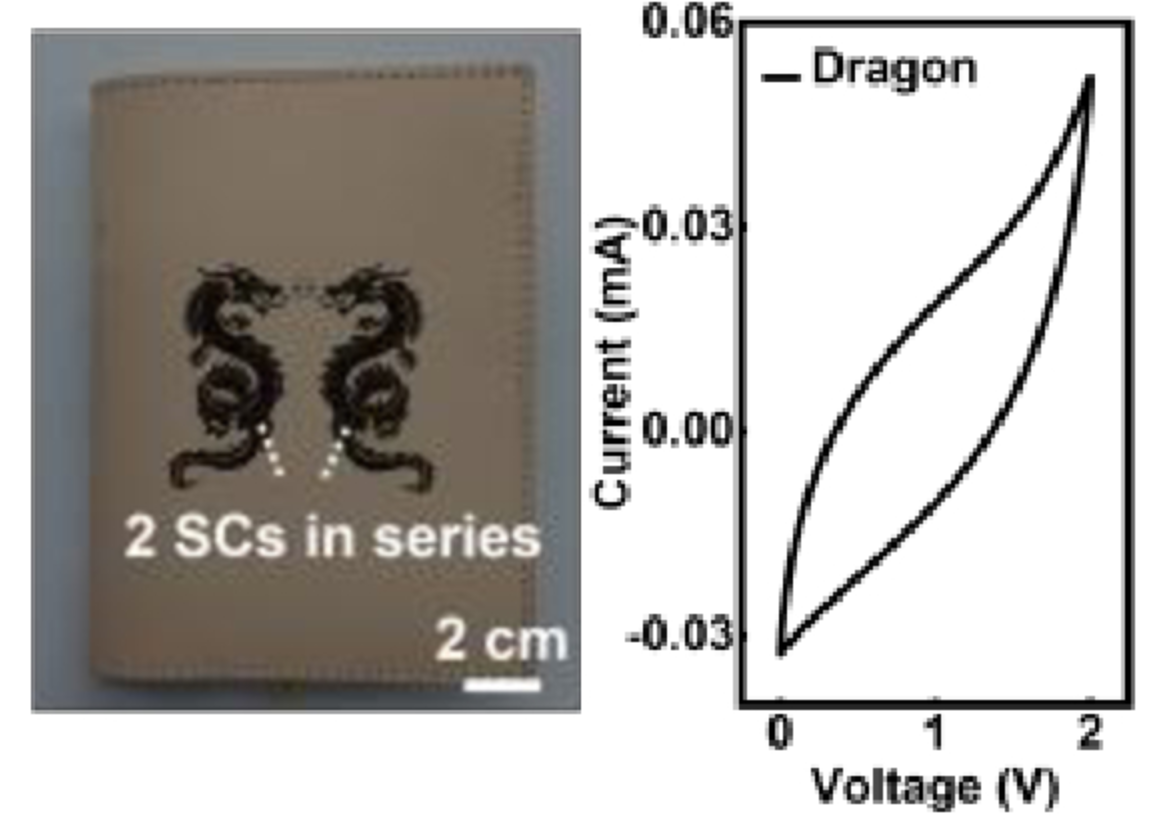
A tiger-patterned device on a VTL bag produced an output voltage of 1 V. Two dragon-patterned devices connected in series on a leather notebook reached a 2 V window and successfully lit an LED at 1.8 V. The rabbit-patterned devices went a step further. Here, the rabbits’ ears formed four microsupercapacitors in series, enough to light a string of LEDs.
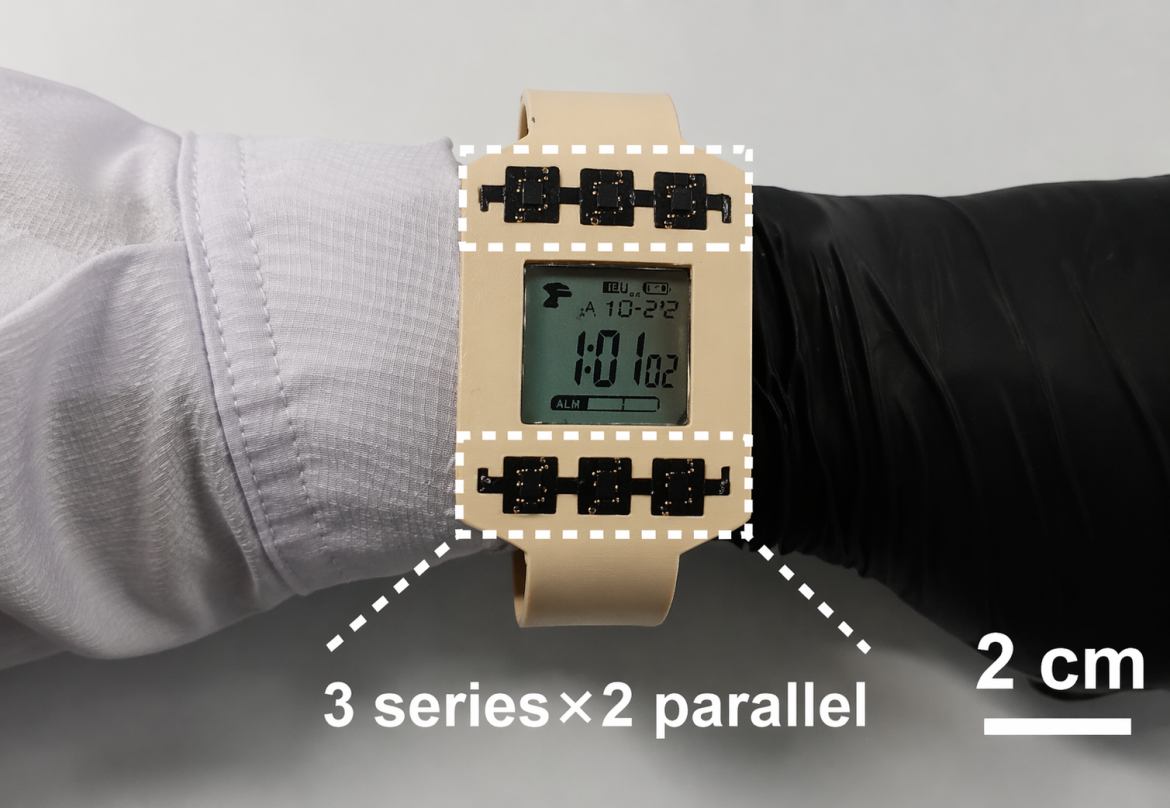
In another demonstration, three microsupercapacitors in series powered a single LED. A 3S × 2P setup also powered an electronic watch.
“The microsupercapacitors are well-suited for flexible and comfortable wearable electronics because they are built on soft materials and can be shaped freely and integrated directly into products,” Han said. “For example, a smartwatch band could store and regulate power instead of relying on a rigid battery, making the device thinner and more comfortable. The technology could also be used in skin-mounted sensors, smart clothing or other everyday accessories that power small electronics.”
The broader appeal is not that these leather devices beat the best existing supercapacitors on every metric. The paper openly says they do not. Other systems, such as CVD-graphene microsupercapacitors and crumpled CNT devices, post stronger capacitive or frequency-response numbers. But those systems often rely on multistep fabrication or do not combine filtering and energy storage in one structure.
That tradeoff is central to the study. The strength here lies in combining sustainability, one-step laser fabrication, design flexibility and usable electrochemical performance on a skin-friendly material.
The researchers are now trying to improve performance, durability and filtering so the devices behave more like ideal capacitors at everyday frequencies. They are also testing long-term stability under sweat, humidity and repeated bending. Furthermore, they are working toward systems such as self-powered health-monitoring patches.
Practical implications of the research
This work suggests wearable electronics could eventually be built into materials people already carry or wear, rather than added as rigid parts afterward.
A leather strap, notebook cover or patch could store small amounts of energy and help stabilize power at the same time.
That would not replace larger batteries, but it could make some devices thinner, softer and easier to integrate into clothing or accessories. This could happen while cutting back on synthetic substrates and more complex manufacturing steps.
