
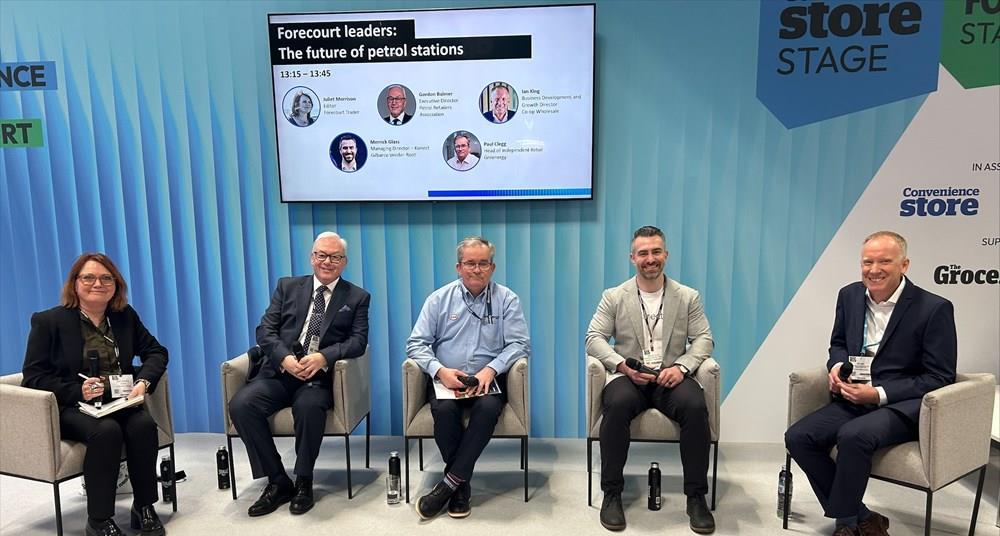
Fuel retailers should consider installing free wi-fi at their sites if they want to attract younger drivers and those transitioning to electric cars, an industry expert has said.
Speaking at the Forecourt Show, Merrick Glass, managing director of Konnect, Gilbarco Veeder-Root’s EV charging arm, said that market research involving over 4,500 drivers across Europe commissioned by his firm revealed that Gen Z drivers (those born between 1997 and 2012) placed greater importance on good connectivity than clean toilets.
Glass also revealed that 70% of drivers charging their EVs in public leave their vehicle, presenting strong opportunities for forecourt firms.
“This is where forecourt retailers can take their entrepreneurial spirit and put it to work”, Glass said. “You’ve got that driver that’s going to be there for 15 to 20 minutes, so if you’ve got the right set of amenities, you can take that time and turn it into a fantastic opportunity for your site.”
Those sentiments were shared by Ian King, business development and growth director for Co-op Wholesale, also on the ‘future of petrol stations’ panel, who observed:
”It’s a really big opportunity because the dwell time is that much greater – with EV charging, people are going to have 15,20 or 30 minutes to shop the ranges, and they might make better use of their time, making top-up shops, picking up three or four-days’ groceries. The opportunity to showcase ranges and offer lots of great, fresh food – it’s much greater with EV.”
King added that the rise of EVs could see forecourts become more like motorway service areas where hot-food is concerned: ”Hot food is still relatively small in the forecourt world, but when people are spending 20, 30 minutes, the need for hot food and good quality food-for-now is only going to grow.”
Speaking on the same panel, Paul Clegg, head of independent retail for Greenergy said that while “EVs are going be the future”, the question was “when will that future be?”
Clegg said that big changes are likely to be seen in 10 rather than five years’ time, explaining: “I’ve always felt the fuel transition will be a case of ‘and’ not ‘or’. EV is going to grow, the function of the forecourt as a hub is going to grow. These things are going to coexist.
“It’s an energy transition that relies on the traditional fuels coexisting with whatever the future brings, then tying in with the services communities need.”
That blended approach was also referenced by Merrick Glass, who said a forecourt visit should be a “seamless experience” regardless of what fuels cars run on. “Drivers want loyalty to work across EV the same way it does traditional fuelling,” he explained.
Glass also said that rather than install one or two EV chargers, operators who are considering installing devices should think bigger.
“A lot of retailers, when they start initially, think to put in one or two chargers because they want to ensure high utilisation. But what we’ve seen is that more plugs, a lot of the time, equals more utilisation. Because as an EV driver, if you’re looking at your apps and see there’s a site that only has one charger, you don’t want to queue.”
Gordon Balmer, executive director of the Petrol Retailers Association and Car Wash Association, meanwhile, advised that high employment costs could lead to an upswing in unmanned sites.
“Some forecourts might want to start looking at unmanned – smaller forecourts might choose to go down that road as employing people is extremely costly now.”
Balmer also highlighted the strong returns valeting operations can bring, explaining that the sector as a whole is worth £2bn a year, while crackdowns on illegal hand car washes had reduced the number of “non-compliant” outfits from around 20,000 to 5,000 over the last nine years, leaving legitimate operators with more customers to court.
