
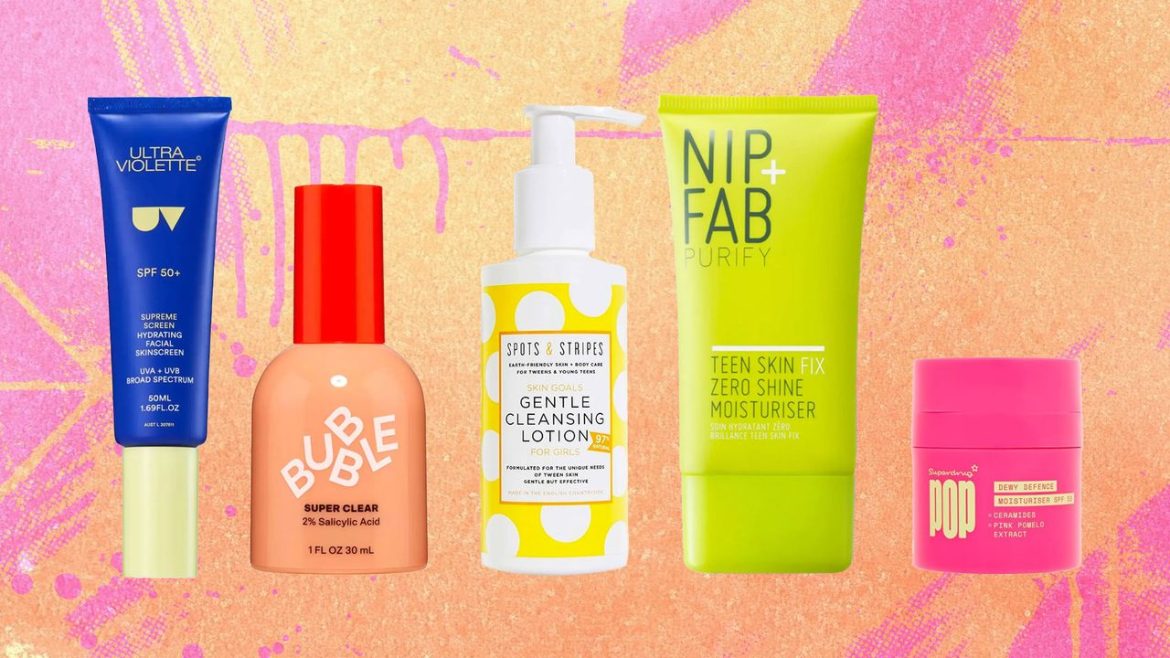
What age should a teenage girl start with a skincare routine?
Skincare is a lifelong commitment, and as consultant dermatologist and founder of Klira, Dr Emma Craythorne points out, it actually starts before teen-hood. “Skincare should be taught from an early age. It is important that young children understand how to wash their hands and face properly as well as using SPF to protect their skin,” she says. However, this steps up a gear in the teenage years. “It becomes even more important to ensure they are cleansing their face appropriately and moisturising where needed,” Craythorne confirms.
Consultant dermatologist Dr Sreedhar Krishna earmarks twelve as a good ballpark age but reiterates that it comes down to the onset of puberty. “This is when hormonal changes can lead to skin issues like acne, making it crucial to establish good skincare habits early on,” he says. Alongside combatting issues such as acne as a result of hormonal changes, pollution – an increasing issue in city living – is also a reason to start skincare young. “Teenagers’ skin is exposed to various pollutants, making a proper skincare routine crucial to cleanse the skin of dirt and pollutants,” Krishna says.
The benefits of doing so are myriad. “Skincare can act as a confidence booster and reduce stress for teenagers dealing with exam pressure, emotional issues, and other challenges,” he notes. It’s also good to get into the habit young. “Skincare is a lifelong pursuit, and starting early can lead to healthier and more youthful-looking skin in later life,” Krishna confirms. A teen skincare routine doesn’t need to be complicated, which we will go into more specifically later.
What should a teen skincare routine look like?
One thing all the experts agree on? Less is more. Teens don’t need multi-step routines packed with potent actives – just a few hard-working, skin-friendly basics to build healthy habits (and confidence) from the get-go.
Dr Sreedhar Krishna suggests the following baseline routine for any teen:
| Cleanser | Gentle, non-stripping, used morning and night. |
| Moisturiser | Hydrating but lightweight, ideally non-comedogenic. |
| SPF | Every single morning, even if it’s cloudy. |
| Spot treatment | Only if breakouts occur, and only where needed. |
Hold up: what are the differences between skincare products for teens and adults?
Teens have different skin types and concerns in comparison to adult women, so products should be adjusted accordingly. “Skincare routines should be personalised and adapted to address the specific needs of each age group,” Krishna notes.
For teens that are suffering at the hands of puberty-induced oily and acne-prone skin, a very common concern, there are particular products that can be beneficial. “Products that target oiliness and acne, such as oil-free cleansers, spot treatments, and non-comedogenic moisturisers, are beneficial,” Krishna says. “Ingredients like salicylic acid and benzoyl peroxide can help treat and prevent acne,” he also adds.
Beyond this, it’s better to stick to a simple routine that includes a cleanser, moisturiser and SPF – and not experiment with active ingredients aimed at older skin. “Teenage girls on the whole need very gentle products with minimal ingredients. They have delicate skin and it should be protected,” Crawthorne recommends.
“Older women tend to need to focus on products that will repair long term UV damage such as mottled pigmentations, sun spots, melasma and lack of glow to the skin. These are not things that teenage girls suffer from – their glow is abundant,” Crawthorne says.
Furthermore, popular ingredients seen in adult skincare, like retinol, are a definite no-no on teen skin. “When teenage girls use many of these products they end up causing irritation to the skin barrier that might induce acne and/or a rosacea or so commonly a perioral dermatitis,” Crawthorne adds.
Should teens and tweens be using active skincare?
There’s some unease around more potent active ingredients and whether they’re appropriate or safe for tween skin. “The main thing to keep in mind when it comes to younger skin is that we build a routine that is simple, effective, but one that doesn’t overwhelm the skin to the point where their delicate skin barrier can be compromised,” insists Dr Mahto. “If, however, there are some skincare concerns, the most common one being acne, then there are a few actives that can be introduced,” she adds.
“For young adults prone to breakouts, salicylic acid is a great active ingredient to introduce in the form of cleansers and the best toners. Benzoyl peroxide can also help manage acne and spots,” advises Dr Ayed.
However, there are ways of adding these ingredients in that are measured and gentle. “Depending on the skin concern, I would advise introducing one active at a time,” recommends Dr Mahto. “If acne is a concern, then choose salicylic acid to begin with and keep the rest of the routine streamlined,” she says.
The frequency used can be tailored to tweens, too. For instance, you could introduce a new ingredient once or twice a week, in the evening, then build from there. The same goes for the strength (which is sometimes written on the bottle, e.g. 2% salicylic acid). “I would recommend starting with lower strengths to begin with. I would also encourage a patch test before introducing new products,” says Dr Mahto. “If specific skin concerns aren’t improving, please get in touch with a consultant dermatologist who will be able to provide a formal diagnosis and recommend an appropriate treatment plan,” she adds.
As for the best skincare ingredients to know for teenagers?
| Vitamin C: | “Vitamin C is an antioxidant that protects the skin from free radicals from the sun and is a benefit to everyone regardless of age. It protects your skin from damage, stimulates collagen growth and supports existing collagen. I always warn my clients that the sun you get as a teen is going to affect how you look in your 30s, 40s, and 50s, which is why it’s important to start a good routine in your adolescence,” explains Dr Michael Gowen. “The best Vitamin C serums are also great for teens because it’s going to provide relief from hyperpigmentation caused by acne and overall supports skin tone and texture. My favourite Vitamin C for tweens, teens and beyond is the Bubble Skincare Day Dream Tone and Texture Serum. The derivative of Vitamin C used in Day Dream is a gentler form that’s perfect for young skin. |
| Salicylic acid | Salicylic acid (also known as a BHA) is one of the most popular and derm-recommended products for counteracting acne, however it is a strong ingredient, so needs to be applied carefully. “Salicylic acid can be abrasive to the skin as it breaks down dead skin cells and combats inflammation which both can play a role in acne. For my clients with sensitive skin, I tell them to do a salicylic acid sandwich by using a toner, a layer of moisturiser, then the salicylic acid serum and finally another layer of moisturiser to help create a barrier and reduce redness and irritation,” advises Dr Gowen. “I love the Bubble Skincare Super Clear Blemish Prevention Serum (2% Salicylic Acid) for my sensitive clients because the formula includes Willow Bark Extract and Colloidal Oatmeal which have anti-inflammatory benefits,” he says. |
