
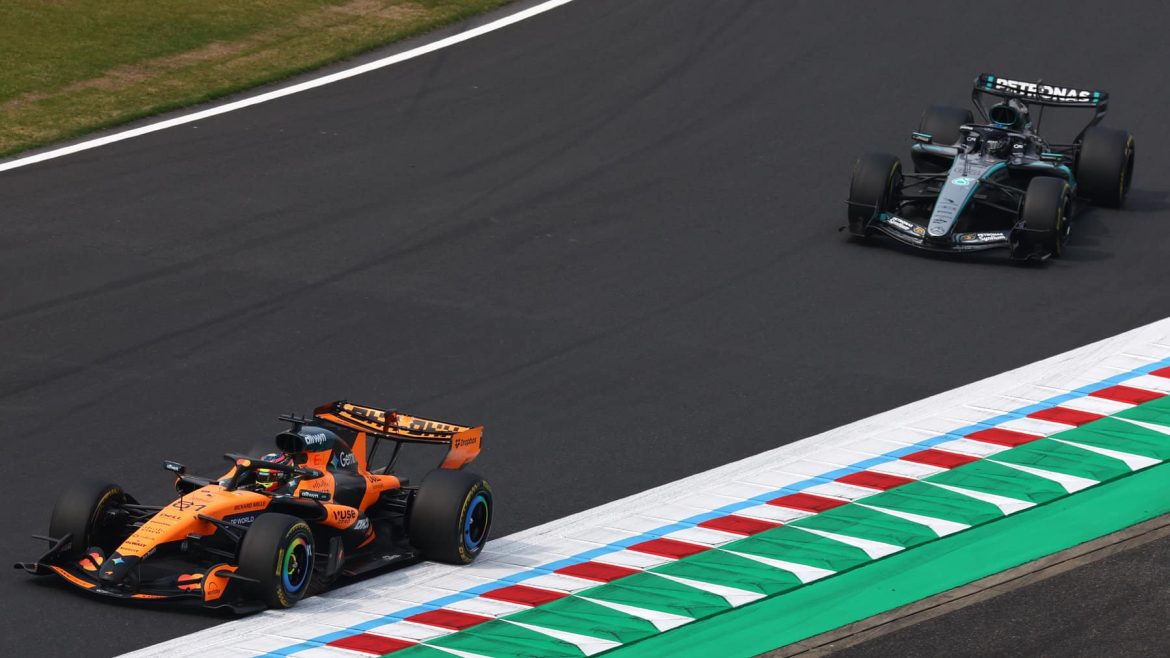
Formula 1 returns from its longest break of the season with more questions than answers.
Five weeks have passed since Kimi Antonelli took victory in Japan, and in that time the sport has been in near-constant debate about the regulations that govern it, with the FIA responding to widespread criticism by introducing a package of power unit tweaks designed to reduce the energy management that has defined, and in many eyes diminished, the opening three rounds.
Miami is the first chance to find out whether it has worked.
The Miami International Autodrome has not been shy of drama in its short history, and this weekend carries extra weight beyond the usual sprint format.
Every team arrives with significant upgrades — some, like McLaren, billing its car as entirely new — after an unusually long stretch at the factory.
The pecking order that emerged in Australia, China and Japan may look rather different by Sunday evening.
At the top of the standings, Mercedes arrives as the team to beat: Antonelli leading team-mate George Russell by nine points in a championship that so far has belonged entirely to the Silver Arrows.
The question is not whether it remains favourite, it does, but whether the combination of new regulations, new car concepts and a circuit that has historically favoured its closest rivals is finally enough to bring the rest of the field into the conversation.
What to watch out for: McLaren’s reset

McLaren plans big upgrades for the next races
McLaren
McLaren’s bid for a third consecutive constructors’ championship had a wobbly start when the team found itself trailing the leaders; its closest competitor in the title race is currently fourth-placed Haas.
Miami brings the chance of a reset. It’s something of a talismanic track for the team after it arrived there in 2024 with an upgraded car which launched it into championship contention by way of Lando Norris‘s maiden grand prix victory. Last year was a papaya whitewash as the drivers finished 1-2 in both the sprint and GP.
To aid its chances of closing that gap, McLaren has spoken of bringing an “entirely new” car over the course of the next two races, and believes it is now getting the maximum out of its Mercedes HPP customer engine, which it was struggling to do – in contrast with the championship-leading factory team – at the start of the year.
“We have made a significant step forward compared to where we were in Australia,” said team principal Andrea Stella. “While at the start of the season, a deficit might have existed for the natural consequence of being a customer team… I think we have filled this gap, and we should have all the tools that are required to extract the most out of the power unit.”
Yet the mood within the team is one of cautious realism rather than optimism. “I would love to say yes, but I don’t really think so,” said Piastri when asked whether McLaren could challenge Mercedes this weekend. “We’re clearly still a fair way behind on downforce and performance from the chassis. Our biggest deficit in Japan was, not that we were lacking time from the power unit, or how we exploited it – it was that our car wasn’t as good as theirs.”
The team is hopeful that having a month without travelling to races has helped it deliver significant upgrades, but Stella conceded that others will be in the same position.
“There was always the idea to deliver sort of a completely new car, especially from an aerodynamic upgrades point of view for the North American races. Obviously, the fact that the calendar has been changed helped, like I’m sure helped all the other teams, [to] work more streamlined towards upgrading the car, rather than being busy with racing.
“Across Miami and Canada, we will see an entirely new MCL40. I would like to stress that this is what I would expect of most of our competitors. So not necessarily is going to be a shift in the pecking order. It will be effectively just a check who has been able to add more performance within the same time frame. And we also have some performance to recover if we look at Mercedes and to some extent Ferrari as well.
“Hopefully we should be able to see a slightly more competitive MCL40 in Miami and then in Canada.”
The hope within the team is that it can come close enough to take advantage of the internal battle for dominance within Mercedes between George Russell and Kimi Antonelli – much like Max Verstappen fought the McLarens last season in a car that didn’t quite have the same pace.
“The more they can battle, the better it’s been,” said Norris. “We certainly hope that we can catch up, and the more points they can take away from each other the better – the same as kind of like us last year and Max in a fight. Hopefully it can be a similar story, but the other way around.”
Of course, that’s likely to mean that McLaren would have to put the weight of the team behind a single driver.
Who’s under pressure: The rules

Bearman’s crash left the FIA with no option but to act
Getty
Three races in, the verdict from drivers, teams and fans about the 2026 technical rules has been pointed enough that the FIA has already felt compelled to act.
The specific complaints are well-documented by now.
Extreme energy management has forced drivers to lift and coast to a degree that has been visible, jarring and, in the eyes of many, antithetical to what a grand prix should look like.
Cars have appeared to slow on the straights mid-session, drivers managing deployment windows rather than racing. The criticism, in conjunction with Oliver Bearman‘s crash at Suzuka, reached a level that made it difficult to dismiss as simple resistance to change.
So the FIA has responded. A package of regulation tweaks has been introduced ahead of Miami, designed to reduce the most counterintuitive driving behaviours and allow for more sustained flat-out running.
The changes have been cautiously welcomed, but most people noted that more meaningful gains may ultimately require hardware solutions rather than regulatory adjustments.
