
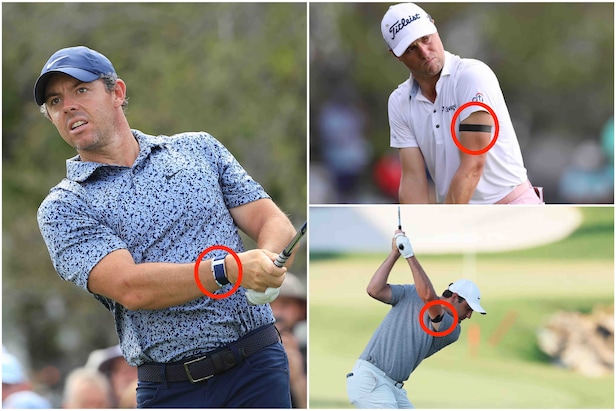
Sleeping probably shouldn’t be a competition, but a wearable device at least presents the option.
Maybe you know the deal: Wake up, roll out of bed, and in my family at least, check for proof you did a better job overnight than the other people at the breakfast table.
Advertisement
That this is juvenile and pointless is a given. The question is whether it’s also counterproductive.
For all of the valuable insight we glean from our fitness monitors, the trickiest dynamic is how we should feel about the feedback in the moment. The topic seemed relevant last week, when I spoke to my son on the morning of a college golf tournament, and he lamented his Whoop “recovery” score was alarmingly low. He then went on to have his best round of the week.
Conversely, I’ve had mornings when I’ve sprung out of bed after a solid eight hours with all the data to prove it and still left two in the bunker on the first hole.
Wearable devices like Whoops, Oura rings, or Apple Watches can certainly provide directional guidance on healthy decisions. If my Whoop reports I’m not getting enough sleep, I tend to prioritize going to bed earlier. When my workouts don’t push my heart rate to a sufficient level, I try to ramp up the intensity for next time (Golf Digest’s Drew Powell and I also recently conducted an experiment that examined how our performances changed based on elevated heart rates, and the conclusions were … complicated).
Advertisement
The trap we fall into is when we make those readings the ultimate arbiter of our ability to perform. University of Rochester psychology professor Jeremy Jamieson, who has contributed to my “Mind Games” series, says heart rate variability (HRV), is an insightful metric, but can be a misleading gauge of our resilience. A common refrain from Jamieson is that our interpretation of stress is more impactful than the stress itself, and that extends to a low HRV.
More Low Net

Golf Digest Logo The art of feeling bad and still playing well

Golf Digest Logo You should practice being annoyed

Golf Digest Logo What really happens when you ‘find something’
Advertisement
”You thinking you have less resilience today because of seeing that had a stronger effect on anything that happened with your internal body,” Jamieson says.
The performance coach and author Steve Magness made a similar observation about the runner Don Bowden, who broke the American mile record on a day when he had slept poorly and just taken an economics final. This was in an era before wearable devices, but if they were around, Bowden likely would have been encouraged not to run, or to expect a poor result.
This part extends beyond perception. Stanford psychology professor Dr. Alia Crum has researched the “nocebo effect” of negative beliefs fueling negative consequences. The golf example: You walk up to a hole you rarely play well, run through a checklist of all the bad shots you’ve hit there before, which creates a physiological response that leads to another bad shot.
But the opposite is true, too. When Crum studied people’s perceptions of stress, for instance, she said those who believed stress could help responded better than those who viewed it as detrimental.
Advertisement
“We found in a number of studies that a more enhancing stress mindset was linked to better health outcomes and higher performance,” Crum said recently.
So, back to golf, the answer is to see your wearable device as a tool, but one that can easily be overruled. As performance coach Jason Goldsmith said, every low reading on your screen is also an opportunity to prove it wrong.
“You have to have a little bit of that chip on your shoulder,” Goldsmith says. “You have to say, ‘I appreciate this device. It’s very helpful, but I’m not going to let it affect the rest of my day. I’m going to show up and do what I need to do anyway.’”
This article first appeared in Low Net, a weekly newsletter written for an average golfer, by an average golfer. To get Low Net, sign up for Golf Digest+.
Have a topic you want me to explore? Send me an email at Samuel.Weinman@wbd.com with your feedback.
