
After slamming the brakes on its EV push, Ford is charting a new route back to the electrified future.
This week, the Detroit automaker formally announced Ford Energy, a subsidiary that’s repurposing its EV battery-making infrastructure to supply large-scale energy storage systems for utilities, large industrial and commercial customers, and, of course, AI data centers. When in doubt, drive toward the hyperscalers …
Powering Up
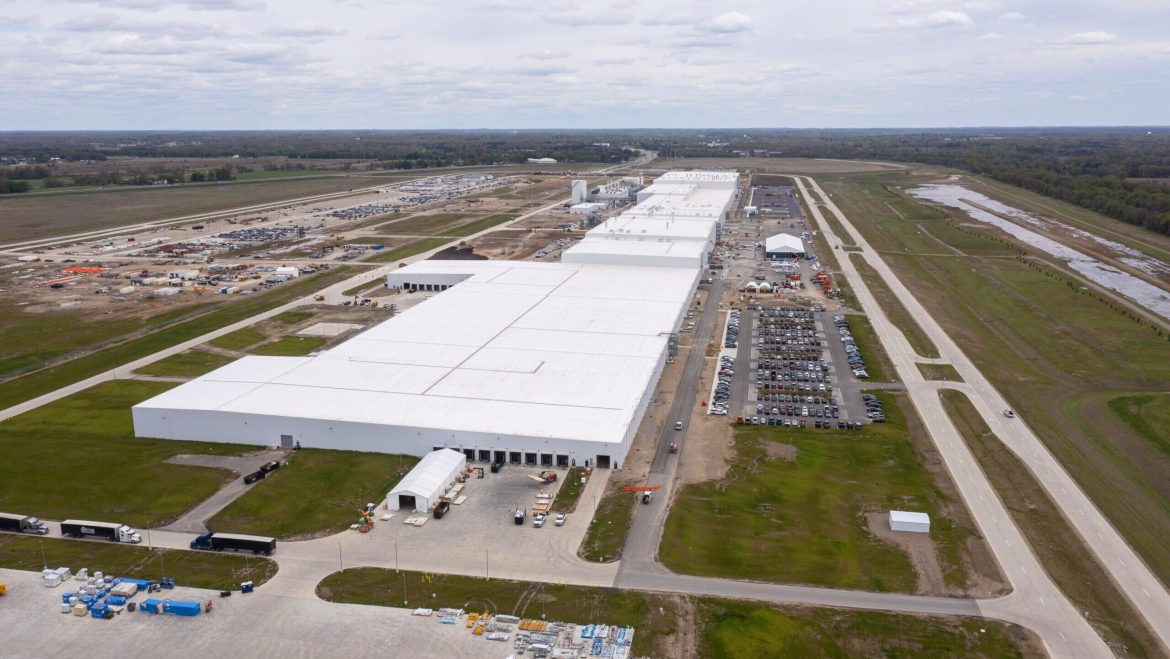
The energy unit has been in the works for a long time, and Morgan Stanley analysts flagged its launch as the potential starting point for a $10 billion business. Of particular note, they said, is Ford’s license to use technology from Contemporary Amperex Technology Co. Ltd., a.k.a. CATL, the Chinese behemoth that is the Nvidia of battery tech. In fact, Ford has almost finished building its $3 billion “BlueOval” battery manufacturing plant in Marshall, Michigan, despite pushback in Washington over its China ties. Another facility in Kentucky is pivoting from EVs to storage battery units. Morgan Stanley has called access to CATL technology an “underappreciated strategic competitive advantage” for Ford Energy and projected the unit would sign supply agreements with major customers in the coming months. Shares climbed 6.7% on Thursday as Ford reiterated plans to plow $2 billion into the unit, re-energizing investors after its EV strategy flopped:
- In December, the company said it would record a $19.5 billion writedown of its EV business. It canceled a line of EV trucks amid a broader pullback due to lackluster US demand and said it would double down on good ol’ combustion-engine cars.
- That was all before the energy shock from the Iran War prompted drivers to rethink their dependence on oil and gas. Global registrations of EVs rose for the second straight month in April, consultant Benchmark Mineral Intelligence said this week. They dipped 28% in North America, however, reflecting the loss of the $7,500 EV tax credit that was still in effect last spring.
Highway Diplomacy: Speaking of international relations, Ford’s CATL partnership may be a sign that Beijing’s presence in America’s auto scene will expand, if politics doesn’t get in the way. During a speech to the Detroit Economic Club in January, President Trump said it was time to “let China come in” and build auto factories that employ US workers, though he later walked back the sentiment. More recently, a bipartisan bill has been introduced to restrict certain Chinese vehicles, software and hardware from entering the US market, though some see such restrictions as self-defeating. “The only way international carmakers can compete with the Chinese carmakers is to collaborate with the Chinese suppliers,” Morgan Stanley’s Tim Hsiao recently told the South China Morning Post. Not for nothing, Detroit’s Big Three was not invited to tag along on the president’s Beijing trip this week.
