
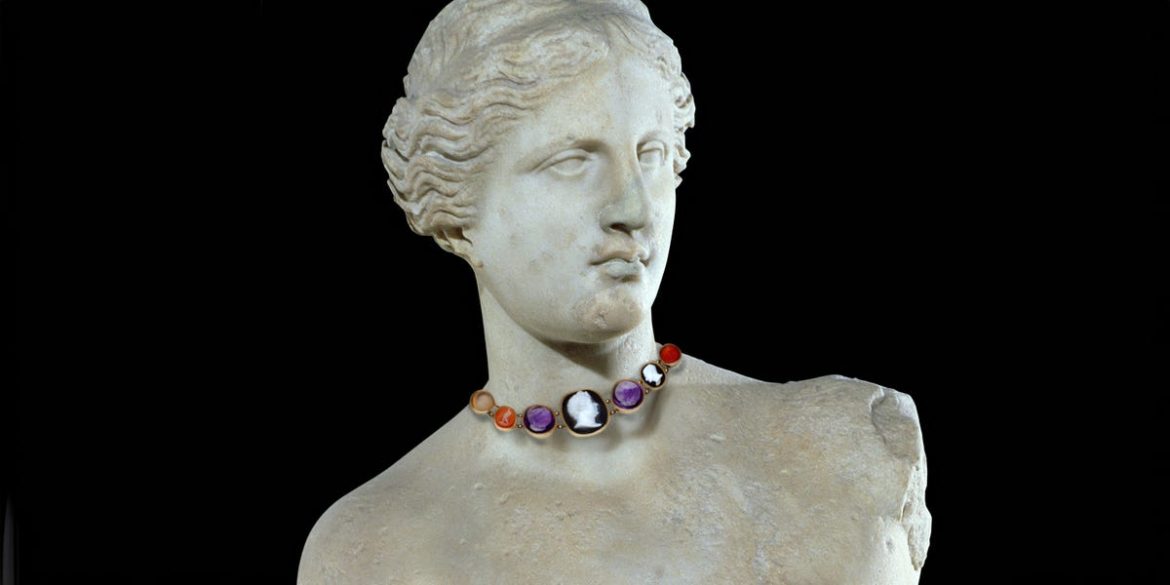
It’s well documented that economic sentiment impacts discretionary spending, as with the oft-cited “lipstick index” that shows consumers buy this relatively affordable luxury when times are tough. But, political instability can also impact jewelry purchases. “I think that in uncertain times people look for objects that carry meaning,” says Zoé Monnier, the proprietor of Pierres Paris gallery. “Wearing a stone that has existed for nearly two thousand years can feel grounding.”
Buyers today are looking for jewels with symbolism as much as style, searching for pieces that communicate something about who they are (and provide good fodder for dinner party conversations). As such, ancient jewelry, a category ripe with history and context, is seeing a resurgence. “If you’re buying ancient jewelry, you know that no one else will have it,” says Claudio Corsi, a former Christie’s antiquities specialist who left to open a lifestyle shop, Almanac, in Pietrasanta, Italy. He oversaw last summer’s Christie’s sale of 19 pieces of ancient jewelry from the Kofler-Truniger collection for £447,000, more than three times the estimate.

Greek gold and crystal box-shaped bezel ring from the Hellenistic period (circa 3rd-2nd century B.C.). Sold for £100,800 against an estimate of £12,000.

Since ancient gold was 24-carat, it boasts a deep, rich color, but it’s also fairly soft, making it even more remarkable that pieces like this survived intact to the present day.
“Ancient” jewelry usually refers to pieces from Greece or Rome, circa 800 B.C. to 500 A.D., but the category can date back 4,000 years to ancient Egypt and extend into the Byzantine era. Even the oldest pieces resemble jewelry we still wear today. There were chain necklaces and hoop earrings, created in all types of metals, though gold was the most prized. Animal motifs, which were a common trope in classical civilizations, still resonate with snakes in particular remaining popular, seen as powerful symbols of protection.

A Roman Carnelian Ring Stone with a Satyr Mixing Wine, circa 1st-2nd Century A.D., sold for $18,900.
Chicago-based auction house Freeman’s has also seen this surge in demand for ancient jewelry—and leaned in. In 2023, they added annual “Jewelry Through the Ages” sales every spring, with offerings ranging from ancient to modern. In their inaugural sale they sold a Roman carnelian ring depicting a Satyr (a creature with a human torso and horse legs) mixing wine, for $18,900 against an estimate of just $500.
A particularly sought-after category of ancient jewelry is intaglios. These engraved semi-precious stones, including chalcedony, agate, and jasper, are usually fashioned into rings. Their small, detailed carvings depict satyrs and nereids (sea nymphs) and gods and goddesses, like Apollo, the god of music, and Hygieia, the goddess of health.
“An intaglio is a perfect meeting point between nature and art,” says Monnier, whose gallery specializes in the category. “We rarely imagine how much detail and symbolism they hold. They have an incredible capacity to surprise people.”

Prase intaglio depicting an offering bearer, 1st-2nd century AD, mounted in gold and green enamel by Monnier.
Finding personal meaning in these carvings is not a new tradition: Sigmund Freud gifted carefully chosen intaglio rings to his inner circle of students in the 1920s and 1930s. But, they’re experiencing a revival now, as the market grows for loose intaglios that can be fashioned by skilled jewelers into stylish new settings. “There has been a noticeable increase in interest over the past few years,” says Monnier. For instance, she just mounted a prase (green chalcedony) intaglio, dating from the 1st to 2nd century A.D., in gold with green enamel. It depicts an offering bearer, representing the “link between the mortal and the divine, a timeless gesture of devotion,” she says.

Engraved signet ring, Roman Period, Carnelian in a modern gold setting, possibly gifted from Sigmund Freud to fellow psychoanalyst Ernest Jones’s wife.
Another draw to the ancient? Monnier’s pieces range from €3,000 to €5,000—a bargain compared to the new fine jewelry iterations that are based on these ancient designs. “It’s been an uninterrupted chain of inspiration,” from ancient to contemporary jewelry, says Corsi.
Rome-based dealer Alessandra Di Castro, who has a gallery in Piazza di Spagna, has also noticed this increased demand for intaglios. But she focuses on 18th and 19th century versions by the likes of Castellani and Luigi Pichler. These pieces were inspired by the ancient jewels unearthed in Italy during that period’s excavations of historic sites. “Antiquity is a source of constant inspiration in Rome,” says di Castro. “They were trying to reinvent ancient techniques.” Her clients are now clamoring for them.

Gold bracelet composed of three hard-stone cameos and four hard-stone intaglios. 21 cm. Rome, first half of the 19th century.
Di Castro says there is so much demand for these jewels that her challenge is finding inventory for all the buyers, rather than the other way around. She has also sold a fair number of pieces to museums, including the Metropolitan Museum of Art, who, too, are building up collections in this category.
“They’re not only beautiful but have layers of meaning,” says di Castro. “I see them as portable works of art.”
