
Before computers and A.I., beautiful trinkets were formed with a combination of hubs, dies, finesse and force. Kevin Potter has perhaps the world’s largest assemblage of them
:focal(916x690:917x691)/https://tf-cmsv2-smithsonianmag-media.s3.amazonaws.com/filer_public/32/01/32011ab5-0bc7-456f-8877-28932a530c36/21_four_military_hubs_in_vintage_tool_makers_to.jpg)
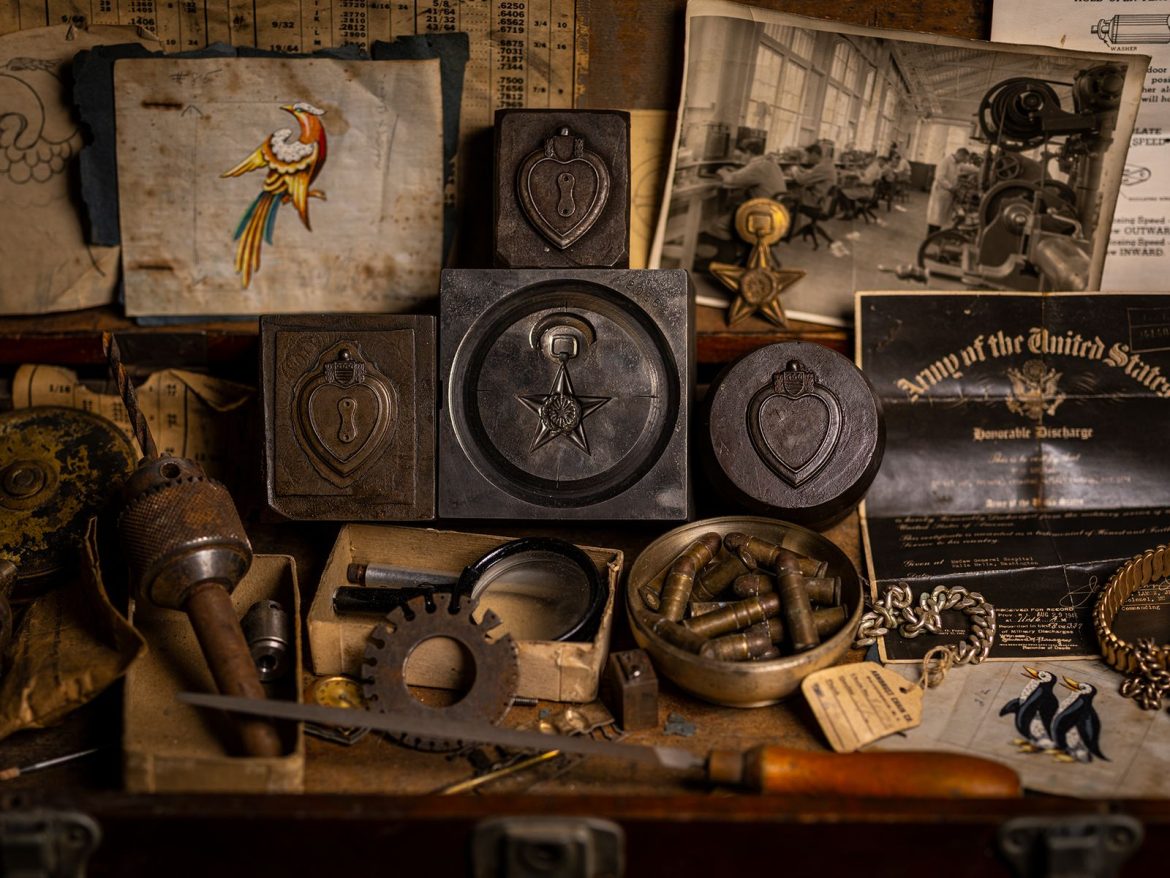
Original hand-carved hubs for the Purple Heart and Silver Star rest in the jeweler’s toolbox of legendary Providence-based hub carver Elio “Duke” Lossini.
Wayne Martin Belger
“Look at this,” says Kevin Potter, marveling at an intricate Art Deco butterfly design carved into an old, weathered block of steel. “A guy made this with chisels and files. It probably took him two weeks. This hub would have made gorgeous, top-quality brooches.”
At Potter USA, treasures hide within nearly every drawer—as in this one, which contains hubs depicting various cats and dogs. Wayne Martin Belger/https://tf-cmsv2-smithsonianmag-media.s3.amazonaws.com/filer_public/57/38/57388796-a28a-4b26-8d66-48c8a9b08b77/38.jpg)
Potter, 56, is a jewelry maker, but he also presides over the largest collection of artifacts from America’s golden age of jewelry manufacturing, which he’s packed into two big warehouses in a scruffy old Tucson neighborhood. Animated and loquacious with a sardonic edge, almost invariably clad in work overalls, Potter has preserved a part of American history, which—even though it touched tens of millions of lives in intimate, emotional ways—is now largely forgotten.
A vintage hub for creating U.S. Army officers’ belt buckles. The Latin—e pluribus unum—appeared in reverse on the resulting die. Wayne Martin Belger/https://tf-cmsv2-smithsonianmag-media.s3.amazonaws.com/filer_public/58/26/5826335a-eae4-4746-8070-c0acb3fe6c67/27.jpg)
“People love jewelry, but most of them don’t think about how it was made,” Potter tells me with an air of wistful indulgence. “They don’t think about the artistry involved, the craftsmanship, the techniques. They don’t think about the tools and equipment.”
Potter’s great collection is dominated by hubs and dies, which are small blocks or pucks of steel with designs engraved on them. Back in the bygone era of industrial die-struck jewelry, factory workers would use powerful machines to press or strike these engraved designs into sheets of gold, silver and other metals.
Kevin Potter, collector extraordinaire, before a wall of vintage hubs. Trained as an artist and a jeweler, he founded Potter USA in 1997. Wayne Martin Belger/https://tf-cmsv2-smithsonianmag-media.s3.amazonaws.com/filer_public/30/80/3080980d-42d3-4aca-9189-88b844cf765a/1.jpg)
The difference between hubs and dies is usually described in terms of male and female. Hubs are male: The design is engraved in relief, such that it protrudes from the surface. A die is then made by pressing or striking a hub into a blank piece of steel, embedding a mirror image of the hub’s design in a shallow cavity. Jewelry can be struck between the male hub and the female die, or between the die and a flat steel surface. Collectively, hubs and dies are known as “tools,” and here, in these extraordinary warehouses, Potter has amassed an estimated 1.2 million hubs, far more than anyone else in the world.
In the front warehouse building, tools are stacked on racks of shelving, lining the walls and corridors. They fill up drawers and cabinets and invade bathrooms and office spaces. Potter, who began his career as a goldsmith, says, “Every one of these tools took between 40 and 100 hours to make. You’re looking at lifetimes of human labor and artistry, often multiple generations of the same families making these tools. Forty years ago, they would have been worth hundreds of millions of dollars, but that value evaporated when the technology changed. People sell them now as paperweights.”
Did you know? Inside Rhode Island’s bygone jewelry empire
-
Rhode Island’s jewelry dominance began with the economic boom that followed the Civil War. In 1865, 45 jewelry companies employed some 700 workers in Rhode Island. Ten years later, there were 130 jewelry companies in the state, accounting for nearly 2,700 workers.
-
By 1880, Rhode Island produced more than a quarter of all jewelry made in the United States.
-
At that time, the state was home to 148 firms, 142 of which were based in the major hub of Providence.
A collection of vintage and contemporary hubs from the U.S. military are stored in a drawer at Potter USA. Wayne Martin Belger/https://tf-cmsv2-smithsonianmag-media.s3.amazonaws.com/filer_public/82/19/8219d7cd-96a5-4b98-82e7-c7e7f03c7753/36.jpg)
The air inside the building has a metallic, oily, industrial smell. The hubs and dies compete for space with antique engraving machines, screw presses, hulking drop-hammer machines, old wooden toolboxes that belonged to master engravers, Rube Goldberg-looking contraptions for making fine, delicate necklaces, hand-forged anvils—including a French specimen dating to 1789—and a mind-boggling array of other archaic machines and equipment.
The sheer volume of unfamiliar visual information is overwhelming, and it’s noisy, too—bang, clang, thud, whoosh—because Potter and his 25 employees are using the old machines to make jewelry, and the old hubs to make new dies. His company, Potter USA, founded in his garage in 1997, sells the dies on the internet to hobbyists, along with small hydraulic presses, so that customers can use them to make their own jewelry. Those customers, he says, are predominantly older women. They number nearly 15,000 and live all over the world.
A selection from Potter’s collection of hand-carved automotive hubs, including such bygone brands as the Stutz Motor Car Company and Nash Motors Company. Wayne Martin Belger/https://tf-cmsv2-smithsonianmag-media.s3.amazonaws.com/filer_public/a8/5b/a85bd220-19ce-4177-8a29-53599712b32c/26.jpg)
“I think it’s the coolest thing,” Potter says. “A guy 150 years ago made this tool. Now his design is being used again, and thousands of people are falling in love with his art. It’s like we’re bringing him back to life.”
The hand-carved hub for a silver cigarette box said to have once sat on President Franklin D. Roosevelt’s desk. Wayne Martin Belger/https://tf-cmsv2-smithsonianmag-media.s3.amazonaws.com/filer_public/ae/dd/aedd6128-e042-4a6c-91dd-dceb25319e90/28_hub_for_a_silver_cigarette_box_that_sat_on_the.jpg)
The profits from this business enable Potter to keep up his voracious collecting habit. He has bought up consignments of tools from defunct jewelry factories in New York City; Newark; Attleboro, Massachusetts; as well as Paris, Prague, Helsinki and various German cities. But a major part of his collection comes from Providence, Rhode Island, once known as the jewelry capital of the world. By the late 19th century, jewelry makers in Providence were using hubs, dies, drop hammers and heavy presses to mass-produce detailed jewelry from sheet gold and other metals. It was a major departure: Before die striking, jewelry was made almost entirely by hand, using metalwork skills dating back thousands of years. Artistry and craftsmanship were still required to make the tools, but die striking was a shift from an artisanal era to an industrial one.

A hand-carved hub for the medals presented to all athletes competing in the 1932 Winter Olympics in Lake Placid, New York. Wayne Martin Belger/https://tf-cmsv2-smithsonianmag-media.s3.amazonaws.com/filer_public/a5/49/a54908c9-c5c4-4319-bd47-bf3c6d45d0c6/19.jpg)
Many of the Providence factories were family owned, and conflicts would often arise. Potter says that a cousin, usually a toolmaker, would leave in a fit of spite and start his own factory. “The companies kept multiplying over time, and the whole thing kept getting bigger and bigger until you had these giant factories, 300,000 square feet, which is three Home Depots.”
For most of the 20th century, these factories produced millions of pieces of die-struck jewelry a year, and they were being exported all around the world. “Providence made good-quality jewelry available to everybody for the first time in history,” Potter says. “Rolled gold really put them on the map. It looks like solid gold, but it’s a very thin layer of gold over brass, so it’s affordable.”
Vincent Potter, Kevin’s son, has followed his father to become an accomplished jeweler (and jewelry historian) in his own right. Wayne Martin Belger/https://tf-cmsv2-smithsonianmag-media.s3.amazonaws.com/filer_public/ef/8f/ef8fb3b5-ae43-45b6-8987-85c7422b3aa8/6.jpg)
At its peak in 1978, the Providence jewelry industry employed 32,000 people in some 3,000 production facilities, ranging from giant factories to front-room mom-and-pop operations. Soon afterward, it fell into a calamitous decline. The business was decimated by companies in Asia, which undercut prices using cheaper labor and inexpensive lost-wax casting, in which molten metal is poured into a mold.
Vincent Potter holds a micrometer—used to measure metal sheet thickness, ring sizes and more—that once belonged to Philip Linton, a 19thcentury jeweler. Wayne Martin Belger/https://tf-cmsv2-smithsonianmag-media.s3.amazonaws.com/filer_public/62/4c/624c2159-6bf8-47fe-a3de-388fee81f3f5/14.jpg)
Hundreds of U.S. jewelry companies shut down, laid off their employees and shuttered their factories. Around 2007 or 2008, when Potter found out that bankrupt jewelry companies were melting down their hubs and dies into scrap, he was horrified. “I couldn’t stand to see all that history and artistry destroyed forever, so I started buying up tools to save them, as many as I possibly could. And that’s what I’ve been doing ever since.”
Peter DiCristofaro, founder and curator of the Providence Jewelry Museum in Rhode Island, recalls how, in 2008, “Kevin came to Providence like a tomb raider coming into the Valley of the Pharaohs. He bought $300 million worth of tools for pennies on the dollar. He mounted an enormous collection, and he got the best.”
Potter USA is largely a family operation. Kevin works alongside his wife, Danielle, who’s in charge of the office and the finances. Their son, Vincent, 25, is a jewelry maker who dresses in overalls and a newsboy cap. From his father and his own research, he has acquired a vast knowledge of the history of American jewelry making. Vincent helps his father with the collection and the tool business, and he runs his own company, Cranston Fancy Wire, which sells bracelets and engraved strips of copper, brass and silver.
Vincent Potter operates a mid-1850s drop hammer from Sheffield, England. The force of the hammer imprints a die’s design onto a hot piece of metal. Wayne Martin Belger/https://tf-cmsv2-smithsonianmag-media.s3.amazonaws.com/filer_public/40/ae/40aefa10-68e1-4d89-bfb5-aa9ce3a610e1/12.jpg)
“We have the tools organized by the companies who made them, because it keeps a better historical record,” says Vincent, as he shows me around the collection, which includes pieces from 74 companies. Opening a cabinet loaded with hubs and dies, he says, “This is Gorham,” a company founded in 1831. “They made high-end silverware and trophy-ware in Providence and closed in 1986.”
Lovingly, Vincent shows me a gold bracelet he spotted recently in a Tucson thrift store. It was made in the mid-20th century with one of the dies in the Potter collection. He bought the bracelet and says he’s now reunited it with the very die that struck it decades ago in Providence.
A hub that created the National League’s first award for Most Valuable Player, which went to pitcher Dazzy Vance of the Brooklyn Robins in 1924. Wayne Martin Belger/https://tf-cmsv2-smithsonianmag-media.s3.amazonaws.com/filer_public/31/1e/311ec774-90f8-4ef4-babf-1f58743851ef/25.jpg)
As we move through the collection, over several hours, it becomes apparent that the Potters preside over a unique record of American life in the 19th and 20th centuries, and not just the changing fashions in men’s and women’s jewelry. The die-striking process was also used to make medals, silver Christmas ornaments, souvenir pins, law enforcement shields and hood emblems for cars, to name just a few.
A collection of hand-carved French hubs from the 1760s depicting faces used to produce coins and medals, likely at a mint. Wayne Martin Belger/https://tf-cmsv2-smithsonianmag-media.s3.amazonaws.com/filer_public/1e/c2/1ec2e2b4-ddea-4e39-8fdd-d7404422e705/32.jpg)
Kevin shows me into one office that’s devoted to military tools, including the dies that struck the Purple Heart, the Bronze Star, the Silver Star and the Medal of Honor. Potter has a vintage hub for US. Army officers’ belt buckles, and one that made badges for the space program. In another room, displayed high on a wall, is the die that struck early badges for the Los Angeles Police Department.
“I’ve got the tools that made the pins and rings for the Skull and Bones Society at Yale,” Kevin says.
The original hubs used to create the championship rings for the St. Louis Cardinals following their World Series victories in 1942 and 1946. Wayne Martin Belger/https://tf-cmsv2-smithsonianmag-media.s3.amazonaws.com/filer_public/e1/6c/e16cafe4-5d50-4a30-9491-7a970c5ead79/29.jpg)
Moving into a different room, he rifles through a cabinet and pulls out the dies that struck the World Series rings in 1942 and 1946, and both the prize medals and the participation medals for the first Winter Olympics hosted by America, at Lake Placid in 1932. “The actual medals sell for about $10,000, so what’s this worth?” he says. “This is the die that made all those medals, the real original.”
Other than Kevin and Danielle, the employees at Potter USA are mostly in their 20s and 30s, and this is a deliberate strategy on Kevin’s part. “The techniques for making die-struck jewelry weren’t written down. You can’t look them up in a book. It was all passed down by word of mouth, by showing the next generation how it was done. That’s what I’m doing here. I don’t want to see the knowledge die out.”
In the 1980s and 1990s, die-striking from hand-engraved hubs was supplanted by CAD (computer-aided design) software and CNC (computer numerical control) machines that engrave, texture and create models for the lost-wax casting process. Now those technologies are threatened by the advent of artificial intelligence 3D model generators. “You don’t even have to draw anything,” says Potter. “Just tell it what you want, and there it is, ready for 3D printing. In the spirit of ‘meet your destroyer,’ we tried it, and it made a perfect die from a photograph of a piece of jewelry.”
He thinks Potter USA will survive because it caters to hobbyists who enjoy working with their hands, but Potter has no doubt that the jewelry industry will once again be transformed. “You can’t fight technological change that powerful,” Potter says.“The artisans who made jewelry by hand for centuries were put out of business by industrial die-struck jewelry. Now A.I. is upending the business model again. That’s just how it goes.”
