
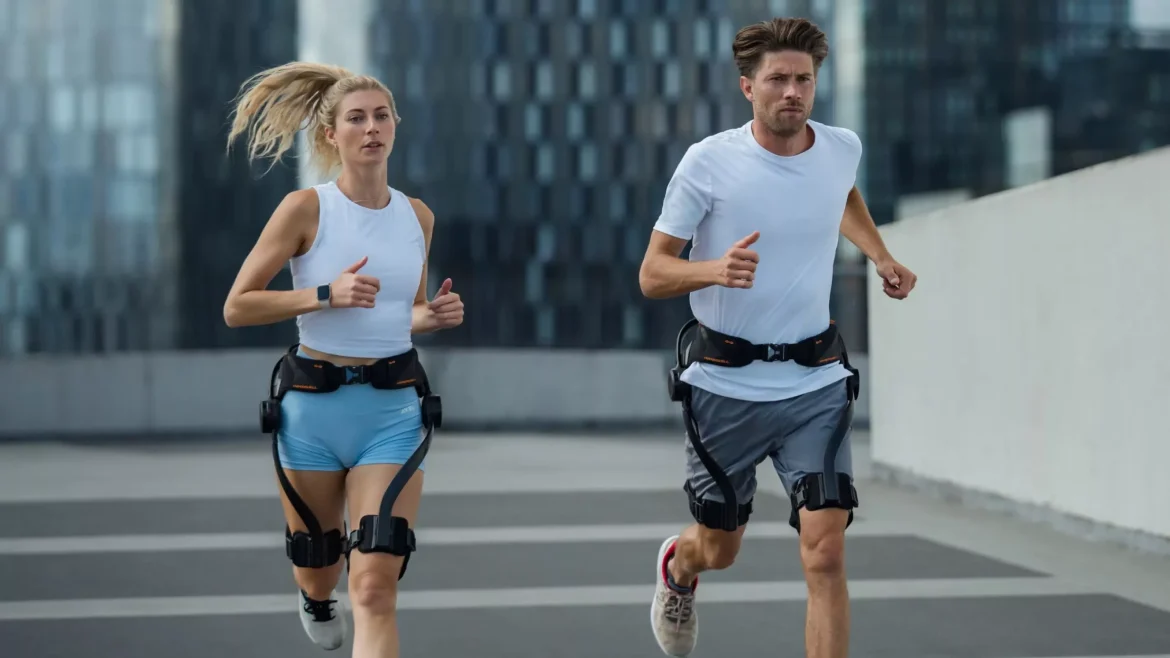
First look: Is AI starting to move off screens and into gear people actually wear, including devices that change how their legs move? One such example is Hypershell’s X Ultra S, a $2,000 exoskeleton aimed at hikers and outdoor enthusiasts willing to pay early-adopter prices for motorized leg assistance.
The hardware looks straightforward at first glance: a waist belt connected to hinged braces along the thighs, but the mechanics beneath do more than stabilize movement. The system uses dual hip-mounted motors that can draw up to 1,000 watts, pushing carbon-fiber linkages that add force to each step. Instead of simply supporting the wearer, it actively drives motion forward.
The real difference, though, comes from the software. Hypershell calls its control system “HyperIntuition,” an AI model that reads a person’s movement and adjusts motor output in real time. It tracks changes in stride and cadence, then decides how much assistance to apply and when. When that alignment works, the added power can blend into a natural rhythm. When it doesn’t, especially during quick stops or direction changes, the system can feel overbearing, as if something else has briefly taken over.
The assist is most noticeable on inclines. With the torque turned up, uphill sections require less effort, and stairs feel more mechanical than physically taxing. Softer terrain like sand, where energy is typically lost with each step, is another area where the system can help offset fatigue. Whether that tradeoff justifies the price depends heavily on the user.

Control runs through a mobile app, which ends up playing a larger role than the hardware alone might suggest. Users can adjust assistance levels or trigger short bursts of higher power through a Boost setting. The AI handles moment-to-moment adjustments, but overall behavior still requires manual configuration. That dependency becomes more apparent where the system runs into limits.
Downhill movement is one of them. The AI does not automatically detect descents, leaving users to switch modes manually. On uneven ground, too much assistance can work against the wearer, requiring constant adjustment to stay stable.
The experience shifts on a bike. The added force can reduce how much the rider contributes to each pedal stroke, but the cardiovascular load doesn’t drop proportionally. The heart and lungs still have to keep up, so the rider may feel nearly as spent despite technically producing more power.
There are also practical limits. Battery life is rated at around 18 miles under typical conditions, though high-power use can shorten that. The device also carries physical risks: components under tension can snap back if not properly disengaged, and the motor forces can cause injury if handled carelessly. The app includes guidance on safe use, but the responsibility still sits with the user.

Even with those constraints, this development is hard to ignore.
Systems like the X Ultra S move AI beyond analysis and into direct physical output, applying force in real time rather than simply offering information or recommendations. That opens up potential applications from recreational hiking to search and rescue, though the technology is still finding its footing.
For now, the technology feels early. It is functional, and occasionally impressive, but not seamless. It demands attention and willingness to adapt. Whether it’s worth $2,000 depends on what problem you’re trying to solve. As the hardware gets lighter and the software gets better at interpreting context, it’s likely to feel less like gear you manage and more like an extension of your own legs.
