
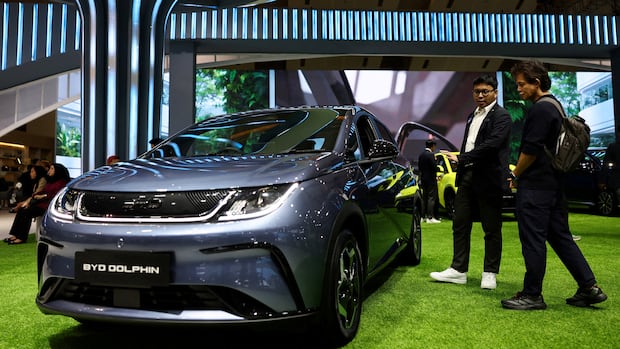
As Canada lowers its tariffs and imports more electric vehicles from China, an upcoming report from New York-based labour rights researchers is making new allegations of forced labour practices at the world’s bestselling EV manufacturer, BYD.
China Labor Watch (CLW) received a complaint last fall from one of the thousands of migrant workers brought to Hungary from China to help build BYD’s first European plant in the city of Szeged — a $6-billion investment intended to supply the European market with around 300,000 vehicles per year.
The non-profit organization launched an investigation and provided CBC News with an advance copy of its findings, set for publication later this month.
“It’s important that consumers know what’s really behind some of these electric vehicles, and the labour conditions that are behind the production of these cars,” said project officer Elaine Lu.
“Chinese workers who are being brought in to work on these sites are being employed in quite horrible conditions.”
CLW interviewed 50 workers. To protect their safety and reduce the risk of retaliation, no names appear in the report. Many of those interviewed by CLW field workers were construction and installation labourers recruited through subcontractors or other intermediaries.
The report, first covered by the American public radio news program The World, describes potential violations of Hungarian labour and migration laws, including:
- Seven-day workweeks with no days off to rest, with workers telling CLW they were instructed to lie to inspectors about their working hours if asked.
- Shifts of up to 12 or 14 hours, with only a short meal break and no paid overtime.
- Delayed wage payments of up to three months, with final payments withheld until workers returned to China.
- Steep recruitment fees used as a form of debt bondage, with low-income workers saying they were forced to stay despite poor conditions because they can’t afford to default on their contract.
- Workers entering on business visas instead of authorized work permits, leaving them vulnerable to abuse and unable to access services like health care for workplace injuries.
CBC News has not independently verified any of the allegations.
BYD did not respond to a request for comment.

Opaque recruitment, shifting accountability
CLW also laid out how tangled webs of tiered subcontracting blurred the lines of legal responsibility for poor working conditions, potentially allowing BYD to shirk responsibility.
“If there’s any issues, they just say, well, ‘this was the subcontractor’s issue, they hired them.’ So it’s evading their own responsibility,” Lu said.
She said workers are vulnerable because they are unfamiliar with the local language or local laws. “They don’t know who to go to if they want their wages back.”
Lu said local Hungarian media have begun to report on safety concerns at the site following the death of a Chinese worker in February. CLW met with local authorities to share its findings last month.
“We are hoping that BYD will take these violations and these findings very seriously because they are … contraventions of local laws and international standards,” Lu said.
Conservative foreign affairs critic Michael Chong said a report like this makes it all the more urgent for Prime Minister Mark Carney to clarify his position on whether or not he believes there’s forced labour in Chinese supply chains.
“If we allow these products to enter Canada, we are creating a market, and that allows these states to suppress human rights and control populations,” Chong said. “That’s why these clauses have been written into Canada’s trade agreements — to prevent this stuff from happening.”

These findings aren’t the first time BYD’s labour practices have been questioned. Last May, prosecutors in Brazil sued BYD and two of its contractors over what they alleged were “slavery-like conditions” at its plant in the state of Bahia.
CLW’s also conducting a separate investigation on the labour conditions in BYD’s factories in China itself.
“Nobody asks themselves why the cars were so cheap: it’s because when you decide to choose affordability to serve your finite resources at the expense of society’s values of fairness, somebody else pays the bill,” said Automotive Parts Manufacturers Association president Flavio Volpe.
“Increasingly in advanced Chinese manufactured goods, they’re not just exporting the product. They’re exporting their domestic business practices and hiding behind impressive investment numbers in the hopes that we look away.”
The report is “deeply concerning,” said Canadian Vehicle Manufacturers Association president Brian Kingston.
“Canada’s auto industry can compete and win but the playing field must be level,” he said.
BYD imports: ‘forced labour risk’
In the wake of Canada’s deal earlier this year to lower tariffs on Chinese electric vehicles, there are increasing signs that BYD, which overtook Tesla last winter to become the world’s bestselling EV maker, is preparing to open dealerships in Canada and gain a foothold on the North American market.
Canada is a signatory to the International Labour Organization’s forced labour convention and has passed domestic legislation prohibiting the import of any manufactured goods made with forced labour.
CLW’s allegations are consistent with the ILO’s indicators for forced labour.
“I think there would be a serious forced labour risk if you are importing BYD cars from China into Canada,” Lu said.
In a March 27 social media post, the Chinese Embassy in Ottawa said allegations of forced labour in its automotive supply chains are a “blatant lie spread by a handful of anti-China individuals.”
“What they want is simply to deprive the Chinese people of their right to pursue a happy life through hard work, disrupt the normal production and operation of Chinese enterprises and suppress China’s development, which will also severely damage the stability of global supply chains,” the post said.

The U.S. continues to levy 100 per cent tariffs on all imports of electric vehicles from China.
The United States Trade Representative’s 2026 Foreign Trade Barriers report said “it does not appear that Canada is effectively enforcing its forced labour import prohibition.” The USTR’s 2025 report did not call out Canada on this issue.
As part of the Trump administration’s plan to replace tariffs struck down by the U.S. Supreme Court, Canada’s been included in an investigation of countries suspected of allowing goods made with forced labour to enter its market. Hearings in this probe will be held later this month.
Canada’s exports could face tariffs of up to 25 per cent if it’s found in violation. The Canada Border Services Agency has not answered a CBC News question on whether it has been contacted for the USTR’s investigation.
In 2024, a U.S. Senate probe found that car parts manufactured with forced labour were imported into the North American market for use by global brands including BMW, Jaguar, Land Rover and Volkswagen.
CBSA detained suspect car parts
Questions from CBC News about whether any EVs have actually entered Canada from China since its tariffs dropped have yet to be answered by either the border agency or several ministers’ offices.
The CBSA, however, did share an explanation for how Canada’s law differs from U.S. rules: Canadian authorities cannot prohibit imports strictly on the basis of where they originate. Forced labour violations are determined case by case, shipment by shipment.
When officers have doubts, they can detain suspect goods for 30 days and request more documentation. Importers are responsible for running due diligence on their own supply chains.
The CBSA disclosed to CBC News that in 2023, an unspecified number of shipments of automotive parts from China were intercepted and detained because of forced labour concerns. Facing scrutiny, the importer opted to re-export the car parts back to their country of origin.
Canada’s Customs Act does not allow the CBSA to share company names or identifying details, nor will it confirm, deny or reveal the status of its investigations. But this example suggests border officials are aware of the forced labour risks in China’s automotive supply chain and, at least in this instance, have blocked tainted goods from entering.
Finance Minister François-Philippe Champagne told CBC News he discussed supply chain integrity issues when he met with senior Chinese officials in Beijing last week.
“I suspect that they may have seen the press in Canada before my visit. And they know that this is part of Canadian policy, to be very clear as to where we stand on these issues,” he said, while refusing to divulge more about his private meetings.
The deputy minister at Global Affairs Canada also met with China’s ambassador in Ottawa last week. In a social media post, the embassy said the pair had “positive and in-depth discussions” about implementing the deal their two leaders struck earlier this year.
