
Right now, people rely heavily on individual gas-powered vehicles as a main method of transportation. However, the influence of their emissions on climate change and the environment has prompted discussion of other transportation alternatives.
The main proposed alternative is electric vehicles; their popularity has grown in recent years due to perceived environmental advantages. Despite sustainability marketing strategies, the end of 2025 and start of 2026 was a bumpy road for EVs, especially with worldwide market declines following the expiration of EV related tax credits in the United States last September. But the future of EVs is still up in the air, leaving room for the popularization of public transit as a viable alternative.
With electric cars claiming to be a “green” alternative, people are buying them and contributing to the EV movement without realizing their full effect on the environment. Often, EVs are perceived as cars that run clean. The benefit of EVs come from reduced carbon emissions, which is significant but not a complete solution to the environmental crisis. It’s not that carbon doesn’t matter; it’s just that it’s not the only thing that matters when it comes to saving the environment. Because of this, the EV movement is often misunderstood. And consequently, EVs shouldn’t be the end goal for sustainable or cleaner transportation — public transit should.
It’s not that EVs are less environmentally friendly than gas cars. The cars have zero tailpipe emissions, meaning they release no greenhouse gases like carbon dioxide into the air. Their life-cycle emissions, gases released during manufacturing, usage and recycling, are significantly less than the norm. Additionally, EVs use their energy more efficiently, wasting 31%-35% compared to the 75%-84% wasted by gas-powered vehicles. It’s clear that, once on the road, EVs are better for the environment. Their non-environmentally friendly nature instead comes from the production process.
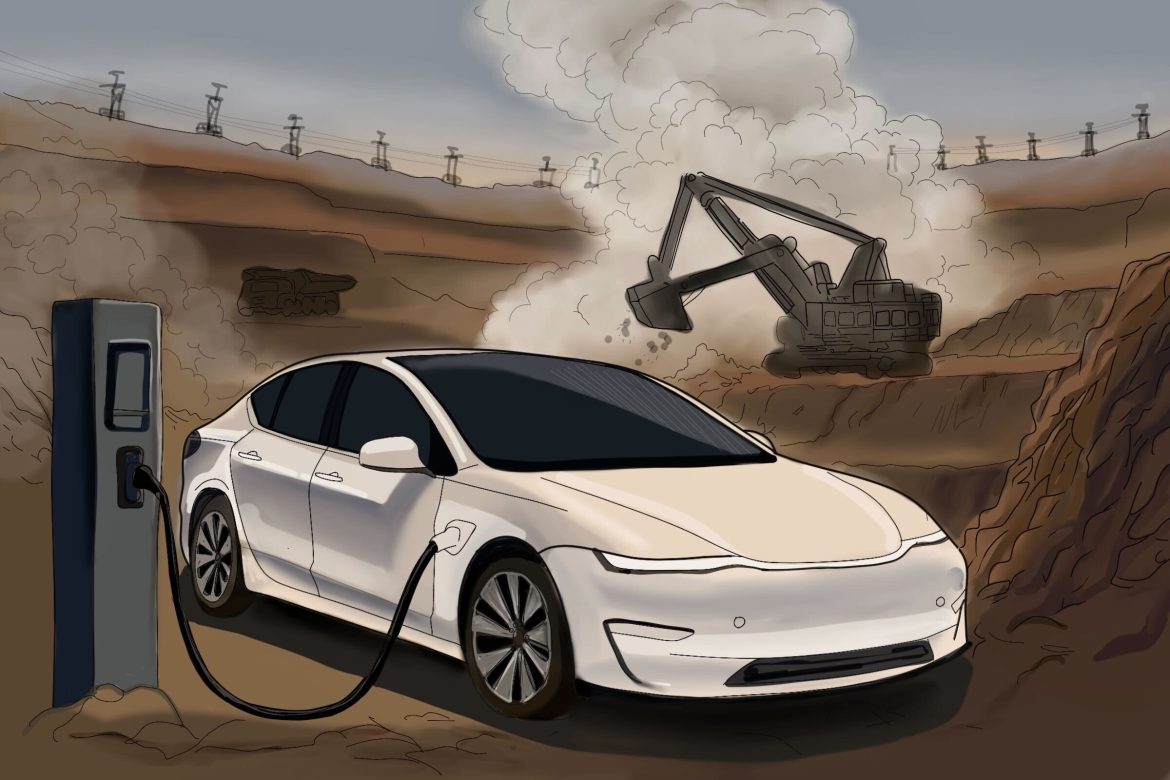
There are serious environmental impacts from building EVs and their batteries. In order to construct the batteries, companies need to conduct extensive mining and resource extraction of rare earth metals like nickel, cobalt and lithium. Plus, EVs need six times the amount of material than that of gas powered vehicles. And more mining of these rare earth metals means greater water, fuel and electricity usage, taking more from already limited resources. For a car that claims to be environmentally beneficial, its production certainly isn’t.
This mining also harms nearby living things as surrounding water, air and soil become contaminated. Human laborers’ health and safety is put at risk by unfair working conditions and exposure to toxins, radiation and chemicals. Often, mining occurs on Indigenous land, destroying the natural running of ecosystems and Indigenous social structures. Sixty percent of the lithium triangle, the world’s largest lithium preserve, is made up of Indigenous communities. Looking at EVs from this perspective shows that their intense mining and subsequent ecological strain undermines their other environmental benefits.
If support for EVs as an environmentally friendly transportation alternative continues, mining for raw materials is going to increase, and these adverse environmental impacts will intensify. Rare earth metals are finite, and more mining will eventually result in their scarcity. It’s especially concerning since the recycling of rare earth metals isn’t widely implemented yet, either. Currently, recycling of lithium batteries occurs at a rate of 5%. Apart from a production process that’s far from being environmentally sound, EVs lack sustainability through the future use of their materials as well.
There must be a collective switch from societal reliance on individual automobiles to public transportation. This includes scaling back on both gas and electric cars. Public transit reduces the demand for individual travel, reducing both carbon emissions and mining. Instead of funding a green transition to EVs, the U.S.should fund and further develop public transit. People need to utilize these truly sustainable systems involving modes like bus transit or rails. And when individual transportation is absolutely warranted, walking and biking should be the first choice. These methods are proven to be better solutions for the environment than EVs.
People see the green sticker tag of EVs and think they are doing their part to help the environment. But the reality is, they still have their environmental tradeoffs. Change in the transportation sector to reduce environmental impact shouldn’t be fueled by EVs. The greener, more sustainable solution is use and acceptance of public transit. Car culture needs to move aside and make way for buses, rails, pedestrians and bicycles.
Emma Margaron is an Opinion Columnist from Holland, Michigan who writes about science, the environment and justice in her column “Environment Everywhere.” She can be reached at margaron@umich.edu.
