
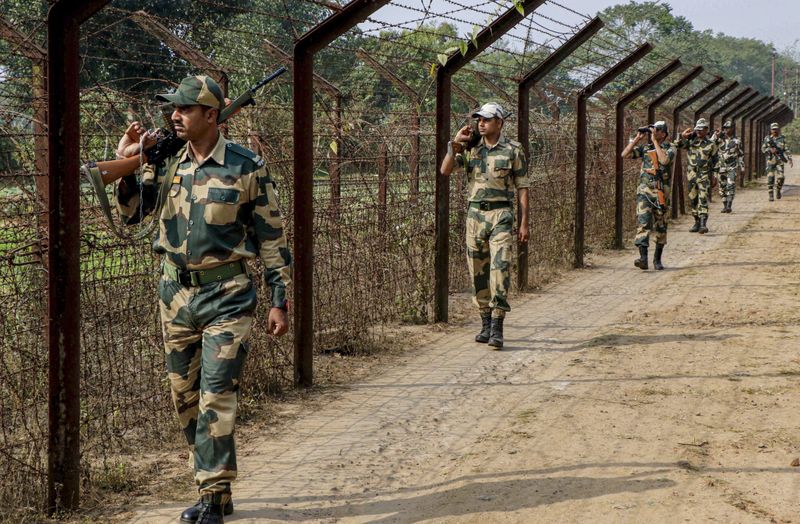
The communication was reportedly in line with Union home minister Amit Shah’s direction to achieve ‘operational’ successes along the border. Introducing dangerous wildlife would risk entire local populations and make land and rivers unviable for economic activities.
New Delhi: The Border Security Force (BSF) has directed field units to explore the feasibility of using “reptiles such as snakes and crocodiles” in riverine stretches along the Bangladesh border that can’t be fenced, to prevent infiltration and criminal activities, The Hindu reported, citing an internal BSF communication.
Fencing along the Bangladesh border began in the nineties, with plans predating the actual implemtation, and a variety of objectives from stopping illegal immigrants to controlling crime. Plans have included fencing, floodlights and better roads to improve border policing under successive government. The present Narendra Modi government has pushed fencing projects, though it has not always been welcomed by residents of border areas.
India shares a 4,097 kilometre border with Bangladesh, over five states – Assam, West Bengal, Meghalaya, Tripura and Mizoram. Most of the border is in West Bengal, followed by Assam and Meghalaya. In the agrarian border regions, the disputes over fencing have to do with land owned by individuals coming under the fenced area. In riverine and mixed-terrain areas, such as in Cachar, Assam, restrictions imposed on trade and movement when illegal trade or infiltration is suspected – even without the crocodiles and snakes being introduced – is already a cause for difficulty and hardship.
According to a parliamentary standing committee on Home Affairs, the government had approved the fencing of 3,326.14 km, and most of it – 2,954.56 km has already been fenced. However, the BSF’s note seems to consider parts of the border that are geographically impossible to fence, like the char sites, or stretches where any of the four major rivers of the region define the border.
As per the Hindu report, the communication, dated March 26, said the suggestion to use reptiles was in line with Union home minister Amit Shah’s direction to achieve “operational” successes along the border, though it has not been implemented. “The feasibility of deploying reptiles (such as snakes or crocodiles) in vulnerable riverine gaps is to be explored and examined from an operational perspective,” it said.
The communication was sent from the BSF headquarters to the field units along the Bangladesh border, following a meeting on February 9 in New Delhi. The BSF is the primary defence force guarding India’s borders along Bangladesh and Pakistan.
The Union government had in 2015 sanctioned phase-wise fencing to “prevent illegal migration and illegal activities, including anti-national activities from across the border”. However, according to a 2024-25 annual report of the Ministry of Home Affairs, some areas such as riverine/low-lying areas, habitations close to the border, pending land acquisition cases and protests by the border population, had slowed down the installation of fencing in certain stretches.
Last year, the Border Guard Bangladesh (BGB) officials, who guard the border on the other side, had protested against India’s fencing, citing violations of a 1975 pact requiring a 150-yard gap from the zero line. It caused the BSF to suspend the activity near the Dahagram border in Lalmonirhat’s Patgram district.
The Bangladesh government had summoned Indian high commissioner Pranay Verma over “deep concerns” that the work was being carried out without proper authorisation.
Sections of the eastern border with Bangladesh are prone to heavy flooding at least once a year. Apart from the marshy land, the terrain itself varies from hills to valleys, making physical fencing impossible. But the border between India and Bangladesh is also densely populated in parts, and introducing dangerous species of animals could put locals on both side at risk, potentially worsening the human-animal conflicts that already exist.
A BSF official, as quoted by The Hindu, said, “Till now the directions on reptiles have not been implemented. The directions have come to explore the possibility of it. There are several challenges… how does one procure the reptiles and what impact it may have on the local population who live along the riverine stretches?”
It is unclear from reports so far if the government or BSF have considered the impact on economic activities such as fishing and farming from such a plan, or whether controlling the animal populations is part of the items under consideration. Further, it is primarily the Sunderbans region in West Bengal that has a population of native crocodiles close to the border region, whereas Assam has a small ppopulation of crocodiles, mostly in protected wetlands – not in border areas specifically.
The data on snake populations and snakebites in India is patchy, but some reports indicate that around 50,000 died in 2023 after encounters with venomous species. The northeastern states have a varied snake population, including some venomous varieites, which are said to cause ten thousand cases of snakebite (not deaths) every year. West Bengal recorded one of the highest snakebite incidence rates in India – 36.6 per 1,00,000 population in 2017-18 and 39.4 in 2018-19. Meanwhile, national estimates (as per this study) suggest over 2 lakh envenomings – a snakebite where venom is actually injected – annually.
According to PTI, there are other proposals the BSF is considering for policing the border than snakes and crocodiles, from deploying technological tools to surveillance gadgets. For instance, the communication directed the BSF to identify border outposts in “dark/no-signal areas” that lack mobile network connectivity, and furnish detailed inputs for further action. It also reportedly sought a detailed report regarding cases registered against villagers living in border areas.
This article went live on April sixth, two thousand twenty six, at forty-four minutes past seven in the evening.
The Wire is now on WhatsApp. Follow our channel for sharp analysis and opinions on the latest developments.
