
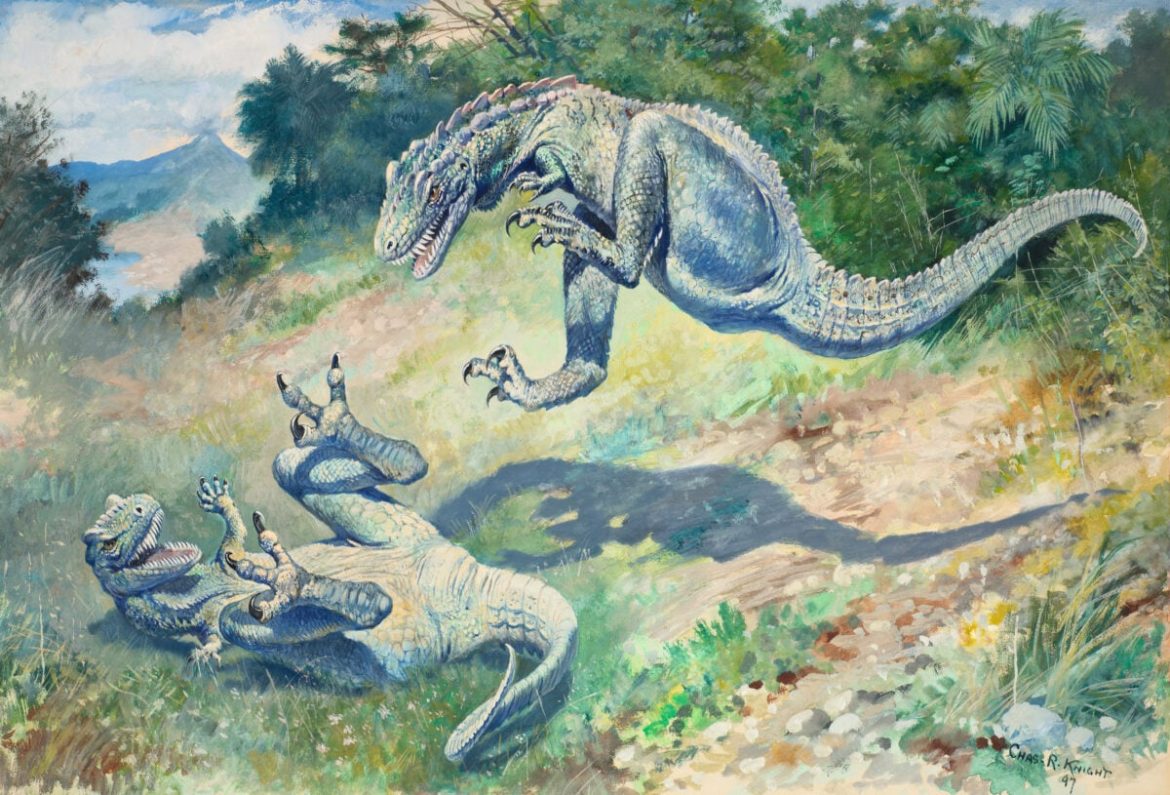
Working in Montana in 1964, American paleontologist John Ostrom unearthed a smallish, bird-like theropod with unusually hollow bones, sickle-shaped claws on its hind feet, and a sleek, horizontal posture. Ostrom’s 1969 description of this creature, Deinonychus (“terrible claw”), suggested an active, fleet-footed predator whose energetics demanded warm-bloodedness like modern birds and mammals. This renewed the idea of birds descending from dinosaurs, floated around 1868 by Darwin-defender T.H. Huxley based on the skeletal similarities of bird-like dinosaurs and dino-like birds from the same Bavarian limestone. Ostrom had his own defender in his outspoken student Robert Bakker, a real-life preacher who proselytized these new views in magazine articles and a 1986 book, The Dinosaur Heresies. Bakker helped sway public perception of dinosaurs from animated versions of plastic gift-shop models to warm-blooded, big-brained evolutionary success stories.
Bakker was joined in his crusade by another American paleontologist, Jack Horner, the first to uncover dinosaur eggs and nests in North America. From 1978 to 1983, in a small area of Montana, Horner and associates found 14 nests, 42 eggs and 31 babies — complete with a picture of what the ancient environment was like, and that it was used for generations. This formulated a previously unheralded vision of dinosaurs caring for their young in penguin-like colonies. They named the species Maiasaura — “good mother lizard.” This “snapshot of a fleeting moment” 80 million years ago bolstered an important hypothesis: metre-long baby dinosaurs would be unlikely to wander beyond the nest lest they be crushed by 10-metre adults; and if they stayed at home, they’d have to be fed and grow fast — like warm-blooded birds and quite unlike cold-blooded reptiles.
Unsurprisingly, this new paradigm ignited lively debate with those who clung to traditional dinosaur orthodoxy. Logic would soon settle some of the arguments, and technology would take care of the rest. In 1969, Bakker drew Deinonychus as a streamlined, horizontal sprinter. When British counterpart Peter Galton followed suit for the hadrosaur Anatosaurus, the “truth of their insight was grasped immediately,” writes paleontologist Michael J. Benton in Dinosaurs Rediscovered, “and the kangaroo-dinosaurs were never to be seen again.”
Almost overnight, the largely intuitive dinosaur stances that had undermined both science and art were traded for correctly balanced bodies that could not only sway and bob as the animals walked but also strike efficient running postures. The timing was fortuitous, coinciding with the rise of scanning electron microscopy (with 100 times the resolution of regular microscopy), CT scanning (short for computed tomography, a 3D X-ray that allowed researchers to see inside fossils) and powerful computers that could test evidence from footprints, skeletons, biomechanics and modern analogs for likely poses and gaits. One finding in particular explained earlier misunderstandings: some dinosaurs moved in ways no modern animal can.
