
On February 25, 2026, on American soil, something small happened — and yet, not small at all. A Kanaani pair, Haifa and Arbuz, gave birth to two female kittens, Chaya and Neshama. At first glance, this is simply good news — the birth of kittens, life continuing. But in the language of Torah, names are never only names.
The names Chaya and Neshama carry meanings that reach far beyond translation. Chaya means “life,” while Neshama means “soul,” and together they point toward something deeper than biology. In the Torah, living beings are described as nefesh chaya — “living souls,” a term that applies not only to humans, but to animals as well. Life, in this sense, is not merely physical existence, but something that carries an inner essence. There is also the memory of a covenant: after the flood, the covenant was not made with humanity alone, but with the entire living world — with animals as well — suggesting that the relationship between humans and animals is not accidental, but part of a greater design. And so these names are not random; they reflect something that perhaps we already know, but often forget — that life and soul are not separate from the world of animals, but present within it.
This is where the story begins.
In Brooklyn, New York, there now lives one of the rarest cat lineages in the world, a lineage that nearly disappeared and whose survival cannot be explained by commercial breeding or institutional programs, but rather by a fragile continuity that carried it forward until this moment, when it is beginning, quietly but unmistakably, to return. I did not encounter this lineage as an observer, but as someone who lives with it.
The Kanaani cannot be understood simply as another cat breed, because what it represents is a rare convergence of origins that are usually separated by time. While all domestic cats ultimately trace their ancestry to the Felis lybica, in most modern breeds that connection has long since faded, whereas in the Kanaani it remains visible — in the body, in the movement, and in the behavior — as a living echo of that origin. In a symbolic and literary sense, this ancient lineage may be seen as the “Adam and Eve” — or, in Hebrew, Adam veChava (Adam and Eve) — of all domestic cats, the beginning from which all others descend.
This is a cat whose body is long, lean, and muscular, without the heaviness that characterizes many domestic breeds, and whose movement is precise and efficient, supported by powerful hind legs that allow it to move through space with remarkable speed, often crossing an entire room in only a few movements. Its behavior reflects the same continuity: a need for space, curiosity toward the environment, an ease with movement outdoors, and even a lack of fear toward water — not traits imposed by training, but expressions of something older. Kanaani cats are also notably vocal, producing sounds that feel directed and responsive, often giving the impression not simply of sound, but of interaction.
Watch the Kanaani in motion:
These cats live with me in Brooklyn, and through direct observation it becomes clear that what defines the Kanaani is not a single feature, but a convergence — structure, movement, behavior, and presence — forming a coherent and recognizable type.
The near disappearance of the Kanaani was not the result of biology, but of human dynamics within the breeding world. As explained by Angelika Koltsova, a long-time judge of the World Cat Federation, the fate of a breed often depends not on its inherent quality, but on its popularity among breeders; when a breed loses the attention of those who work with it, it gradually disappears. This is what happened. The early development of this lineage is associated with Dorit (Doris) Polachek, whose work in Jerusalem helped bring initial form and visibility to what would later be recognized as the Kanaani. For a time, a small number of breeders showed interest, but that interest did not grow into a stable community. When that center of effort was no longer present, the momentum faded, and the lineage receded from view.
And yet, its beginning was not scientific. It was human.
In Jerusalem, a woman who had survived the Holocaust and devoted herself to caring for street cats encountered an injured African wildcat. There was something in his presence, something in his eyes, that she could not ignore. She took him in, treated him, and allowed him to recover. A quiet rapport developed between them, and from that rapport emerged a genuine human–animal bond. He did not return to the wild; he stayed, and in time, kittens were born.
What we now call the Kanaani began not as a project, but as an act of care — not control, but responsibility; not design, but response. And it is no coincidence that this took place in Jerusalem.
For many years, however, the lineage remained largely undocumented, not because it lacked significance, but because it depended on individuals rather than systems. Even today, Kanaani-type cats exist, including in Israel, where dedicated individuals continue to work with them. Among those contributing to the present understanding and preservation of the Kanaani is Ludmila Vlasova, whose work reflects a deep familiarity with the type and its characteristics. Yet much of this work remains undocumented, and without systematic records, it is often difficult to trace exact lineages or fully understand their composition. The lineage exists — but its structure is still forming.
And yet, this is not a story of decline. It is a story of return.
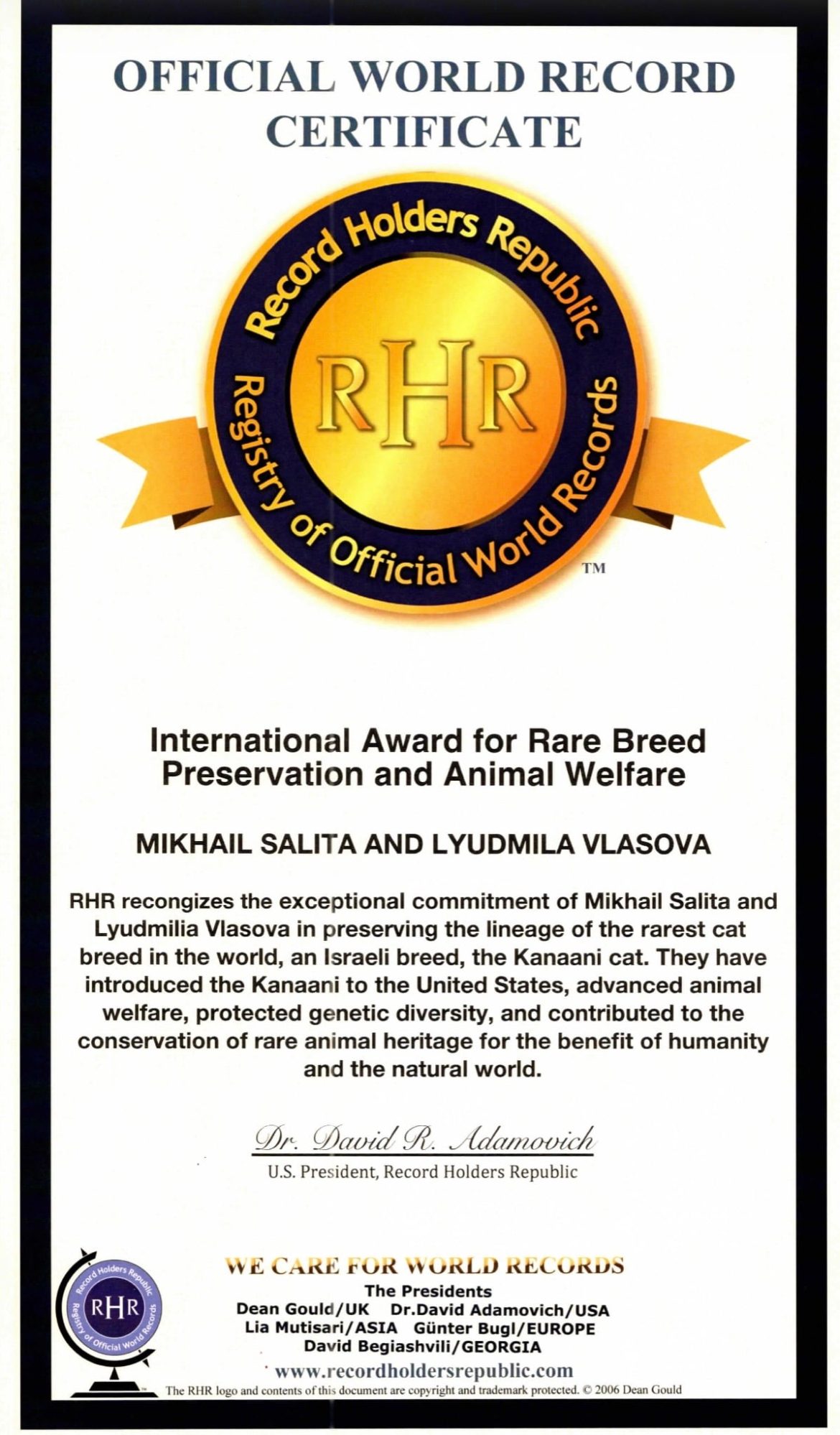
A new phase has begun. Today, the Kanaani is supported by a small but growing circle of individuals working across Israel, Ukraine, the United States, and the United Kingdom. This effort is not centralized and is not about ownership, but about preservation, documentation, and opening the path for others. Among the organizations contributing to this process are The International Cat Association, the World Cat Federation, the Feline Alliance of Ukraine (FAU), Pedigree Club UK, the Association of Rare Breeds of Cats (ARBC), and other dedicated contributors. The role of The International Cat Association in particular deserves recognition, as its willingness to register the Kanaani, even at an experimental stage, has opened the door for formal documentation and future development. This work has already received international recognition, including acknowledgment from ARBC for contributions to the preservation of rare experimental breeds, and documentation within international record frameworks, where the Kanaani has been recognized as among the rarest documented cat lineages in the world. In addition, support and encouragement from Sarah Bowen and the Compassion Consortium have contributed to a broader understanding of the ethical and spiritual dimensions of human–animal relationships within this work.
Within formal systems, the Kanaani remains experimental, but this is not a limitation — it is a beginning.
I am writing this during the period of Passover, a time that reminds us that meaningful change rarely comes all at once, and that recognition often follows persistence. In the Book of Genesis, humanity is placed in the Garden “to work it and to keep it,” a formulation that establishes responsibility as a condition of existence. The Kanaani can be understood within that same idea.
It is not only a rare lineage. It is a living connection — biological, historical, and cultural — to a place and to a story that extends far beyond breeding. And now, it has reached the United States. It is here, it is visible, and it is at a turning point.
This is not only a story of preservation. It is an opportunity — an opportunity to recognize something of value before it is lost again, to support a lineage that carries both scientific and cultural meaning, and to take part in something larger than ourselves.
Because in the end, preservation does not begin with institutions. It begins with people who recognize what stands before them — and choose to care.
Rabbi Moshe (Mikhail) Salita is a Brooklyn-based rabbi, legal scholar, and emerging animal chaplain whose work unites Jewish spirituality, international law, and compassion for all living beings.
He holds a Master’s in International Law (with honors) from the National University “Odesa Law Academy,” where he is currently a PhD student researching the restitution of unlawfully confiscated Jewish communal property in Soviet Ukraine. He also earned a Master’s in Library and Information Science from Pratt Institute (New York) and a Master’s in Education and Special Education from Touro University, with graduate certificates in Applied Behavior Analysis (ABA) and Bilingual Education.
Rabbi Salita is an ordained rabbi of the Jewish Spiritual Leaders Institute (JSLI), a Doctor of Ministry student in Jewish Spirituality at the Graduate Theological Foundation, and an Animal Chaplain-in-Training with the Compassion Consortium in New York. His mission is to weave together justice, mercy, and creation care into one sacred path of Tikkun Olam — healing the moral and spiritual wounds of the world.
He serves as Executive Director of the Salita Foundation, originally founded by his brother, Dmitriy Salita — former WBF World Champion boxer, and inductee of both the New York Boxing Hall of Fame and the Jewish Sports Hall of Fame. Today, Rabbi Salita leads the Foundation toward a broader vision — uniting humanitarian ethics, environmental awareness, and cultural restitution.
Through the Foundation, he has launched the “Eco-Kosher Initiative,” a global program encouraging support for businesses and individuals who respect the environment, animals, and their communities. For him, “eco-kosher” is not limited to food — it is a moral philosophy of living in balance with creation, where sustainability and holiness walk hand in hand.
He is also devoted to preserving and gaining international recognition for the rare Israeli cat breed Kanaani — a living symbol of harmony between Jewish heritage and the natural world.
A descendant of Sruel ben Aharon Lekhtman, a Ruzhiner Hasid and brick-factory owner in Kitai-Gorod, Kamianets-Podilskyi — once a spiritual heart of the Ruzhin Hasidic movement in Tsarist-era Ukraine — Rabbi Salita continues his ancestor’s legacy of faith, integrity, and bridge-building. Sruel Lekhtman served as a close friend and estate manager for Pan Dembitsky, a Polish landowner remembered with respect in both Jewish and Ukrainian memory. Their friendship, crossing lines of faith and culture, remains a profound symbol of coexistence — especially meaningful for Ukraine today.
Although Rabbi Salita received Reform rabbinic education in the spirit of Jewish Universalism, he maintains a deep spiritual connection with Chabad, whose living Hasidic tradition unites intellect, compassion, and joy.
Following the example of the prophets — from Adam, the first caretaker of creation, to King Solomon, who understood the language of animals, and to Rav Papa, the sage who spoke kindly of cats — Rabbi Salita teaches that true holiness is revealed through compassion for all living beings. His life’s work is to show that caring for animals and serving God are one and the same sacred breath.
