
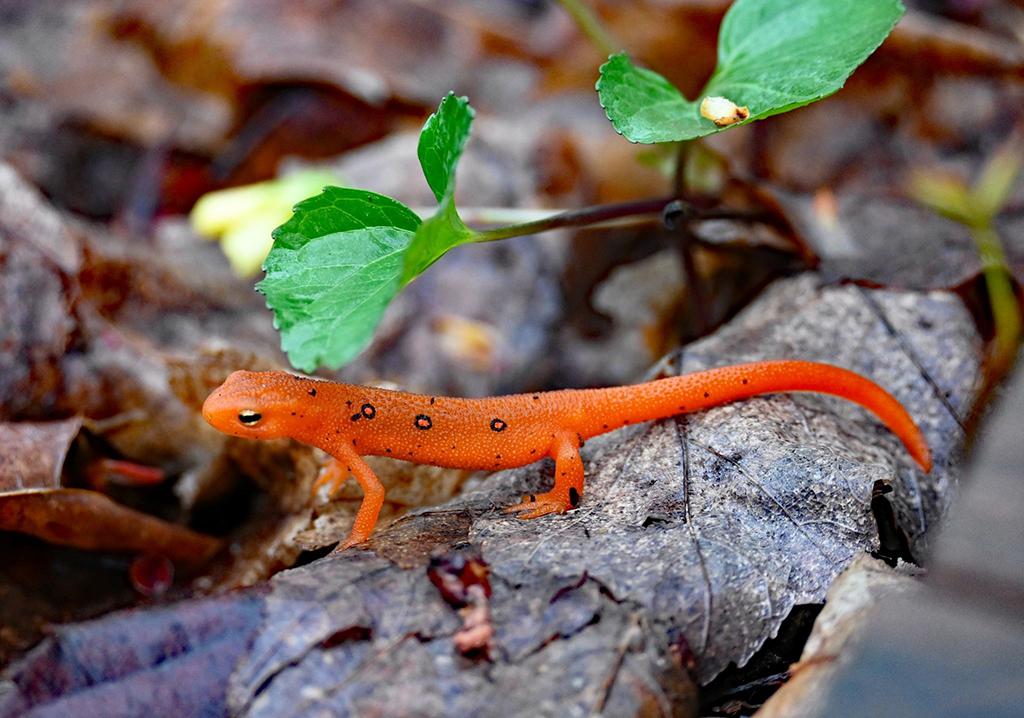
Have you ever gone for a walk in the woods following a rain event? Drops of water dangle from the leaf tips, and the smell of rich humus fills the air. Suddenly, something bright on the forest floor catches your eye.
Upon closer examination, you find a small salamander, bright orange in color with red spots along its back, each of which is outlined in black. The small amphibian has golden eyes, a thin tail and rough skin that appears virtually dry.
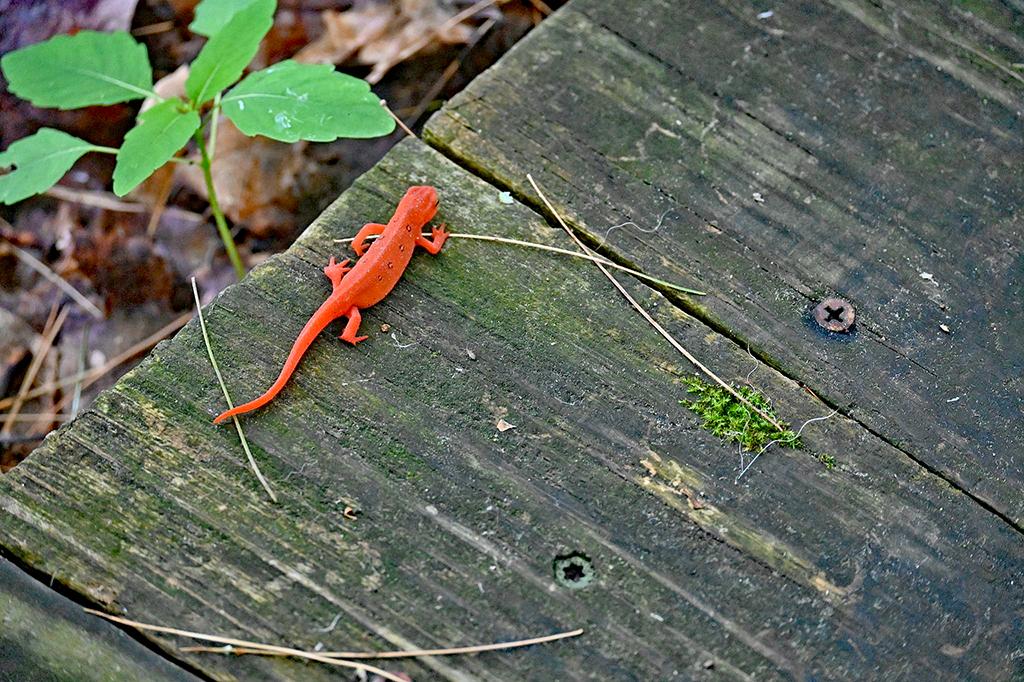
You place your hand down in front of the little traveler and without hesitation, it crawls onto and across, continuing its journey. You marvel at its bold movement over open ground, fully exposed to potential predators.
Congratulations! You have just met the endearing red eft, the juvenile stage of the Eastern or red-spotted newt (Notophthalmus viridescens).
Double lives
Salamanders are amphibians, as are frogs and toads. The word itself can be broken down into two parts “amphi,” meaning double and “bio” meaning life. All amphibians live this double life and require a moist environment throughout their lifetime.
Think of frogs. The females lay their gelatinous egg masses in permanent bodies of water, such as ponds. The eggs hatch into tiny tadpoles, which feed and grow, some species for up to several years. Eventually, tiny legs appear and the tadpoles transition to land where they live out the second (and final) stage of their lives.
Cycle in reverse
Most frogs, toads and salamanders begin their lives in water and finish up on land, but the newt is different. Unlike other amphibians, its life cycle is somewhat backwards, making it quite unique.
Eastern newts begin their life in a pond as eggs deposited singly or in groups on aquatic vegetation. The tiny, gilled larvae hatch out and gain a foothold on life beneath the surface. These tiny predators feed on invertebrates for 2 to 5 months before their first transformation begins. As gills are absorbed and lungs develop, the larvae emerge from the water to begin their juvenile stage as terrestrial red efts.
Probably the most striking thing about this little salamander is its coloration. The creature virtually glows bright orange, denying it the ability to blend into its surroundings. This brilliant hue is a warning signal.
Toxic
Much like the monarch butterfly, the red eft is extremely poisonous, its skin containing tetrodotoxin, a neurotoxin capable of making any predator that attempts to consume it very sick. Predators learn to recognize this vivid coloration and avoid it at all costs, allowing the eft to wander safely at will.
Picking up a red eft for examination is not harmful, as its toxins cannot be absorbed through your skin. But be sure not to rub your eyes or nose after handling before first giving your hands a good scrubbing. Also, make sure that your pets don’t consume any red efts, or you will be making an emergency trip to the veterinarian!
The red eft spends up to seven years wandering the moist forest floor, feeding on worms, slugs, spiders and any other small invertebrates it may encounter and hibernating beneath logs and rocks. During this juvenile stage, it may grow up to 3.5 inches in length.
Final stage
Eventually, it enters the final stage of its metamorphosis, beginning its transformation into a full, sexually mature adult, known as an Eastern or red-spotted newt.
Back into the nearest pond it goes, though not necessarily its natal body of water. The eft begins to change form and color. Its rough skin becomes smooth and slimy, its thin, rounded tail becoming wide and bladelike for swimming. Furthermore, its back becomes a dark olive-green color, contrasting with a bright yellow underside sprinkled with black dots.
In this final stage, it is now seven times less toxic than it was on land, relying upon its new color scheme to assist in its camouflage from predators. This combination of a dark back and light stomach is known as countershading and helps to conceal the animal while it floats within the water column.
When looking down upon it, the newt’s dark back blends into the dark pond muck below, while predators below looking upward might not notice the amphibian’s light stomach blending with a bright sky above.
Once its transformation is complete, the aquatic newt, retaining its well-developed lungs, measures between 4 to 5 inches in length. In fact, in appearance, there is not a vestige left of its prior self, save the red spots outlined in black along its back and the golden eyes.
Breeding
Newts breed in late winter or early spring. Like other salamanders, males do a dance to attract females to a small sperm packet placed carefully on the bottom of the pond. Males will also “hug” their mate by tightly wrapping their hind legs with big black pads around her neck. Females straddle the packets, pulling them inside where their eggs are then fertilized internally. Over the course of the spring, a female newt will deposit almost 400 eggs in small groups or singly, attached to underwater vegetation, as the life cycle of this salamander starts over again. The adult stage of the red-spotted newt can last up to 8 years, bringing their lifespan (terrestrial aquatic) to a whopping 15 years!
The amazing eft. I spent my childhood excitedly exploring ponds with a net in one hand and a jar in the other. Over the years, I netted hundreds of red-spotted newts. I was always careful to wet my hands before handling them so as not to dry out their skin and was mindful to gently release them where initially captured, after close scrutiny.
On walks in the woods, I often encountered adorable tiny red efts parading across the forest floor. I was amazed at their tameness and beautiful coloration.
If I had to choose, I’m not sure which life stage of this salamander I would pick as my favorite, but one thing I know for sure is that they are one of the most unique amphibians around, and they have a bass-ackward life cycle to prove it!
