
On the forest road that winds through mature stands of hemlock and yellow birch on state game lands 206 in Luzerne County, my son Tommy and I walked back to the truck, after a fishless evening mind you. The early April twilight chilled the air. We had come to try our hand on Huntington Creek, a catch-and-release class A wild trout fishery that, according to the PA Fish and Boat Commission, holds a population of brown trout.
I walked with my head down, frustrated. I had lost too much leader and too many flies. If there had been just one take, then I could’ve chalked it up as billable expense. But this evening I took a straight loss. I pouted to myself. I pouted out loud to my son. A roll reversal in this way: I’m 41, and he’s 10.
Luckily, he wasn’t pouting. He was observing.
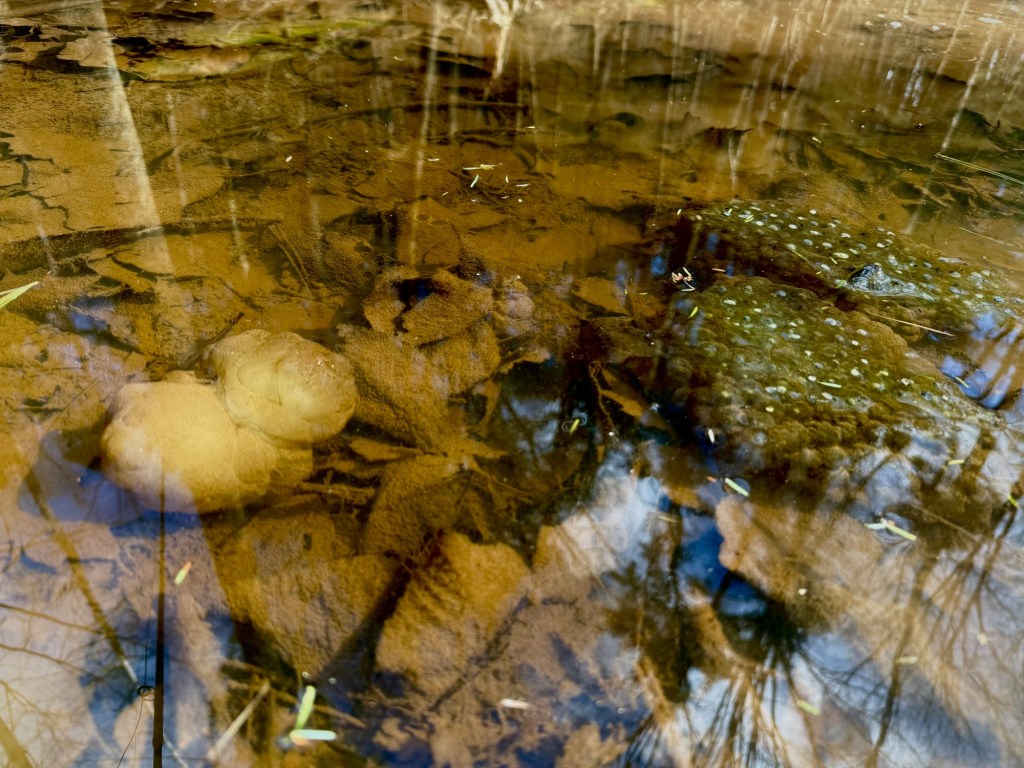
Maybe around the 15th time I said “I can’t believe we didn’t land one,” he noticed the gelatinous, alien globs floating in the crystal-clear pool that had formed on the left side of the track we walked along. The crisp surface tension on the water reflected the surrounding forest looming overhead. Then our dark figures appeared on the pool. Suddenly, by the grace of youthful curiosity, Tommy had discovered something new yet fleeting, as spring never fails to reveal.
Those blobs in the clear shallow water were not alien but quite native. They were the egg masses of the spotted salamander (Ambystoma maculatum) and perhaps those of a wood frog (Lithobates sylvaticus) or the northern leopard frog (Lithobates pipiens). The shallow pool of water was more than just a happenstance puddle from the recent rains. It was a vernal pool, a keystone feature of the landscape in the woods here on SGL 206. A puddle, so to speak, of ecosystem services.
According to the PA Vernal Pool Guide from the Western Pennsylvania Conservancy, vernal pools are critical breeding grounds for many different species of amphibians, insects and crustaceans. Each year come summer, vernal pools dry up, which prevents predatory fish to populate these perennial wet sites. This ephemeral quality is exactly what makes a vernal pool vernal.
The presence of fish and other predators like bullfrogs in permanent wetland ecosystems (like ponds and streams) is one of the main reasons why vernal pool species have adapted to utilize vernal pools to rear their young.
Vernal pools (the Pennsylvania Amphibian and Reptile Survey also calls them seasonal forest pools) reach their maximum size in early spring as winter snows melt and rains become frequent. They can acquire water from surface runoff (melting snow and rain), by flooding from nearby streams, ponds or lakes, or from a rising water table. The seasonal character of a vernal pool can fluctuate each year depending on rainfall, winter snows, water table levels and stream flows. They dry up in the summer and begin filling again in fall and winter.
Speaking of ephemeral, it is not surprising that nearby you are likely to find many of the spring ephemeral flowers in these landscapes such as spring beauties, trout lilies, squirrel corn, trillium and bloodroot.
The guide lists several main indicator species for positively identifying a vernal pool. These include spotted salamanders, marbled salamanders, Jefferson salamanders, wood frogs, eastern spadefoots, springtime fairy shrimps, green frogs, spring peepers, red-spotted newts, swamp darner, meadowhawk, and the four-toed salamander.
Common vernal pool plants listed include cinnamon fern, manna and meadow grasses, marsh fern, northeastern bullrush, rice cut-grass, royal fern, sedges, three-way sedge, wool-grass, buttonbush, highbush blueberry, winterberry, pin oak, red maple, blackgum and swamp white oak.
In the summer when pools dry up, they leave behind characteristic clues like matted gray leaf litter in their depressions, dark soils and buttressed root flares on trees nearby with watermarks on the trunk indicating where water levels sat earlier in the season. Sphagnum mosses can persist on saturated acidic soils.
According to the guide, vernal pools can form in rolling glaciated terrain with poor drainage, on ridgetops and plateaus, at the toeslopes of mountains, in poorly drained lowlands, and in flooded back channels and abandoned oxbows of rivers and streams.
The possibilities seem to live in every pocket of topography.
We found our vernal pool at the bottom of a high, south-facing slope dashed and dotted with gray bluffs. Fishless, in hindsight, was an ironic theme when we stumbled upon that clear pool and those amphibious egg sacks.
As I reflect on our adventure that evening, I think of the words Brian Doyle wrote, “I’m a muddle and a conundrum shuffling slowly along the road, gaping in wonder, trying to just see and say what is, trying to leave shreds and shards of ego along the road like wisps of litter and chaff.”
What strikes me also quite vividly is the brilliance of the reflection on the surface of the vernal pool. The towering hemlocks, birches and old sugar maples, my son and I on hand and knees in wonder, the leaves matted and magnified on the bottom of the clear pool promising life to come; if ever there was a perfect metaphor for a mandala it is the vernal pool of this Pennsylvania spring I’m trying to capture here.
Because vernal pools and mandalas I think are like many nuanced moments in life. They are unexpected, subtle, holy in their own small way, something to worship and be grateful for. Here, and then they are gone.
T.C. Mazar is a freelance outdoors writer and can be reached at wildlife@scrantontimes.com.
