
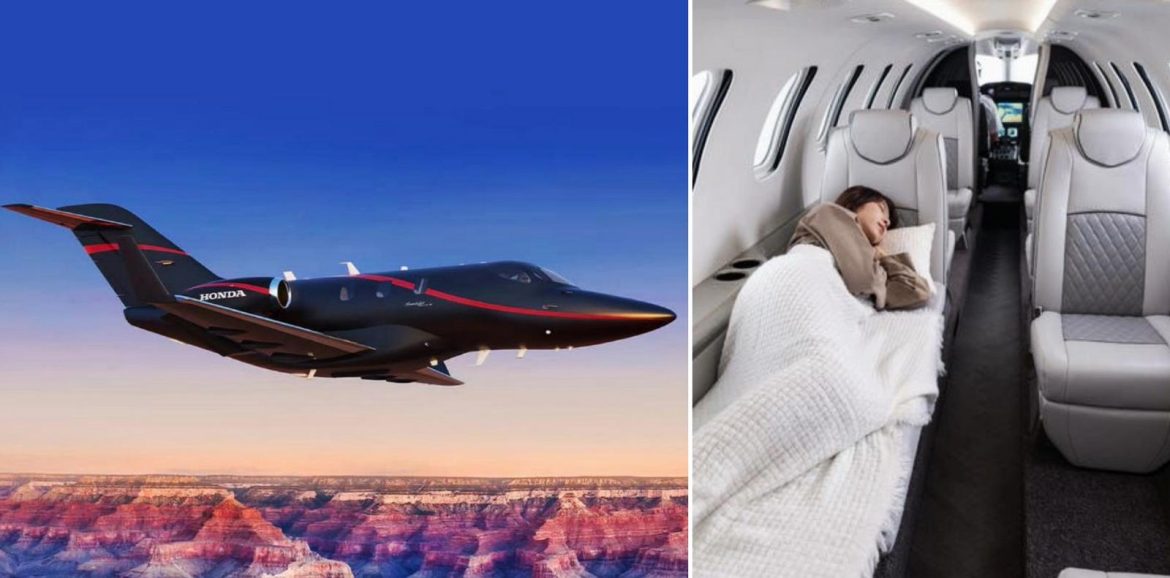
For most of its history, private aviation has relied on a simple assumption that the person in the left seat will always be able to finish the flight. Training systems, certification standards, and cockpit design were built around that belief. Medical emergencies were treated as unlikely interruptions rather than core engineering problems. That thinking changed when Honda Aircraft Company announced that the HondaJet Elite II had received certification for Garmin’s Emergency Autoland system, becoming the first production twin-engine very light jet capable of landing itself if the pilot becomes incapacitated.
This is not a cosmetic layer of automation. Garmin’s Emergency Autoland is a fully integrated safety system embedded into the aircraft’s avionics, navigation, and flight controls. It continuously monitors pilot responsiveness and can be activated manually or automatically. Once engaged, it declares an emergency, communicates with air traffic control, analyzes weather, terrain, fuel status, and runway availability, selects the most suitable airport, flies the approach, manages speed and configuration, touches down, applies braking, and brings the aircraft to a complete stop.

In practical terms, the system replaces the pilot during the most critical phase of flight. It does so without relying on passengers or outside guidance. Every decision is driven by pre-validated logic rather than improvisation. This makes it a complete emergency flight management solution rather than a simple assist feature.
Honda’s path to this milestone was deliberate. The Elite II gained certified Garmin auto throttle in 2024, automating engine power management across the flight envelope. That capability was essential for stable autonomous operation. Certification flight testing for Emergency Autoland concluded in 2025, followed by regulatory approval in early 2026. Years of validation, redundancy analysis, and failure modeling underpin the system’s reliability.

The importance of this development becomes clear in real-world operations. Most HondaJets are flown by owner-pilots operating alone, often with family members or colleagues as passengers. In that environment, pilot incapacitation represents the single greatest uncontrollable risk. Emergency Autoland directly addresses that vulnerability by converting a medical emergency into a managed technical event. For insurers, financiers, and cautious buyers, this reshapes how risk is evaluated.

Strategically, the certification also repositions Honda in the light jet market. The company is no longer competing only on performance and efficiency. It is competing on resilience and system intelligence. The Elite II is being presented as an aircraft designed around human limitations rather than human perfection, a philosophy that is likely to extend to future models such as the Echelon.

In the broader context of private aviation, this marks a quiet transition. Fully autonomous flight remains distant, but practical autonomy has crossed a meaningful threshold. A personal jet can now save its occupants when its pilot cannot. That capability is no longer a promise. It is a certified reality, built on Garmin’s technology and Honda’s conservative engineering discipline.
