
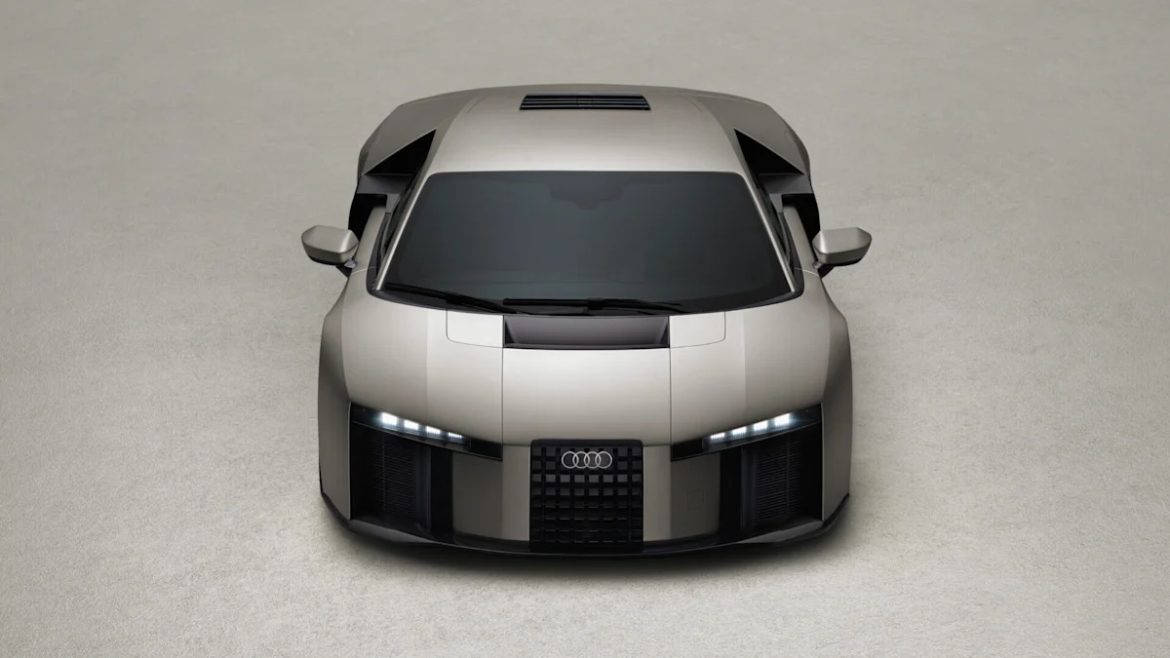
Audi has been telling anyone willing to listen that the R8 is gone and there’s no spiritual successor coming. The Nuvolari makes this statement a little confusing.
Audi has officially entered the elite supercar arena with the debut of the Nuvolari, its first production supercar powered by a high-performance hybrid drivetrain, with production strictly limited to 499 units and global deliveries scheduled for the first half of 2027.
With 1,001 PS and a top speed of more than 350 km/h (217 mph), the Nuvolari is set to become both the most powerful and the fastest production vehicle in the history of the four rings.
Advertisement
Advertisement
That’s a title previously sitting with the RS e-tron GT Performance – not exactly a car that set pulses racing at the Nürburgring.
Titanium, static studio shot, exterior, frontal view top-down perspective
The Powertrain Is Essentially a Lamborghini Temerario’s, Turned Up
At the heart of the Nuvolari is a plug-in hybrid powertrain built around a mid-mounted twin-turbo 4.0-liter V8, a 7.3 kWh lithium-ion battery pack, and three axial flux electric motors – two on the front axle, with the third sandwiched between the engine and transmission.
The combustion engine’s output of 789 hp and 538 lb-ft of torque matches that of the Temerario’s V8, and the basic elements are brought across from Lamborghini’s Temerario, but the Audi has upgrades to take advantage of new tech and is retuned in both powertrain and chassis to give it more of an Audi flavour.
A larger battery, slightly lower weight, and more sophisticated energy management and stability control systems deliver more power, performance, and driveability than the Temerario.
Advertisement
Advertisement
The Nuvolari accelerates from 0 to 100 km/h in 2.6 seconds and reaches 200 km/h in just 6.8 seconds – figures that require a specific set of conditions, including a battery temperature above 28°C and a state of charge above 80%. In other words, warm it up first, just like any other electric powertrain element.
Those performance numbers are enabled by a suite of Formula 1-inspired technologies, including the hybrid powertrain itself, quattro predictive ride, active aerodynamics, and a new Audi Space Frame with carbon exterior.
Titanium, static studio shot, exterior, rear three-quarter view
The quattro predictive ride system processes steering angle, yaw rate, acceleration, and current grip levels in real time, adjusting torque distribution, braking, and aero balance proactively rather than reactively.
Drivers get four primary modes via a steering wheel rotary: E-Hybrid for electric-only urban use, Balanced for everyday driving, Dynamic for sharper responses, and Dynamic+ for full performance. Plus a Track mode with wet, dry, race, and TC-off settings.
Advertisement
Advertisement
The braking setup is equally serious. A new Audi Ceramic Pro braking system designed specifically for track use features massive 420 mm front discs grabbed by ten-piston calipers, with 410 mm four-piston units at the rear. The system also incorporates energy recuperation and a specially designed internal cooling architecture that improves heat dissipation by up to 21 percent.
On the design side, the Nuvolari is the first production car to reflect the “radical simplicity” design philosophy being pioneered by Audi chief creative officer Massimo Frascella. The bodywork features edgy carbon fiber panels, a modern interpretation of the R8’s iconic side blades, and forged center-locking wheels – a first on any production Audi.
The name itself carries meaning. Tazio Nuvolari was the Italian racing driver who found success in the 1930s with Auto Union, one of the German marques that would later combine to form modern Audi.
Pricing is expected to come in just under $600,000. Pretty steep, though for the fastest and most powerful road car Audi has ever built, limited to under 500 examples, that figure was never going to be a surprise.
Advertisement
Advertisement
“With the Audi Nuvolari, we are accelerating technological progress,” says Gernot Döllner, Chairman of the Board of Management of AUDI AG. “It shows what is possible when the focus is on technology, performance, and execution through teamwork — and when we achieve progress together.”
Audi said for years there’d be no R8 follow-up, and technically they’re right. The Nuvolari isn’t an R8. It’s faster, more powerful, more limited, and considerably more expensive. Whether that’s better or worse depends entirely on what you were hoping Audi would do next.
Related Articles
