
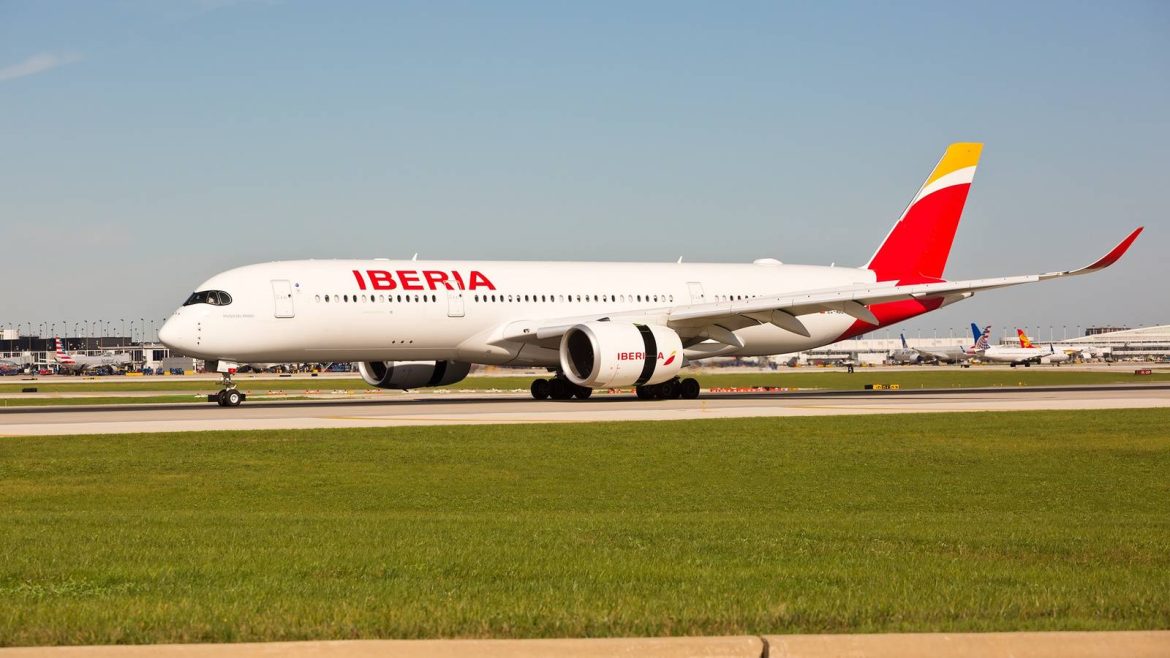
The damaged Airbus A350-900 operated by  Iberia returned to commercial service on Thursday after suffering a rare ground incident at José Joaquín de Olmedo International Airport (GYE) in Guayaquil, Ecuador, earlier this month. The aircraft was damaged on June 4 during a traditional water-cannon salute when its left winglet came into contact with airport firefighting equipment while taxiing. The incident forced the cancellation of IB0262 to Madrid and the immediate grounding of the aircraft for inspection and repair.
The A350-941 involved is part of Iberia’s long-haul fleet powered by Rolls-Royce Trent XWB engines, a type designed for high fuel efficiency on ultra-long-haul routes. EC-NXD was delivered to Iberia in 2022 and is named “Pau Gasol” after the Spanish basketball player, following the airline’s practice of naming A350s after Spanish personalities.
Iberia Airbus A350 Ground Incident In Guayaquil

The damage occurred during a ceremonial water-cannon salute, a standard aviation tradition used to mark special arrivals or departures. In this case, the aircraft’s left winglet made physical contact with airport firefighting equipment.
Following the contact, crews immediately halted departure. Iberia confirmed the cancellation of the Madrid-bound service, and passengers were rebooked onto alternative flights or rerouted through partner carriers.
Whilst rare, water-cannon salutes add another layer of complexity to standard operations. There is a risk when things don’t quite go according to plan, such as when coordination between airport firefighting units and aircraft movement is imprecise. In this case, the aircraft was taxiing at low speed, which likely prevented further escalation of the damage beyond the winglet surface.
Simple Flying contacted Iberia for a statement on Thursday, but the airline could not be immediately reached.
Rapid Replacement Of Composite Winglet Structure

The Airbus A350 is built around the extensive use of carbon-fiber-reinforced polymer (CFRP) in its primary and secondary structures, including the wing and its distinctive raked wingtip design. This wingtip geometry is engineered to improve aerodynamic efficiency by reducing induced drag from the wingtip vortex, thereby reducing fuel burn and improving long-haul performance. Unlike older metallic wing designs, the A350’s composite architecture allows for highly integrated yet replaceable outer wing components.
The wingtip assembly is designed as an individual structural element within the broader wing system, enabling it to be detached and replaced without invasive work on the main wing box. This modular structural philosophy reflects Airbus’ broader approach to composite airframe maintenance, where external aerodynamic surfaces are treated as replaceable units while the primary load-bearing wing structure remains intact and undisturbed.
Catch what other flight trackers miss
Emergency squawks, holds, NOTAMs — live signals, no signup.
Open tracker
Catch what other flight trackers miss
Emergency squawks, holds, NOTAMs — live signals, no signup.
Open tracker
From a structural engineering perspective, this separation between the primary wing box and outer aerodynamic appendages simplifies maintenance pathways for localized damage scenarios. The design ensures that replacement components can be integrated while preserving load paths, aeroelastic characteristics, and certified aerodynamic profiles defined by Airbus for the A350 wing platform.
Ouch: Botched Water Cannon Salute Costs Iberia An Airbus A350 Winglet & A Canceled Flight
An Iberia Airbus A350 suffered winglet damage during a botched water cannon salute in Ecuador, forcing a Madrid-bound flight cancellation.
Return To Service & Operational Impact On Iberia Fleet

EC-NXD has since re-entered Iberia’s long-haul rotation, as confirmed by live flight-tracking data showing the aircraft operating scheduled services. Iberia operates a growing fleet of Airbus A350-900s, which form the backbone of its intercontinental network from  Madrid Barajas Airport (MAD), particularly on high-demand routes to Latin America and North America.
The rapid return of the aircraft minimized disruption to Iberia’s operational schedule, avoiding the need for long-term substitution with other widebody aircraft such as the A330-200/300 fleet. Given that A350 utilization is typically high, any prolonged grounding can create cascading schedule adjustments across long-haul rotations.
The incident also underscores the importance of ground handling safety protocols at international airports, particularly during ceremonial operations. While water-cannon salutes are symbolic gestures of respect, aviation authorities generally require strict coordination among airport fire services, air traffic control, and ramp personnel to ensure safe clearance distances for all aircraft surfaces, including high-mounted wing structures such as those on the A350.
