
Increased fuel prices have made the conditions for EV adoption more favourable, including by encouraging fleets towards more predictable EV charging costs, according to the AA.
The motoring organisation’s EV Readiness Index tracks eight factors influencing drivers’ readiness to switch to EVs on a quarterly basis, combining the results into a Readiness Rating from one to 100.
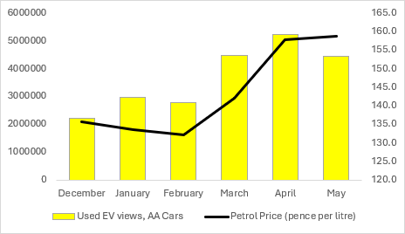
The latest report, for the second quarter of this year, sees the rating increase by five points to 58.8, driven mainly by a widening cost gap between petrol and home EV charging costs, with average petrol prices reaching a high nearly 20% above that in Q1. According to the AA, this made EVs charged at home 67% cheaper per mile than petrol equivalents, up from 57% in Q1.
Ensure you always get Fleet News insight. Make us a preferred source of news on Google.
Although the AA acknowledges that this situation could change if global energy disruption subsides, it argues that the experience of fuel price volatility is likely to influence longer-term car buying habits, with buyers seeking more predictable running costs.
AA Business Services, commenting on the research, said that this was a significant factor for fleets, with high-mileage operators, significantly exposed to changing fuel prices, especially likely to prioritise long-term budget predictability.
James Starling, director at AA Business Services, said: “When petrol and diesel prices rise sharply, businesses feel the impact immediately. EVs can help reduce volatility exposure, particularly where organisations can control their charging strategy.
“We’re increasingly seeing fleet managers view EVs not just as a sustainability initiative, but as a practical running cost-control and risk-management tool, and when it comes to SMR costs too.
“For many businesses, electrification is as much about operational resilience and predictable running costs as it is about sustainability.”
Edmund King, president at the AA, said: “Range anxiety has shifted to pump anxiety as global petrol and diesel prices have rocketed since the Iran conflict began.
“For years, some drivers have been put off EVs by real or perceived range anxiety. But this latest Index suggests the bigger concern for many households is becoming pump anxiety. When global fuel prices rise sharply, drivers feel it immediately at the forecourt.
“EV drivers, particularly those with access to home charging, have been better insulated from that volatility. That is now showing up in the used car market, where searches for electric vehicles on AA Cars have risen by more than 75% in the last three months.
“Not every driver is yet ready to switch tomorrow. Upfront costs, public charging prices, and policy uncertainty still matter. But the economics of EV ownership are becoming harder to ignore particularly for those who can charge at home.”
Vehicle price and public charging cost concerns remain
Despite the improved value of EV charging versus petrol, the Index reveals that some barriers to mass EV adoption remain, with new EVs remaining expensive to buy compared with some petrol equivalents, while used EVs went from being 10% cheaper than petrol equivalents in Q1 to 3% more expensive in Q2, attributed to increased competition and rising demand in the used market.
The Index also reveals that filling with petrol is still cheaper than running an EV from ultra-rapid public chargers, although this price gap has narrowed from 35% in Q1 to 15% in Q2.
The AA also reports improved EV reliability and driver confidence, with running out of charge accounting for only 1.2% of AA patrol EV callouts in Q2, down from 1.5% in Q1 and significantly below historic levels.
King said: “The used EV market is becoming a critical part of the transition. Drivers are not only looking at new technology; they are looking for value, familiarity and lower running costs.
“But the benefits are still uneven. Drivers without driveways or access to cheaper overnight tariffs are not getting the same savings. Unless public charging becomes more affordable and accessible, the EV transition risks becoming a two-speed market.
“Government has helped with the Electric Car Grant and some manufacturers, such as Renault and Hyundai, have changed production to attract higher grants. However, fears about the proposed eVED from 2028 are still putting off some drivers.”
