
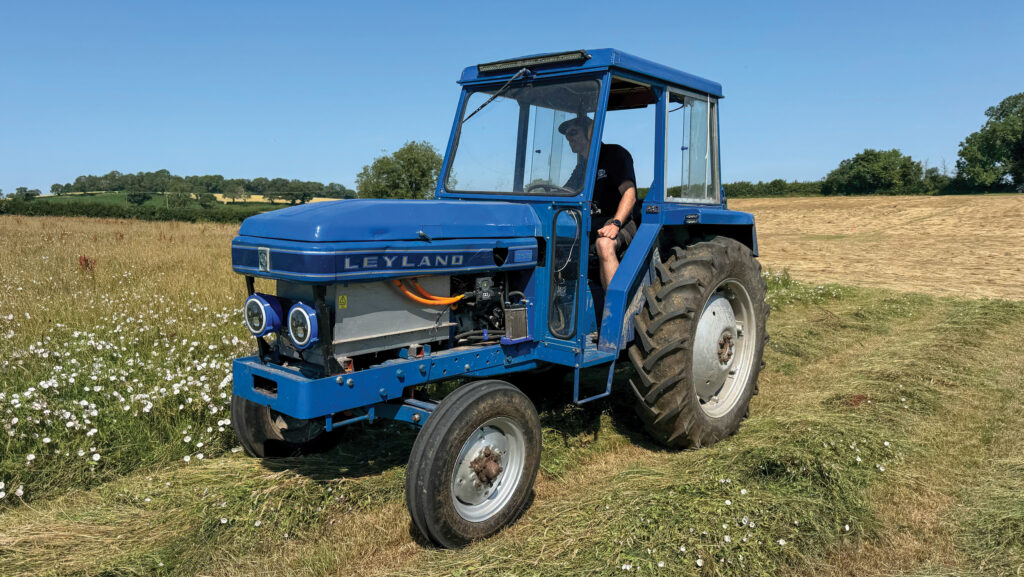
A quick drive-by of Ben Bament’s low-key workshop in Farmborough, Somerset would reveal nothing of the wizardly engineering cloaked under the most ordinary of machines berthed outside.
Among his curious cohort are a 1970s Leyland 255, an 1980s Yamaha Big Bear 350 ATV and Land Rover 110, and his daily runaround – a noughties MG F roadster.
See also: £50k Sabanto Steward kit gets Fendt 700s working autonomously
The self-taught electronics whizz has successfully converted each of them to battery-electric drive using a carefully selected potpourri of eBay-sourced car parts.
And he has done so on a gratifyingly modest budget, with the hotchpotch of key components – Nissan Leaf battery pack, Vauxhall Corsa electric motor and MG charger – transplanted into his two-wheel-drive Leyland for just £3,000.
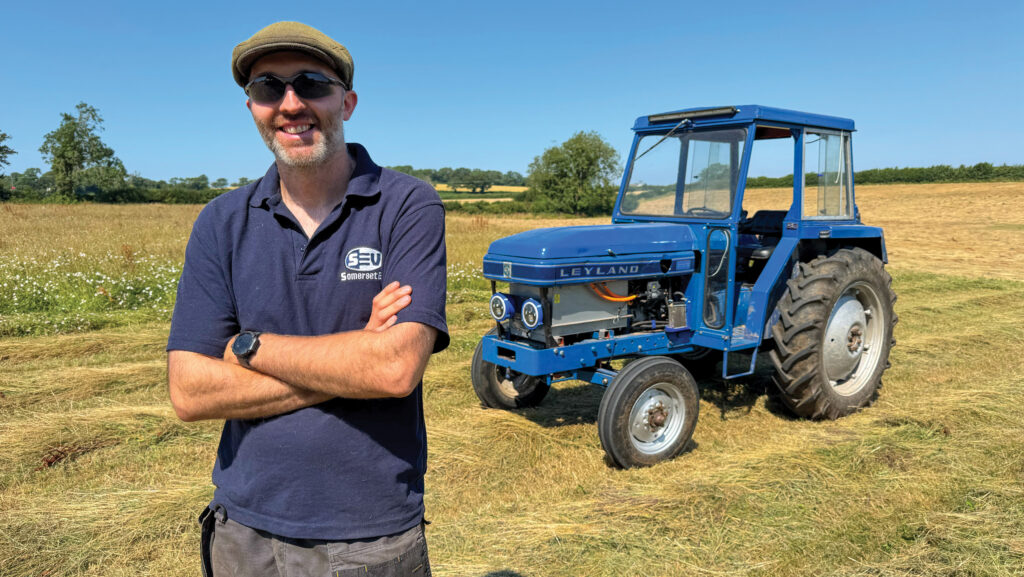
Ben Bament © MAG/Oliver Mark
Having successfully completed the project last year, he’s now offering replacement powertrain kits for similarly sized tractors through his business, Somerset EV.
Alongside this, he has a job at car conversion specialist Silent Classics, where he waves a voltaic wand over Bentleys, Range Rovers and, most commonly, Fiat 500s.
Getting started
Ben has been devising, revising and completing his own conversions at his father-in-law’s beef farm since 2019. One of the many attractions, he says, is the challenge of proving battery-electric naysayers wrong – and doing so on a shoestring.
“I love the problem solving – understanding electric motors and canbus, designing stuff on CAD and using 3D scanners,” he says. “As I’m converting older vehicles, there’s also a good mix of general fabrication in repairing the original metalwork, so they’re true multi-skill projects.”
Ben sails a tight financial ship, so the priority is to find cheap, second-hand components and reverse engineer most of the software that stitches them together. With swarms of electric cars on UK roads, there is a growing selection of these parts to pick from – and they cost less than ever.
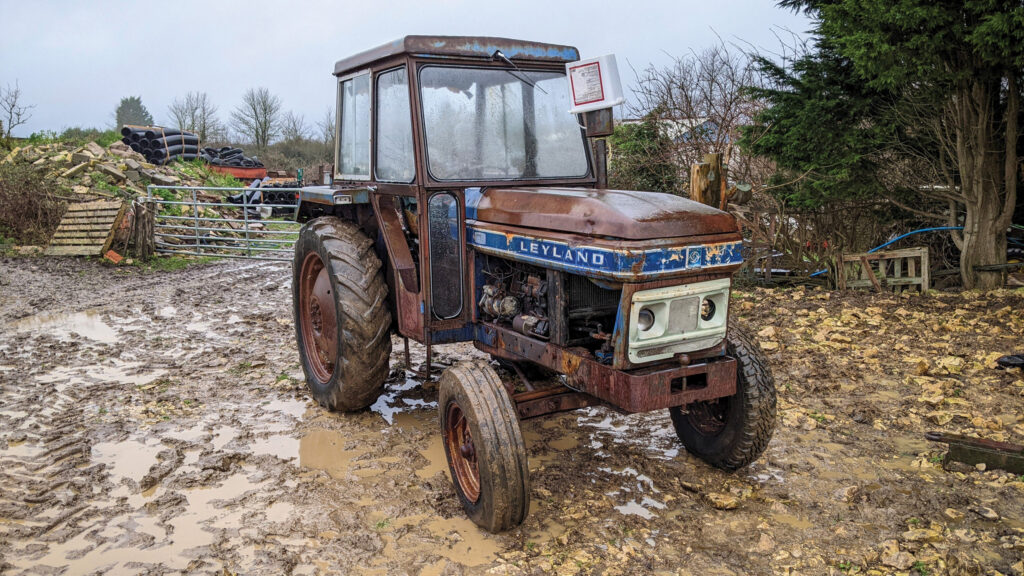
The Leyland 255 before the conversion © MAG/Oliver Mark
To keep the coding work to a minimum, he builds his projects around EV models commonly found in wreckers yards. This meant he could recycle and tweak the software from MG to Leyland – despite them being very different vehicles.
That said, he had relatively low expectations for the latter. “I thought it would be good around the yard and on light fieldwork tasks such as tedding, but less so for baling and mowing,” says Ben.
“No one had proved that to be the case, though. I wanted to get some real field performance data and show that it can be done cheaply.”
Picking the components
Top of the shopping list was a host tractor, and he picked up the rust-bucket 255 for just £800. Cost aside, the attraction was its structural chassis rails on which he could easily mount the new powertrain components.
These included the £250 motor from an old Nissan Leaf, selected to match the performance of the 3.8-litre diesel engine. In fact, it overdelivered, with its 280Nm outgunning the original Leyland fitment by a healthy 64Nm.
“Plus, it’s bombproof and, as it has been around for so long, the software has been decoded and the information is widely available,” says Ben.
“I could have made things easier with a later Leaf model, as they had the motor, inverter and charger all in one stack – leaving me to fit and code a battery. These were a lot more expensive at the time, though not so now.”
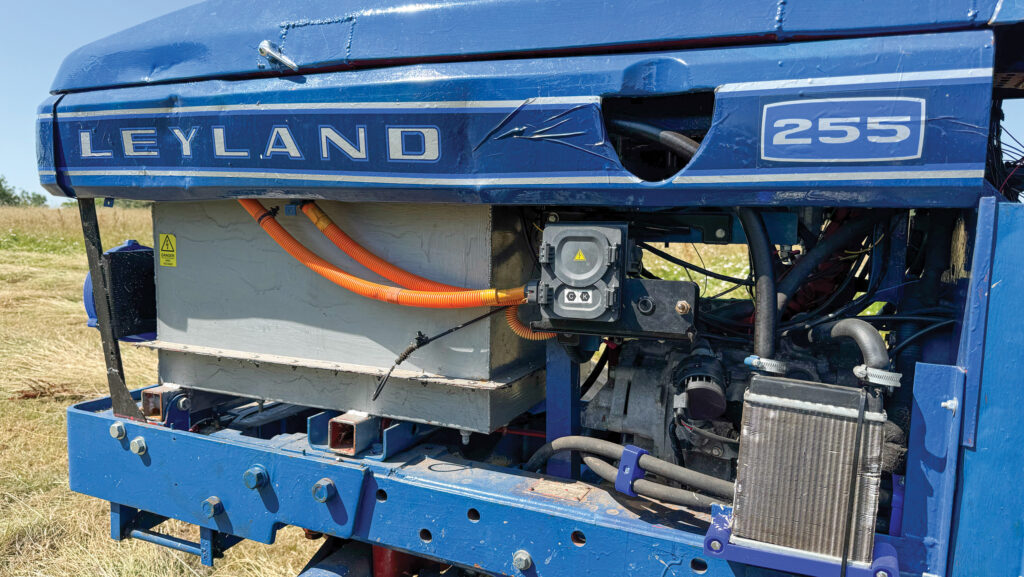
Battery and charge socket © MAG/Oliver Mark
Corsa power
Further eBay browsing yielded a power pack from a written-off 2023-plate Corsa E.
As Ben was operating in virgin territory, the required battery size was a distinct unknown. “I just picked one that I could reasonably afford, and which would fit on the tractor,” he says.
As with motors, the cost of batteries – particularly those from the Stellantis automotive group (Vauxhall, Citroen, Peugeot and Fiat, among others) – is plummeting in price. “I paid £1,200; the year before they were £3,000 and, if you’re patient, you can now get them for £500-£600.”
Packs from VW’s iD3 and iD4 models are eminently more desirable, as they are designed for a dedicated EV platform, are more power dense, and come housed in a big, flat box.
Consequently, they are being bought en masse for solar energy stores and, at £3,000 for 55kWh, are double the price of the Corsa’s.
Battery longevity is of little concern. The current consensus in the automotive sector is that it should outlast the car, thanks to maturing chemistry and better thermal control.
“A tractor is far less demanding than a car, as there’s no fast acceleration nor regular rapid charging, and it’s this that heats up the batteries,” adds Ben.
“Pulling a mower only requires about 15kW – and running a yard scraper even less – so they demand a fraction of the battery’s capacity and almost struggle to reach ambient temperature.”
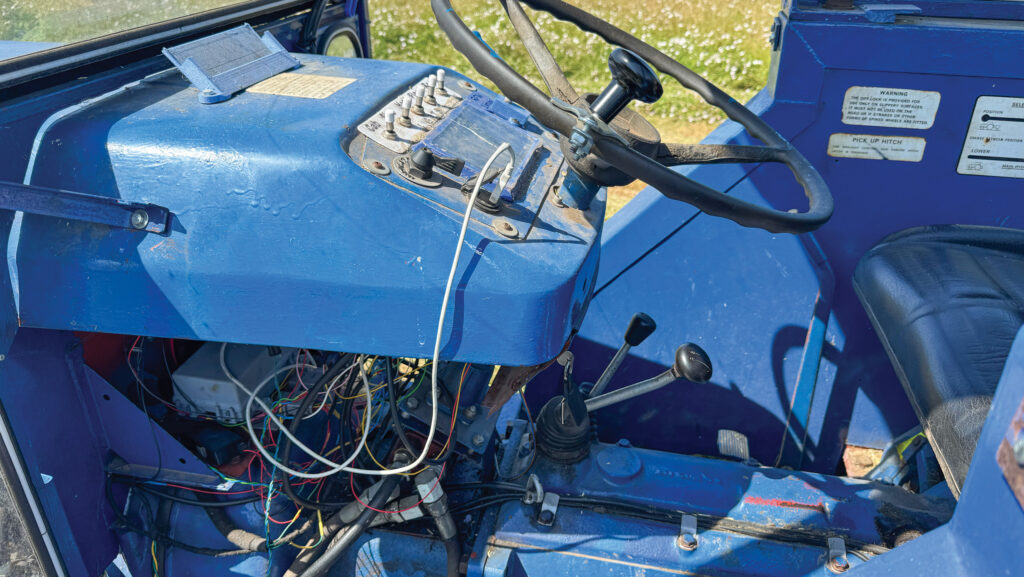
12V wiring © MAG/Oliver Mark
Charging headaches
Rigging up a means of charging the battery was the biggest challenge, albeit partially self-inflicted.
Initially, Ben had a punt at reverse engineering a complex Porsche Cayenne system – on a Leyland tractor, of all things – using the goldmine of information shared among the online community.
Though he got it working, there was simply too much code cracking required to perfect it, and the added cost of an OEM diagnostics tool.
So, he pivoted to MG’s more decipherable charging system, translated and rewrote the canbus messaging and plugged it into an open-source ZombieVerter vehicle control unit (£350).
Ben uses the same system on both tractor and car, albeit with a few tweaks – such as an rpm control for the pto – that he benevolently uploaded to the online repository for others to use for free.
“It’s not just me doing the coding and cracking. Without the Open Inverter community and, in particular, Damien Maguire’s ZombieVerter project, I wouldn’t have managed any of this,” he says.
As Ben’s Leyland has a CCS fast charger, he can replenish the cells at Sainsbury’s, the pub, or anywhere else with suitable infrastructure.
However, he downgraded slightly from the Corsa’s original 120kW to 100kW, due to the lack of water cooling for the batteries – a facility only really required if fast charging more than once a day.
The other benefit of the MG charger is that is has “vehicle-to-load”, which allows the charging socket to put out 240V via an adaptor plug. “I haven’t quite cracked this system yet, but it’ll allow me to take out up to 5kW to run a welder or air compressor.”
Any changes to the rest of the tractor?
In all, Ben spent far more time restoring the tractor than replacing the powertrain. He initially retained the flywheel and clutch, before having second thoughts and removing the latter to give direct drive.
“You lose a bit of convenience, such as the live pto, but it simplifies things and is one less component to break.”
With no clutch pedal, it’s operated on a single pedal, with the foot and hand throttles connected to a Peugeot position sensor.
The accompanying PID controller will keep the throttle at 1,800rpm during work, even when going downhill – during which it harvests energy.
“When I was raking on a slope, it was putting 3kW back into the battery,” says Ben. “The regenerative system makes up for the Leyland’s appalling brakes.”
How has it performed?
It ran a 4m Vicon rake all day in its first year and, after diesel prices rocketed, was roped in to do almost all the hay making this season.
“I’ve been surprised by how little energy it uses. It can do five hours of mowing [about 2.5ha] to a charge, so a scraper tractor would probably last a week.”
And the beauty of the system, he says, is that the powertrain requires no ongoing maintenance, which will be music to the ears of mechanically-averse stockpeople.
One slightly unexpected downside is the noise. The joys of a near-silent electric motor are ruined by the Leyland’s straight-cut gears and whiney hydrostatic power steering pump.
It’s also a little light on the nose, with the 220kg battery failing to make up for the loss of engine and fuel tank. A set of wafer weights should see to that.
Now that he has proved the concept, Ben is selling his conversion kits for £15,000. These include everything required for electric drive, leaving the buyer to fabricate component mounts and complete some 12V wiring, which should be relatively simple for a workshop-minded farmer.
Next project?
Ben now wants to scale up by tackling a full-size telehandler, having earmarked a fire-damaged JCB Loadall at a local engineer – far bigger than machines offered by JCB, Merlo and Manitou.
“Telehandlers suit electrification, as they’re often used for regular half-hour yard jobs,” he says. “And the strong residual value of the machine makes the cost of the conversion stack up.”
With a Nissan Leaf motor likely deemed too wimpy, he plans to use one from a Tesla Model 3. Once done, he’ll compare performance, cost and reliability with a new machine to assess the feasibility, hopefully with some Adopt grant support.
