
The Qantas fleet is entering a period of transformation unlike anything the Australian carrier has experienced in decades. The Boeing 737 is gradually giving way to the Airbus A321XLR, the regional fleet is being renewed with the A220 and Embraer E190, the Airbus A330 will be replaced by the Boeing 787 and Airbus A350, while the airline’s largest aircraft – the Airbus A380 – will begin leaving the fleet in 2028.
The scale of the transformation is perhaps best illustrated by the fact that the Qantas Group has more than 200 aircraft on firm order. Seventeen new aircraft joined the group during the 2026 financial year, with up to 31 more expected in the following year. Alongside the technical renewal of the fleet, the onboard product is also changing. The latest step is the unveiling of an entirely new Business Class cabin for future Airbus A321XLRs and upgraded seats for the additional Boeing 787-9s on order.
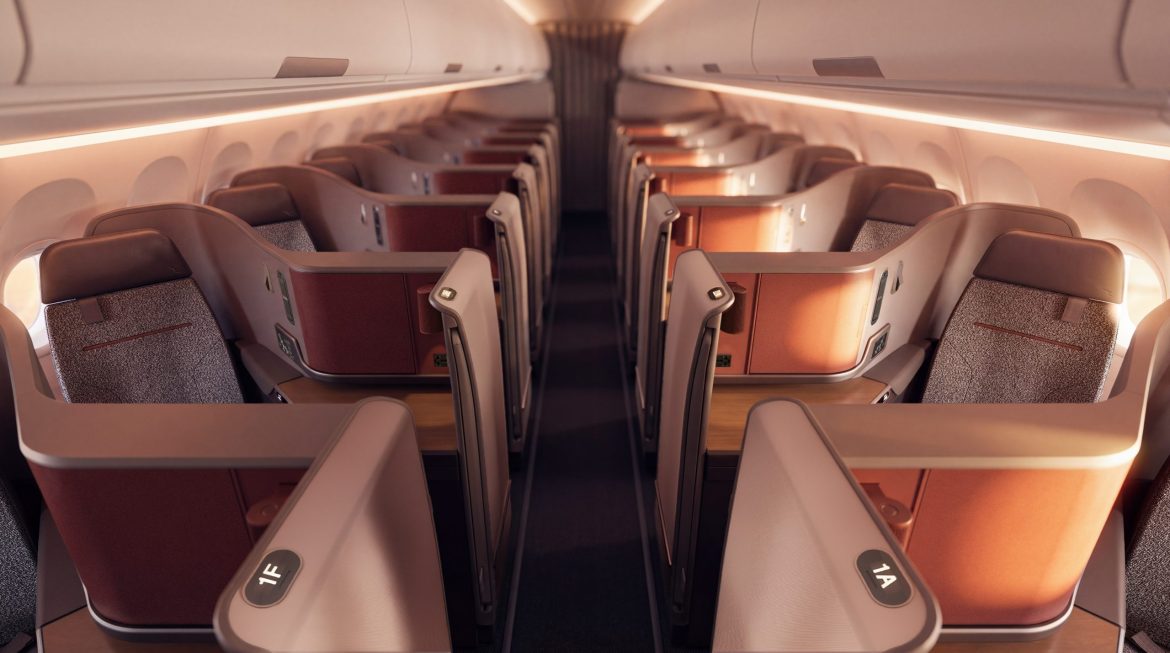
For the first time in Qantas history, a single-aisle aircraft will feature Business Class seats that convert into fully flat beds. The new A321XLR suites will be arranged in a 1-1 angled herringbone configuration. Every passenger will have direct aisle access, a sliding privacy door, a 19-inch entertainment screen, wireless and USB-C charging, fast and free Wi-Fi, and storage for a laptop and personal items.
The product demonstrates how much the boundary between narrowbody and widebody aircraft has shifted in recent years. The A321XLR will be more than a replacement for the Boeing 737 on domestic services. With a range of approximately 8,700 kilometres – more than 3,000 kilometres farther than the 737-800 – it will be able to operate long transcontinental services to and from Perth, as well as numerous short- and medium-haul international routes.
Qantas has ordered 48 A321XLRs in total, with the first seven aircraft already in service. Most of the current aircraft feature 20 Business and 177 Economy Class seats, while 16 aircraft from a later delivery batch will receive the new premium configuration with lie-flat beds. The first aircraft equipped with the new suites is scheduled to arrive in 2028.
The introduction of a substantially improved product is not merely a matter of prestige. Qantas says premium cabin revenue across its international network is growing at twice the rate of Economy Class revenue. As a result, the next-generation aircraft will carry a higher proportion of premium seats than the models they replace. The A321XLR combines a lower capacity than a widebody aircraft with long-range capability and a product suitable for overnight services.
A similar evolution is planned for the Boeing 787-9. Each of the additional aircraft on order will feature 42 Business Suites with sliding privacy doors, marking the first time such a product has been installed on a Qantas Dreamliner. The seats will convert into 80-inch beds, slightly more than two metres long, and feature a wider footwell developed following ergonomic trials and customer feedback. The suites will also include 19-inch screens and redesigned storage areas finished in colours inspired by the red earth of Western Australia’s Pilbara region.
The aircraft form part of an order for 12 additional Dreamliners – four 787-9s and eight larger 787-10s. Together with 12 standard A350-1000s, they will progressively replace the existing A330 fleet. Qantas is expected to deploy the Boeing 787 primarily where long-haul efficiency is particularly important, while the A350 will provide greater capacity and range for the most demanding parts of the network.
The existing A330s will not disappear overnight. Ten A330-200s are undergoing a cabin refurbishment programme that includes new Economy Class seats, larger 4K OLED screens, USB-C ports, Bluetooth connectivity and new mood lighting. The upgrades will bridge the period until sufficient numbers of new 787s and A350s arrive, after which the A330s will be gradually retired.
A special place in the future fleet is reserved for 12 specially modified A350-1000ULRs for Project Sunrise. Equipped with an additional 20,000-litre fuel tank, the aircraft will be able to remain airborne for up to 22 hours and connect Sydney with London without an intermediate stop. The first aircraft, named Vega, is scheduled for delivery in April 2027, with commercial services to London expected to begin in October that year. Each aircraft will carry just 238 passengers across four cabin classes: six First Class suites, 52 Business Class suites, 40 Premium Economy seats and 140 Economy Class seats.
At the other end of the network, the A220-300 is progressively taking over the role of the older Boeing 717, while second-hand Embraer E190s will replace the Fokker 100 fleet within the regional QantasLink operation. The A220 fleet had grown to 12 aircraft by August 2026, while the cabins of the existing A319 and A320 fleets are also being refurbished. The renewal therefore covers virtually every segment of the group’s operations – from regional and domestic trunk routes to the world’s longest commercial flights.
The most symbolic change, however, will be the departure of the Airbus A380. Qantas originally intended to begin retiring its superjumbos in the early 2030s, but that timeline has now been brought forward to 2028. The carrier currently operates ten A380s, the first of which entered service in 2008. According to Qantas Group CEO Vanessa Hudson, the end of A380 production means maintenance costs will gradually increase, along with the financial consequences of technical failures and operational disruptions.
Qantas is therefore discussing the conversion of around 20 existing purchase rights into firm orders for additional A350s and 787s with Airbus and Boeing. Deliveries would begin from 2030. These aircraft are expected to enable the accelerated retirement of the A380 while opening new routes that the large four-engined aircraft could not operate economically due to its capacity and cost structure.
With the departure of the A380, Qantas will lose the largest and arguably most recognisable aircraft in its fleet. In return, however, it will gain a simpler, more efficient and more flexible structure. The future backbone of the fleet will comprise the A321XLR on domestic and regional services, the Boeing 787 and Airbus A350 across the international network, and the specially modified A350-1000ULR on Project Sunrise routes.
The new Business Class seats are therefore more than a cosmetic cabin upgrade. They indicate the direction in which Qantas intends to develop its entire network: towards smaller and more efficient long-range aircraft, a greater number of direct routes and a substantially higher share of premium products. The Australian carrier is gradually leaving behind an era in which aircraft size was the main symbol of global reach and entering one in which its network will be defined by range, flexibility and the quality of the passenger experience.
