
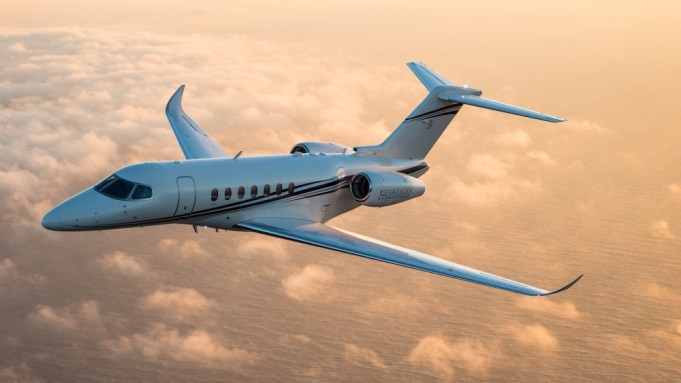

Textron Aviation
Business jets have expanded to cover all extremes of the spectrum, from very-light-jets like the Cirrus SF50 to ultra-long-rangers and even bizliners, or commercial jets adapted for private use. A step-up from light jets is the midsize category, with expanded seating (six to eight passenger seats) and luggage capacity that make travel for corporate executives or extended families more viable. The typical midsize also has four to six hours of range, an enclosed lavatory and cruising speeds of 430 to 480 mph. Some historical examples include the Learjet 45, Hawker 800XP, Falcon 2000LXS, Citation Excel, Gulfstream G250 and Embraer Legacy 450.
Seeking to fill the gap between midsize and large jets, the super-midsize class subsequently emerged, offering higher cruising altitudes and speeds, coast-to-coast range, seating for up to 9 or 10 passengers, and stand-up interior cabin heights of around 6 feet. The Citation X, Hawker 4000, the Falcon 50EX, Challenger 300/350 and Citation Longitude are all examples of this category.
Here are seven of our favorites that fill that sweet spot between smaller, lighter models and more substantial large-body aircraft.
-
Cessna Citation Latitude

Image Credit: Textron Aviation The Cessna Citation Latitude has dominated sales of its segment for good reason: while classified as a midsize, its larger-than-average sized cabin can be configured to carry nine passengers with enough headroom to enable standing up. With a maximum cruise speed of 446 knots and a range of 2,700 nautical miles, the Latitude can satisfy a healthy amount of domestic travel needs while providing super-midsize levels of comfort and amenities.
-
Bombardier Challenger 350

Image Credit: Bombardier Following the success of the clean-sheet Bombardier Challenger 300 which was introduced in 1999, the updated and upgraded Challenger 350 boasts a plusher interior, more cabin-filling light from the bigger windows, and what the manufacturer claims is the quietest flight experience in the super-mid category. Bombardier also says the Challenger 350’s flat-floor cabin is the most spacious in its class. The Challenger 350 offers a range of 3,200 nautical miles and a top speed of Mach .83. While it was succeeded by the Challenger 3500 in 2021, the 350 remains a favorite of standard-setting fractional ownership firm, NetJets, largely because of its reliability and low maintenance costs.
-
Embraer Legacy 500

Image Credit: Embraer Embraer’s Legacy 500 launched in 2008 as the first of its kind to a suite of advanced features including digital fly-by-wire technology and a flat-floor, standup cabin in the super-midsize class. After multiple delays, the 12-passenger Legacy 500 finally saw its first delivery in 2014. The Legacy 500 can carry four passengers for 3,125 nautical miles, or eight for 2,948 nautical miles. With more than 80 units sold to date, the Legacy 500 is a value proposition that enjoys a devoted following.
-
Cessna Citation Longitude

Image Credit: Textron Aviation The super-midsized Cessna Citation Longitude boasts a similarly spacious cabin as the manufacturer’s midsize Latitude model, but is nearly 11 feet longer. Powered by twin Honeywell engines producing 7,665 pounds of thrust, the 12-passenger aircraft can cruise at speeds up to 483 knots, or Mach .84. The Longitude also benefits from 3,706 more pounds of maximum takeoff weight than the Latitude, not to mention a range of up to 3,500 nautical miles, making nonstop flights from Los Angeles to New York possible.
-
Gulfstream G280

Image Credit: Gulfstream While Gulfstream is synonymous with large-cabin aircraft like the G650, G800 and its flagship G700, the G280 was introduced in 2012 in the super-midsize category as the Savannah, Georgia-based manufacturer’s entry model. The G280 seats up to 10 and can be configured for a maximum cruising range of 3,600 miles, enough to fly from New York to Rome. Though the big-boy Gulfstreams earn ultimate bragging rights, the G280 offers a compelling, oval-windowed alternative to competitors such as the Bombardier Challenger 300 and Cessna Citation X+.
-
Hawker 4000

Image Credit: Hawker The super-midsize Hawker 4000 first flew in 2001 and punched above its class thanks to its first-ever all-composite fuselage, which enabled more interior volume and cabin pressurization to a comfy 6,000-foot altitude. As promising as its advanced design was, early examples of the 10-passenger Hawker 4000 were buggy. Parent company Raytheon eventually floundered, the aviation division was purchased by an investment firm, and was rechristened Hawker Beechcraft in 2006, just two years before the global financial collapse led to stagnation in the private-jet world. Only 73 Hawker 4000s were built. The model suffered from poor resale values on the secondhand market—an unfortunate postscript to an innovative and promising aircraft.
-
Bombardier Learjet 60

Image Credit: Bombardier The Bombardier Learjet 60 is a tried-and-true midsize jet whose origins date back to 1990, when Bombardier Aerospace acquired the Learjet Corporation. The final link to the Learjet brand which trailblazed the modern business jet, the 60 boasted improvements to its predecessor, the Learjet 55, and saw a total of 318 aircraft produced before it was discontinued in 2007. The Learjet 60 paved the way for the 60XR, which was built until 2013.

