
The post Rediscovered in 2014, This Salamander’s Habitat Was Almost Lost to Coffee appeared first on A-Z Animals.
Amphibians rarely get the conservation attention they deserve because they are uncharismatic creatures. But given the role they play in their ecosystems, more attention should be paid to these fascinating animals. This is especially true for the rarest amphibian, the nimble long-limbed salamander. Discovered just over 40 years ago, the salamander comes with more questions than answers. However, with a low population number, it is unclear if there is time to learn all there is to know about the nimble long-limbed salamander before it goes extinct.
Why is the Nimble Long-Limbed Salamander So Rare?
The nimble long-limbed salamander (see video of the salamander here) is considered a rare species because of its limited habitat range and the fact that only an estimated 10,000 remain in the wild, in Guatemala and Mexico. Given that the population is declining, the risk of inbreeding is high. This means that future generations of the nimble long-limbed salamander will be at risk of diminishing ability to fight disease, which will lead to further population decline.

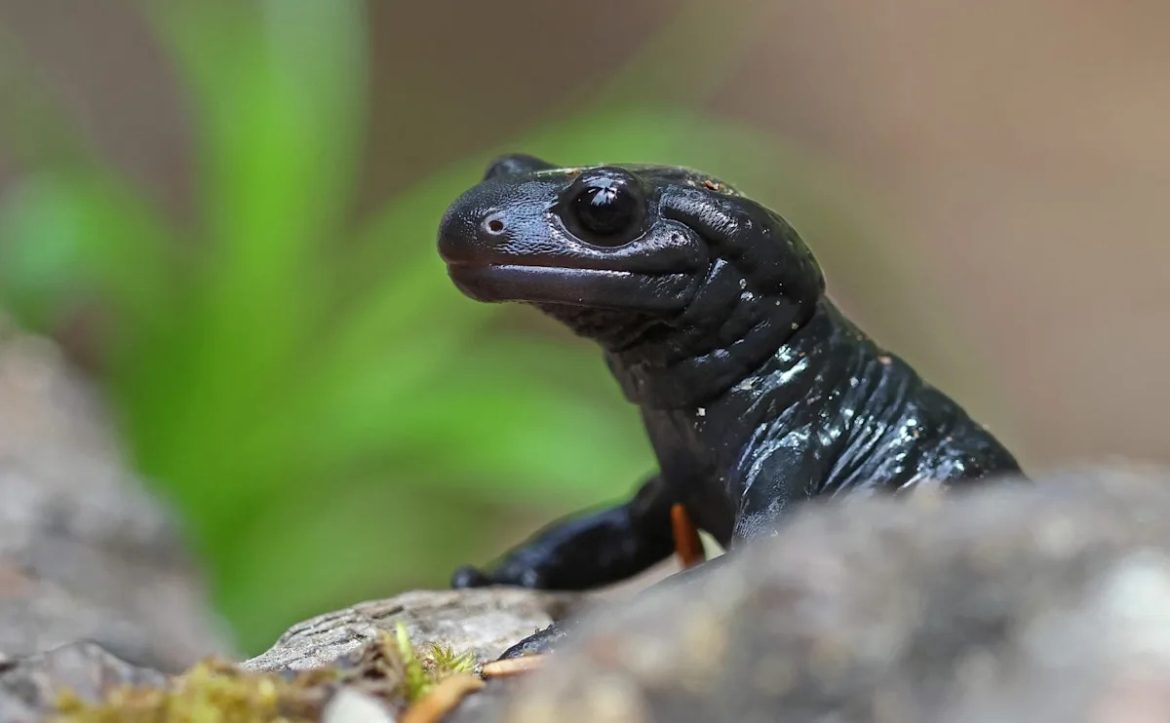
The nimble long-limbed salamander, with similar dark coloration to this Alpine salamander, is one of the rarest salamanders in the world.
©Gergo Nagy/Shutterstock.com
In addition to its limited population, very little is known about the nimble long-limbed salamander. Some of the categories where information is lacking include:
-
What preys on the salamanders
-
What the ecological role of the salamanders is
-
What genetic diversity currently exists
With a dwindling population of nimble long-limbed salamanders, scientists are working diligently to not only learn more about the just under three-inch-long salamander, but also to conserve them before they move from threatened status to that of endangered.
The Nimble Long-Limbed Salamander Was “Rediscovered”
The nimble long-limbed salamander is still a relatively new species. The first description of the species was published in 1983 by Paul Elias and David Wake, who encountered the salamanders during an expedition through the cloud forests of Guatemala’s Cuchumatanes Mountains. However, after that description, the nimble long-limbed salamander went missing, with many fearing it had gone extinct.

The nimble long-limbed salamander, similar in size and coloration to this black alpine salamander, was rediscovered in 2014.
©Mathias Pabst/Shutterstock.com
After years of monitoring for any signs of the nimble long-limbed salamander, it was rediscovered in 2014 by Carlos Vasquez of FUNDAECO, an organization dedicated to conserving biodiversity throughout Guatemala and South America.
The rediscovery came at an incredible time. The land that the salamanders inhabited was scheduled to be cleared to make way for coffee plants. Before this could happen, FUNDAECO and other organizations purchased the property and created the San Isidro Amphibian Reserve. It is now the last known habitat of the nimble long-limbed salamander.
How the Nimble Long-Limbed Salamander Breathes
This rare salamander does not have lungs. Instead, it relies on buccal and cutaneous respiration to oxygenate its body.
To breathe, the salamander uses the skin and tissue in its mouth to receive oxygen. Instead of lungs filtering oxygen into the body, oxygen goes directly into the salamander’s bloodstream. This requires the nimble long-limbed salamander’s skin to be moist at all times.

Like the red-backed salamander, pictured here, the nimble long-limbed salamander does not have lungs.
©Mike Wilhelm/Shutterstock.com
The salamander’s habitat is very specific in that it must be moisture-rich. While salamanders can slow their metabolisms when environmental conditions are not ideal, they cannot exist in this state long-term. If the nimble long-limbed salamander’s skin were to dry out, it would be unable to breathe. The consequences of this, unfortunately, would be death.
Threats the Nimble Long-Limbed Salamander Faces Today
The environmental threats these salamanders face are many. This is problematic, given the species already has an extremely small and declining population. While conservation efforts are underway to better understand and save the salamander, some fear it is not enough to keep the species from going extinct.

The nimble long-limbed salamander, similar looking to the alpine salamander pictured here, is threatened by habitat loss and fragmentation, fungus, and climate change.
©Gergo Nagy/Shutterstock.com
Some of the threats the salamander faces today include:
-
Bsal, a chytrid fungus that can cause severe skin disease and death
-
Exposure to chemicals and other pollution in habitat, including breeding sites
The extinction of the nimble long-limbed salamander would cause a loss of biodiversity in its ecosystem. More importantly, an entire history of evolution would be lost. It has been millions of years since the salamander was closely related to other lungless salamanders. Were it to disappear, an entire genus would disappear along with it, creating a void that can never again be filled.
The post Rediscovered in 2014, This Salamander’s Habitat Was Almost Lost to Coffee appeared first on A-Z Animals.
