
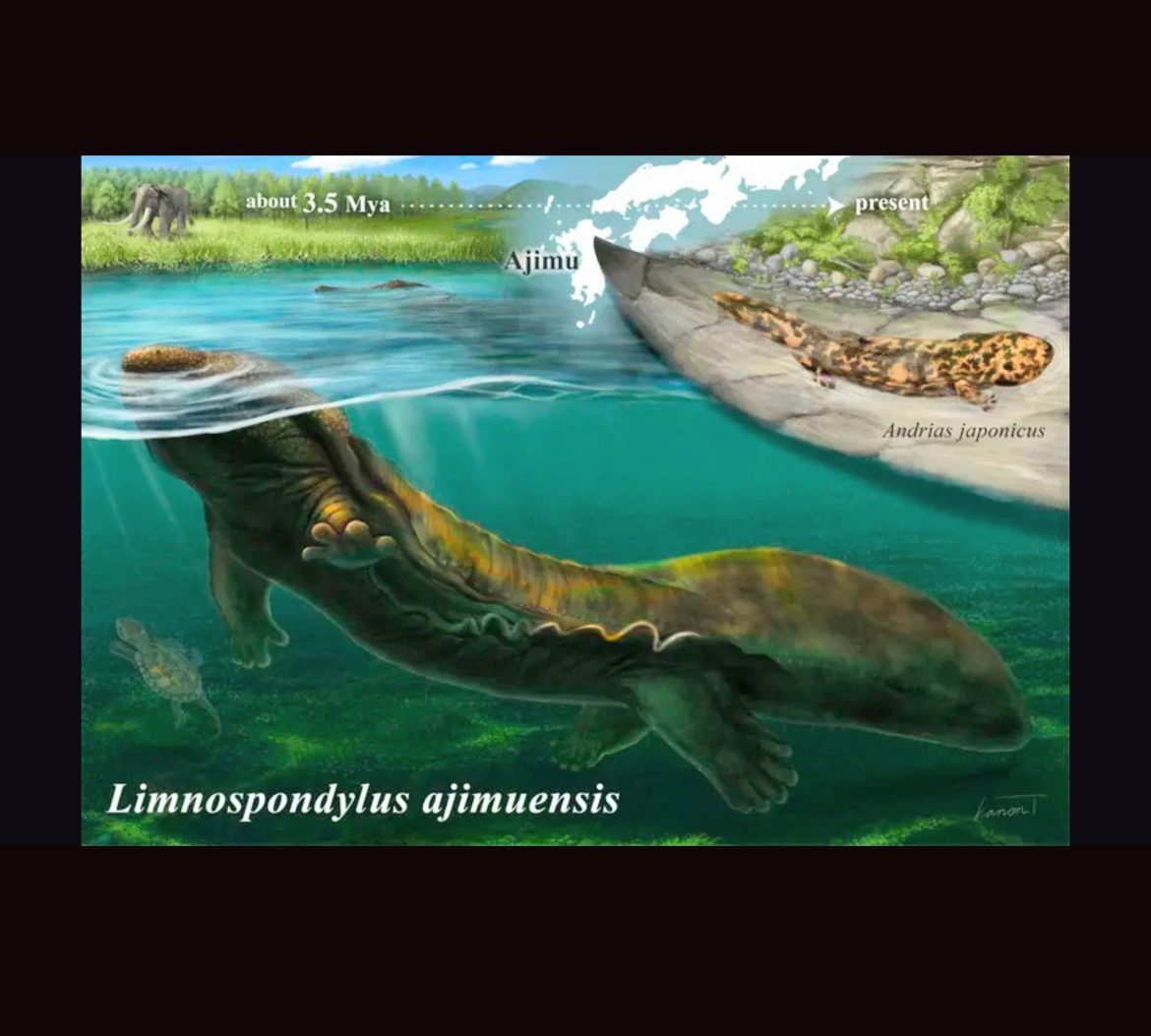
Giant salamanders are the largest amphibians alive today. They are strange river animals with wrinkled skin and small, lidless eyes.
The biggest living giant salamanders can reach nearly six feet (1.8 meters) in length.

Across millions of years, the whole family has kept roughly the same body shape.
That sameness turns their fossils into a real headache, since bones from very different animals can look almost identical.
Three vertebrae from Kyushu
In the late 1990s, a fossil collector named Eiichi Kitabayashi worked the banks of the Fukami River in Oita Prefecture, on the western island of Kyushu.
He pulled out three salamander vertebrae, small bones that weathered out of ancient lake mud.
The sediments date to roughly 3.5 million years ago, in the Late Pliocene. Back then the place was a warm, wet lakeland that was nothing like the cooler Japan of today.
When the bones first surfaced, an earlier team labeled them as Andrias, the genus of living East Asian giant salamanders. There were simply too few comparison fossils around to say anything sharper about them.
Decades passed before a group at Kyoto University decided the specimens deserved another look.
They borrowed the bones, which are kept at the Lake Biwa Museum, and ran them through a micro-CT scanner.
Inside the fossil vertebrae
The scan showed internal detail that no surface inspection could ever catch.
Each of the three bones sat at a different spot along the backbone, one near the front of the trunk, one in the mid-trunk, and one back toward the tail.
The mid-trunk vertebra was the one that mattered most. Set against living and fossil relatives, it carried a bundle of features that showed up in no other giant salamander on record.
Its centrum, the barrel-shaped core of the vertebra, was short from front to back yet tall from top to bottom. That gave it the most compact profile of all the salamanders the team measured.
The joints linking it to its neighbors flared out sideways, sitting on unusually broad, heavy bases.
Seen head-on, the lower rims of its two side wings lined up into a single straight edge, a detail matched by none of its relatives.
New giant salamander genus emerges
Added together, these traits refused to fit any known genus, extinct or alive. The gap was wider than the one separating the two giant salamander genera living today, animals that nobody would mistake for each other.
So the team named a new genus and a new species. They called it Limnospondylus ajimuensis, a name built from the Greek words for lake and vertebra, with the species name tipping its hat to Ajimu.
“Ajimu contains the only site in the world where fossils of the giant salamander family and extant genera have both been found,” said first author Masahiro Noda.
“I’m delighted that this study has highlighted Japan as a crucial region for understanding their evolutionary history.”
Size of the the giant salamander
The largest of the three vertebrae points to a decent-sized animal.
Feeding its measurements into equations built from living giant salamanders, the team landed on a body length near 3.6 feet, about 1.1 meters.
Those numbers carry real uncertainty, since the only yardsticks are two modern species. The authors call the estimate provisional, and good enough until more of the animal turns up.
The same bone also held growth rings, much like the rings inside a tree trunk. Its joint surfaces showed 17 or 18 of them, which suggests the giant salamander was roughly 17 or 18 years old.
The spacing between rings stayed fairly even up to about the 13th one. That hints at steady growth carrying on through much of its life.
The lakes it inhabited
The Kyushu this salamander knew would be unrecognizable now. Wide, freshwater lakes covered the lowlands, and were fringed by marshes and forest.
The climate sat warm and humid, wetter than modern Japan by a fair margin. Giant salamanders do well in such places, where rainfall tops 35 inches (900 millimeters) a year.
Its neighbors made for an odd crowd. Stegodon elephants, rhinos, alligators and southern turtles shared the water and the shore, representing a blend of northern and tropical animals.
Living giant salamanders stick to flowing rivers. Their fossil relatives, though, turned up in lakes and other still waters. So this lake-dweller may have ranged more widely than its river-bound cousins do.
Why the genus vanished
The good conditions did not hold. Around 2.6 million years ago, the world cooled as the Pliocene slid into the Pleistocene.
Colder weather and shifting land dealt hard blows to amphibian communities. Across the region, lakes and wetlands began to shrink.
For a salamander tuned to standing water, that loss was likely fatal. Its river-loving relative came through the change in far better shape.
That survivor is Andrias japonicus, the Japanese giant salamander, which is still swimming today. It even lives in the same Fukami River that gave up the fossils, providing a striking overlap of deep past and living present.
Hidden giant salamander diversity
Before this discovery, only five genera of giant salamander had ever been described, living and extinct combined. A sixth stretches the known shape and range of a group long written off as monotonous.
Plenty of giant salamander fossils have been dumped into the genus Andrias for want of a better match. Some of them, the authors suspect, are unrecognized species still waiting to be sorted out.
“Recently, Japan’s native giant salamanders have faced challenges such as hybridization with foreign species and habitat destruction,” said Noda.
“This research has given me a renewed appreciation for the importance of preserving extant species for the future.”
The study is published in the journal PeerJ.
Image Credit: Kanon Tanaka
—–
Like what you read? Subscribe to our newsletter for engaging articles, exclusive content, and the latest updates.
Check us out on EarthSnap, a free app brought to you by Eric Ralls and Earth.com.
—–
