
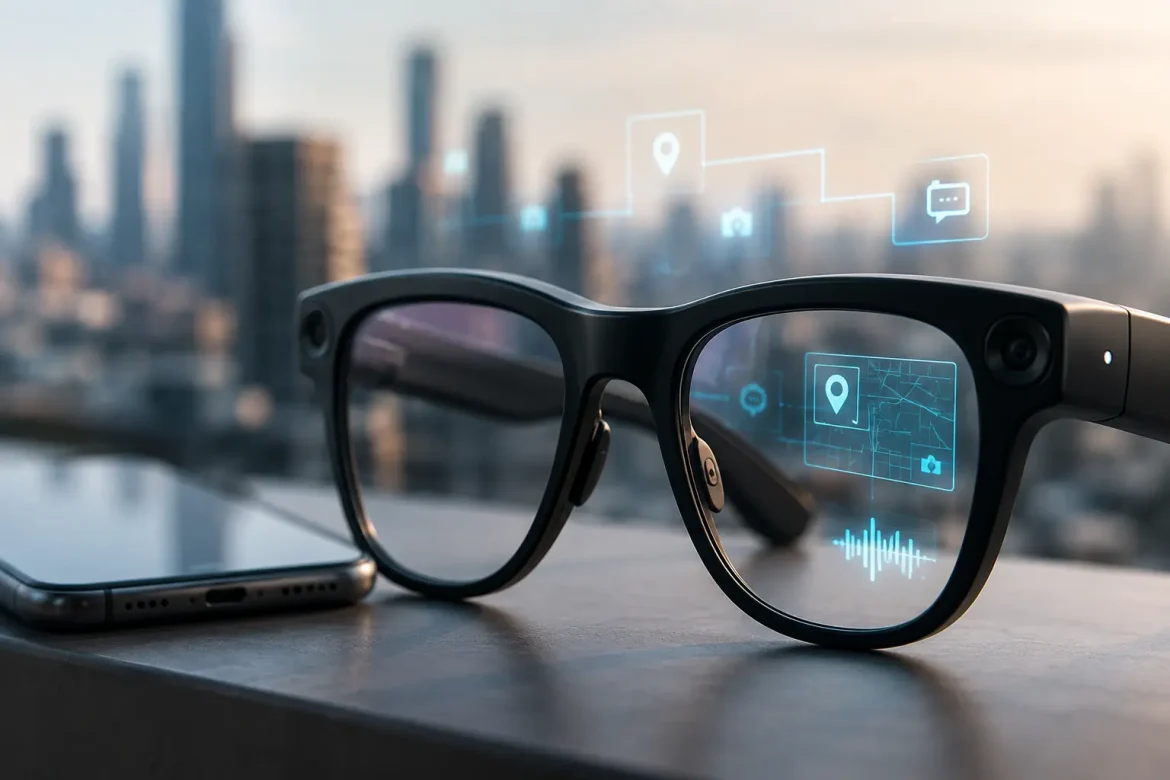
We are witnessing a massive, systemic change across the consumer hardware landscape. For more than a decade now, the smartphone has been the undisputed anchor point of personal technology, and for good reason. It is the singular hub through which we manage our communications, capture media and interface with cloud-based networks.
But we are now finally coming up against an operational ceiling with the form factor of today’s mobile devices. Glancing down at a handheld glass panel introduces friction into our quotidian environments, distracting us from the material world.
With artificial intelligence shifting from cloud servers to highly optimized edge devices, hardware makers are turning to ambient computing formats. Now it is not about pulling users into a digital screen, but to seamlessly superimpose digital intelligence into their natural environment. Of the rapidly evolving categories of modern wearables, intelligent eyewear has emerged as the most promising platform to liberate us from the conventional smartphone.
Unlike smartwatches or fitness trackers, AI-powered eyewear allows users to interact with digital information while keeping their hands free and their attention on the surrounding environment.
This combination of contextual awareness, voice interaction, and real-time visual assistance is why many technology companies see smart glasses as one of the strongest candidates for the next generation of personal computing.
Understanding the Different Types of AI Eyewear
One big problem for the average consumer is the vague language that is used when talking about modern head worn hardware. Marketing departments love to throw around terms like virtual reality, mixed reality, and smart eyewear interchangeably, but they’re all entirely different technological ecosystems oriented towards solving entirely different problems.
As we discussed in our breakdown of the differences between AR and VR immersive hardware, virtual reality is fully immersive in that it removes the user from the real world by placing them in a computer-generated simulation. This is great for high-risk corporate simulations or deep gaming immersion, but it is basically incompatible with everyday outdoor mobility.
On the other hand, the smart eyewear space has bifurcated into two parallel tracks: display-based augmented reality glasses and display-free, assistant-centric wearables. Systems based on displays employ micro-OLED or micro-LED panels to project high-definition virtual monitors or translation subtitles directly into the field of view of the user. These models can be great for remote productivity or portable media streaming, but often at the cost of added weight, limited battery life and a bulkier aesthetic.
Reclaiming the Form Factor: The Rise of True AI Eyewear
The second category, growing fast, trades heavy visual projection hardware for ultra-lightweight frames, built-in open-ear audio arrays and contextual camera systems. By focusing on multimodal processing these devices enable users to engage with generative cloud models through voice commands, real-time audio cues, and hands-free point-of-view media capture.
The ultimate gold standard in this space is the latest iteration of Meta AI glasses that somehow close the gap between bulky technological proof-of-concepts and everyday high-end fashion frames. These models have a form factor that is similar to regular optical eyewear, without the burden of heavy glass prisms and processing for dedicated AR displays. This lightweight architecture is key to long-term daily wearability, solving the ergonomic fatigue that doomed early smart glass initiatives more than a decade ago.
The real advantage of these non-display devices comes from their use of integrated cameras for contextual visual processing. This development mirrors what the National Institute of Standards and Technology (NIST) records as a broader shift to seamless hands-free integration as wearable computing transitions from hard, obstructive boxes to natural everyday wear. Instead of making you take out a phone, unlock a screen, frame a photo and upload it to an application, an integrated on-board assistant can actively analyze exactly what you are looking at. Whether it’s translating a foreign street sign on the fly, identifying an unknown landmark or guiding a technician through a complex hardware installation, the technology works totally in the background.
For everyday users, these capabilities translate into practical benefits rather than simply new technology. Instead of stopping to unlock a phone, users can ask questions, capture moments, receive navigation guidance, or translate signs while continuing their activity. This reduction in screen dependence is one of the primary reasons AI eyewear is attracting attention from both consumers and businesses.
Important Specifications: Computational and Ergonomic Balance
Head-borne wearables are a different world, and the engineering priorities change dramatically from traditional consumer electronics. A few extra grams of weight or a slight increase in thermal output doesn’t tend to affect the user experience on a typical smartphone or handheld gaming console. Those same metrics determine if a device is useful or unwearable on a pair of glasses sitting on the bridge of the nose.
| Hardware Metric | Optimization Objective Goal | Operational Impact Daily |
| Distribution of Weights | Achieving a proper front to back balance | Eliminates pressure points and frame slippage |
| Loss of acoustic signal | Projects phase-cancelled sound directly into the ear canal | Public Spaces for Calls and Assistant Responses |
| Edge Computing Performance | Reducing local thermal throttling | Keeps the frames cool on the temples during long video processing |
Comfort, battery efficiency, and software optimization ultimately matter more than raw processing power. Since smart glasses are designed to be worn for extended periods, even small improvements in weight distribution, thermal management, and battery placement can significantly improve the overall user experience. Battery life also remains a practical limitation, as advanced AI processing, cameras, and continuous voice recognition can significantly increase power consumption during extended use.
As we discussed in our technical overview of current AR smart glasses and wearable hardware design, total product mass is only half the battle. True comfort is all about weight distribution. The devices where batteries and circuit boards are mounted all at the front of the frame lead to extreme fatigue over long periods of time. Modern versions do this by stringing high-density, miniature battery cells all along the temple arms, pulling the center of gravity back over the ears.
Can AI Smart Glasses Replace Smartphones?
Although AI smart glasses continue to evolve rapidly, they are unlikely to replace smartphones entirely in the near future. Smartphones remain better suited for tasks such as document editing, mobile banking, gaming, and extended media consumption. Instead, smart glasses are emerging as companion devices that reduce the need to constantly interact with a phone by providing instant information, voice assistance, navigation, and contextual AI support.
The Future of Ambient Technology and Privacy Paradigm
Integrating continuous capturing tools and voice-activated assistants directly onto a person’s face presents serious data security and privacy challenges. Unlike the early wearable experiments, which had no clear visual cues to signal recording statuses, the new intelligent frames include bright privacy LEDs that cannot be overridden, and which light up automatically whenever the camera sensor draws power from the frame.
In the bigger picture of data security, the ambient computing market will ultimately win if companies adopt strong encryption standards for media synced to the cloud and voice command logs. The security frameworks of the Federal Trade Commission (FTC) describe the need for strict guardrails around how consumer-generated data is secured against illegal harvesting and unauthorized tracking, especially given the rapid growth of interconnected tech platforms. As spatial computing engines get smarter, the infrastructure behind them will need to be as aggressive about user data sovereignty as hardware makers are about weight and battery efficiency.
The smartphone isn’t disappearing overnight, but its role as our primary interface to cloud computing is being actively eroded. With the advancement in natural language processing and improvement in form factors, the smart wearables will continue to attract users for hands-free context tracking. Rather than replacing smartphones overnight, AI smart glasses are gradually introducing a more natural way to access digital information through voice, vision, and contextual intelligence. As AI hardware continues to mature, these devices are expected to become an increasingly important part of everyday computing.
Frequently Asked Questions
What can AI smart glasses do?
AI smart glasses can perform tasks such as hands-free photography, voice-assisted searches, language translation, navigation, object recognition, and contextual AI assistance without requiring users to constantly interact with a smartphone.
Can AI smart glasses work without a smartphone?
Some AI smart glasses can perform limited on-device tasks independently, but most current models still rely on a paired smartphone for internet connectivity, app integration, and certain AI features.
Are AI smart glasses the future of personal computing?
AI smart glasses are expected to become an increasingly important part of personal computing by offering more natural, hands-free interactions. However, they are currently designed to complement smartphones rather than replace them entirely.
