
image:
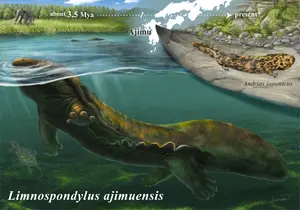
A reconstruction of the Ajimu giant salamander, which is believed to have inhabited the lakes and marshes of the Ajimu region approximately 3.5 million years ago when its environment was warmer and more humid. Today, this area is home to Andrias japonicus, the Japanese giant salamander endemic to Japan.
Credit: Kanon Tanaka
Kyoto, Japan — In the late 1990s in the Ajimu region of Japan’s Oita prefecture, researchers discovered three fossilized vertebrae belonging to the Cryptobranchidae family of giant salamander. These were embedded in the Tsubusugawa Formation, Pliocene-era strata of lake deposits dating back approximately 3.5 million years. The strata have also yielded fossils of animals that no longer roam Japan, such as elephants and crocodiles, revealing a glimpse of an era much warmer and humid than Japan’s current climate.
Researchers originally assigned the three Ajimu specimens to the genus Andrias, which includes the world’s largest living amphibians, but at the time, a lack of comparative specimens and research prevented their precise taxonomic identification. Now, more than two decades later, a new research team at Kyoto University has succeeded in shedding more light on these mysterious fossils.
After comparing the Ajimu specimens to the skeletons of extant Cryptobranchidae species, the team found that the three fossils belonged to an anterior trunk vertebra, a mid-trunk vertebra, and a sacro-caudal vertebra. Further comparisons revealed that the mid-trunk vertebra possessed unique morphological characteristics not seen in other Cryptobranchidae species. This led the researchers to conclude that the Ajimu specimens represent a new species and genus.
“Ajimu contains the only site in the world where fossils of the giant salamander family and extant genera have both been found,” says first author Masahiro Noda. “I’m delighted that this study has highlighted Japan as a crucial region for understanding their evolutionary history.”
The team named the new species Limnospondylus ajimuensis, derived from the Greek words limne for lake and spondylos for vertebra, with ajimuensis referencing Ajimu. This species of giant salamander inhabited the extensive freshwater lake and marsh environments that characterized the island of Kyushu a few million years ago, and may have reached a length of approximately 1.1 meters by adulthood.
To date, only five genera of the Cryptobranchidae family have been described, so the discovery of a previously unknown genus represents a significant breakthrough highlighting giant salamander diversity. Fossils belonging to the Cryptobranchidae family have been found across the Northern Hemisphere, but the lack of sufficient knowledge for accurate identification led to many of them being classified under the extant genus Andrias. This study suggests that other fossils may be hiding numbers of previously unknown species.
Climactic cooling during the transition from the Pliocene to the early Pleistocene and subsequent habitat changes may have contributed to the extinction of Limnospondylus ajimuensis. But its cousin Andrias japonicus, the Japanese giant salamander, still inhabits the rivers flowing through the Ajimu region and other parts of Japan.
“Recently, Japan’s native giant salamanders have faced challenges such as hybridization with foreign species and habitat destruction,” says Noda. “This research has given me a renewed appreciation for the importance of preserving extant species for the future.”
###
The paper “A new genus of giant salamander (Urodela, Cryptobranchidae) from the Pliocene of Japan” appeared on 3 June 2026 in PeerJ, with doi: 10.7717/peerj.21362
About Kyoto University
Kyoto University is one of Japan and Asia’s premier research institutions, founded in 1897 and responsible for producing numerous Nobel laureates and winners of other prestigious international prizes. A broad curriculum across the arts and sciences at undergraduate and graduate levels complements several research centers, facilities, and offices around Japan and the world. For more information, please see: http://www.kyoto-u.ac.jp/en
Method of Research
Observational study
Subject of Research
Not applicable
Article Title
A new genus of giant salamander (Urodela, Cryptobranchidae) from the Pliocene of Japan
Article Publication Date
3-Jun-2026
COI Statement
The authors declare there are no competing interests.
Disclaimer: AAAS and EurekAlert! are not responsible for the accuracy of news releases posted to EurekAlert! by contributing institutions or for the use of any information through the EurekAlert system.
