
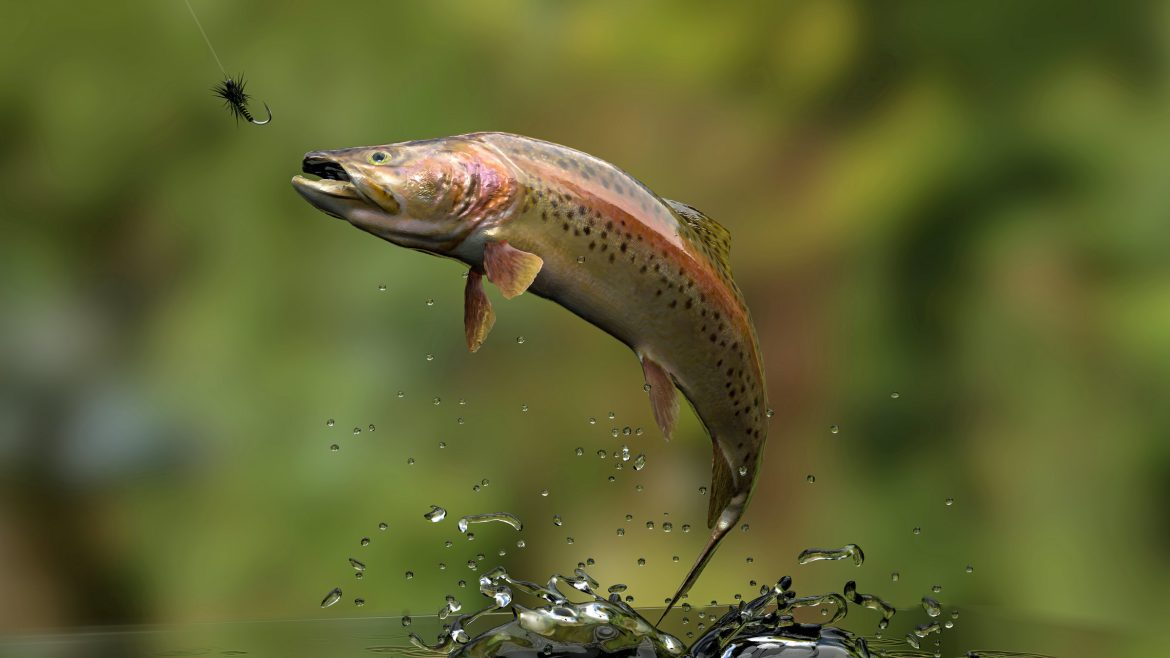
Fish and amphibians have a kind of neck after all, according to new research that redraws one of the oldest lines in animal anatomy.
Scientists who filmed trout and salamanders feeding found the animals bend sections of the backbone to move the head on its own.

The finding challenges a rule taught in biology for generations – that a true neck belongs only to four-limbed animals like us.
It also touches a much deeper question about how the first creatures left the water and began to live on land.
What, exactly, is a neck?
The textbook neck is the run of bones between the skull and shoulders that allows the head to turn and tilt while the rest of the body stays put.
That description fits mammals, birds and reptiles neatly. It has never fit fish, which were long written off as animals with no neck at all.
Roxana Taszus, a postdoctoral research associate at the University of Liverpool, suspects that clean split has been hiding something.
Reading through decades of anatomy studies, she and her colleagues kept hitting the same snag. No two studies defined the neck in the same way from one group of animals to the next.
That inconsistency has real consequences. Without a shared definition, comparing necks across the animal kingdom is nearly impossible, and the way the neck evolved becomes far harder to trace.
Rethinking the vertebrate neck
Taszus and her team set out to define the vertebrate neck in a way that works for any backboned animal, whether it swims or walks. Their analysis rests on both shape and movement.
Dr. Ariel Camp, a University of Liverpool biologist who studies how animals move, explained this in an email to Earth.com. “We think ‘neck’ should mean the bones of the spine that allow the head to move independently of the body.”
That functional test, rather than a fixed set of bones, is what makes it possible to line up necks that look nothing alike.
Reading the backbone
To see what a fish actually does with its spine, the team used X-ray video, and filmed the animals as they lunged at food. The researchers then rebuilt their moving skeletons as three-dimensional computer models.
Frame by frame, the movement came into focus. They could see the bends between bones, the magnitude of those bends, and where in the vertebral column the motion started and stopped.
That method had already turned out to be a surprise. A 2021 study, led by Camp, filmed feeding fish and found they raiseed their heads in an unexpected way.
Instead of pivoting only at the joints just behind the skull, a rainbow trout flexes as much as two-thirds of its spine to lift its head toward food. A frogfish does something similar, swinging large portions of its backbone to aim its head.
Fish necks do unexpected things
“I was really surprised by how complex these neck motions can be in fish,” said Camp when asked by Earth.com what surprised her most.
In a frogfish, the spine coils and then uncurls as the animal lifts its head. A trout bends its spine upward to raise the head while also flexing side to side to swim. That gap between shape and motion ran through the whole project.
The team separated the morphological neck, which describes vertebrae near the head, from the functional neck, which describes the bones that genuinely move the head.
Where nearly all mammals carry seven neck bones, fish break every pattern. In some species the vertebrae behind the head disappear entirely; in others they fuse into a single, rigid block, or grow into unusual specialized shapes.
The notion that a fish might own a neck is not actually new. As far back as the 1940s, anatomists noticed that the vertebrae directly behind a fish’s head can form their own distinct zone, marked off from the rest of the spine.
What has changed is the power to prove this in a living animal. “Only recently, with tools like X-ray video, have we been able to show the functional neck of fish and demonstrate their ability to move the head independently from the body,” explained Taszus.
A neck’s deep past
The deeper reason to care reaches back hundreds of millions of years. When the first animals dragged themselves onto land, a movable head was part of the equipment.
The oldest neck known from the fossil record belongs to Tiktaalik roseae, a flat-headed predatory fish from about 375 million years ago.
Most fish carry bony plates that lock the skull to the shoulders and pin the head in place. Tiktaalik had lost those plates.
A separate study of its skull argued that the loosening let the head swing freely – a change bound up with hunting in shallow water and, later, on land.
Those shallow-water pioneers sat right at the origin of the tetrapods, the four-limbed lineage that every land vertebrate, humans included, descends from.
Their loosened, mobile heads were an early version of the same trick that living fish are now revealing.
Salamanders set the scene
That evolutionary thread is why the team has now turned to salamanders. These amphibians are the closest living stand-ins for the earliest four-limbed animals, the creatures that first divided their lives between water and land.
The researchers have only just begun filming salamanders as they feed, both underwater and on dry ground, mapping how each animal coordinates head and spine in the two settings. Biologists already agree salamanders do have some kind of neck.
What no one has pinned down is exactly which vertebrae do the job, and how those bones behave during a lunge at prey. Answering that would do far more than settle a quarrel over words.
Onto dry land
A neck that can raise and aim the head is what allowed early land animals to feed and scan their surroundings while their bodies stayed braced against the ground. Tracing where that ability began fills in a chapter of our own journey out of the water.
The larger prize is a single, consistent measure of the neck that holds across every branch of the vertebrate tree.
“We think this new, broader definition of the neck will be a helpful tool that lets the community better compare and combine these studies,” said Camp in response to questions from Earth.com.
For an animal long filed as lacking a neck, the fish is proving both stranger and more familiar than the textbooks allowed. What began as a quarrel over a definition is turning into a clearer picture of how heads first learned to move on their own.
The research was presented at the Annual Conference of the Society for Experimental Biology, held in Florence.
—–
Like what you read? Subscribe to our newsletter for engaging articles, exclusive content, and the latest updates.
Check us out on EarthSnap, a free app brought to you by Eric Ralls and Earth.com.
—–
