
Buying a car in India has never been just about getting from one place to another. It has long been tied to aspiration, status, independence and, increasingly, identity. Today, India is the world’s third-largest automobile market by volume, producing over 30 million vehicles annually across categories. Yet, for all its scale, the industry’s biggest transformation is perhaps not happening on factory floors or dealership networks, but in the minds of consumers.
The Indian car buyer now arrives armed with weeks of research, YouTube reviews, Reddit threads, creator recommendations, AI comparisons and price calculators. By the time they walk into a showroom, they often know the variants, features and financing options as well as the salesperson does. In this environment, advertising can no longer rely on glossy highway shots, horsepower figures or celebrity endorsements alone. Specifications still matter, but they rarely win consideration in isolation. Instead, marketers are tasked with answering a more layered question: where does a vehicle fit into the consumer’s life, and why should that story matter?
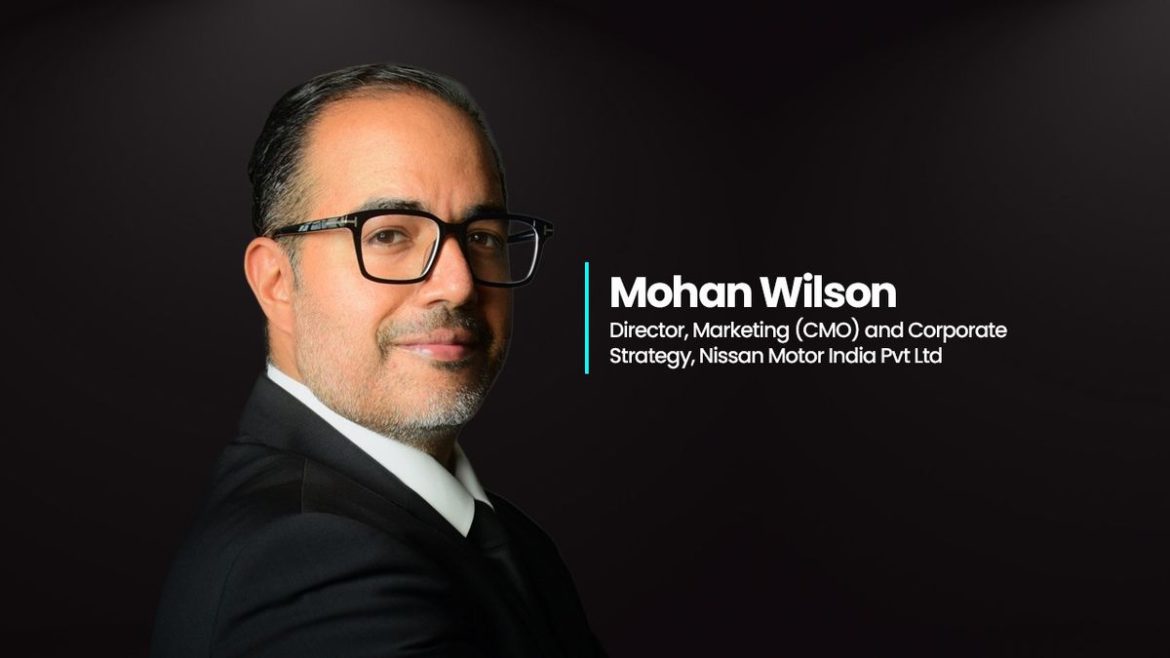
This shift has pushed automobile brands to rethink everything from storytelling and media planning to customer experience and digital ecosystems. For Nissan India, that evolution has coincided with a renewed product push, anchored by models like the Magnite and the recently launched Gravite, alongside investments in connected customer experiences through platforms such as Nissan One. In this conversation, Mohan Wilson, Director – Marketing (CMO) and Corporate Strategy, Nissan Motor India Pvt. Ltd., discusses why relevance has overtaken reach, how AI is changing customer engagement and more.
Edited Excerpts:
Q. The automobile category in India has traditionally leaned heavily on product-first communication. But increasingly, we’re seeing brands move toward lifestyle and identity-led narratives. Where do you think this shift is coming from, and how is it reshaping how auto brands build equity today?
The shift is fundamentally driven by the consumer. Today’s buyer is far more informed, digitally exposed and context-driven, so brand equity can no longer be built on specifications or price alone. Product substance continues to be critical in our category, but increasingly, brands are expected to demonstrate how a vehicle fits into people’s everyday lives, routines and aspirations. It is the overall value that a product brings in – beyond mere features.
We have seen this play out clearly with the Magnite, which has crossed over 200,000 cumulative sales globally. Its success underscores that strong product value, when combined with relevant and relatable storytelling, can drive both scale and deeper brand connection. At Nissan, our direction in India reflects that balance — strong product substance, expressed through relevance, usability and customer experience. With recently launched Gravite, for instance, the communication is anchored in how Indian customers actually use an MPV — shared journeys, modularity, comfort, safety and ease of ownership, rather than relying only on feature-led messaging.
Q. In a market that is both price-sensitive and aspiration-driven, auto marketing often has to straddle rational and emotional storytelling. How do you decide which lever to pull harder for a given campaign or product? Given this, how has Nissan’s storytelling evolved over the years, and where do you stand today?
At Nissan, the starting point is always the role the product plays in the consumer’s life. If the product is chosen primarily for practical, family or usage-led reasons, then the storytelling has to lean harder on rational strengths like functionality, safety, comfort, versatility and total value. If the purchase is more identity-led, the emotional layer can be dialled up.
Our storytelling in India has evolved in that direction, from being more conventionally product-forward to being more insight-led, while retaining strong product credibility. We have seen this approach work effectively with Magnite, where a compelling value proposition combined with sharp, insight-led communication helped the brand connect with a wide and diverse customer base globally. With Gravite, for instance, the narrative is rooted in functional usage and togetherness, while platforms like Nissan One extend this further by building a broader, customer-first ecosystem. As a unified, single sign-on digital platform, Nissan One seamlessly integrates the entire customer journey — from initial inquiry and test drive booking to vehicle purchase and real-time service scheduling creating a more connected, intuitive, and personalised brand experience around the product, extend this further by building a broader, customer-first experience around the product.
Q. Auto has historically been a high-spend category on mass media like TV, but digital is now far more measurable and performance-driven. How has your media mix evolved in the last 3–5 years, and what does ‘effectiveness’ mean to you today beyond just reach?
Our media approach is much more full-funnel than it used to be. Reach still matters, especially in a mass category, but effectiveness for us now means whether communication is helping the consumer move meaningfully from awareness to exploration to action. That is where digital has become far more important, because it allows us to connect storytelling with utility.
Effectiveness today is not just how many people saw the campaign; it is also how many took the next step, how frictionless the journey felt, and whether the experience stayed consistent across touchpoints.
Q. The Indian auto buyer today is far more informed, digitally native, and often enters the showroom with pre-formed opinions. How has this changed the role of marketing in influencing consideration versus just reinforcing decisions?
It has changed the role of marketing quite fundamentally. Earlier, a lot of persuasion happened at the dealership. Today, a large part of consideration is being shaped before the customer even steps into a showroom. That means marketing now has to do more than generate awareness — it has to simplify decision-making, answer questions earlier, reduce friction and create continuity between digital and physical touchpoints. This ensures that the transition from research to showroom to ownership feels far more seamless, intuitive, and efficient.
Q. Younger consumers, especially Gen Z, are entering the auto-buying funnel differently—sometimes valuing access over ownership. How is this influencing your targeting and messaging strategy? Can you speak about your target audience?
Gen Z are definitely changing the path to purchase. They expect speed, transparency, flexibility and much more digital-first brand interaction. But in India, ownership still remains a very powerful milestone, especially when it is tied to utility, progress and independence. So our approach is not to assume a single youth mindset, but to recognise that younger audiences want both relevance, convenience and gratification. In the context of Nissan, our target audience is consumers who are practical, digitally engaged and value-conscious, but who also expect the experience to feel contemporary.
Q. With the launch of Gravite, what was the core consumer insight that shaped its communication strategy, and how did that differ from your previous launches?
The core insight behind Gravite was very clear: there is a large set of Indian customers looking for a vehicle that can do more, every day. It has to support commuting, shared travel, business and household usage, longer drives, changing seating needs and practical ownership realities — all without becoming complicated or unaffordable. That is why Gravite has been positioned around roominess, modularity, comfort, safety and value at an introductory Launch price of INR 5.65 lakh without compromising on emotional elements such as styling. Here, the product truth is functional usage, and the storytelling had to reflect that honestly.
Q. EVs are one of the biggest shifts in the category, but consumer scepticism around range, infrastructure, and long-term value still persists. How do you market a category that consumers are curious about but not fully convinced by?
We, at Nissan, market it through confidence-building, not hype. In a category like EVs, consumers are not just evaluating the product; they are evaluating the ecosystem around it — charging, service support, running economics and long-term peace of mind. So communication has to be transparent, educational and grounded in actual use cases.
From a Nissan standpoint, our larger approach in India is already moving in that direction: build stronger product relevance, strengthen customer touchpoints, and make the ownership journey more dependable. That same discipline applies to EV communication as well — clarity over exaggeration, and trust over noise.
Q. AI is increasingly being used across the funnel—from creative generation to predictive targeting. Where are you seeing the most tangible impact of AI in your marketing ecosystem today?
The most tangible impact is where AI can remove friction. That includes earlier-stage product discovery, more conversational engagement, faster responses, better lead handling and stronger continuity across touchpoints. With the Nissan AI assistant, that value is very visible because it turns exploration into a more natural dialogue rather than a static information search. Beyond that, the next meaningful layer is in connecting digital discovery with retail and ownership journeys more intelligently. Our broader direction is clear: use technology to make the experience simpler and more relevant, while keeping the journey anchored in real customer needs.
Q. Looking ahead, what are the biggest shifts you anticipate in automobile marketing over the next 3–5 years and what can be expected from Nissan?
Over the next three to five years, I think automobile marketing will become much more integrated across product, platform, retail and ownership. The old silos between brand building, lead generation and customer experience will continue to collapse. Consumers will expect one connected journey — from first discovery to dealership to service.
From Nissan, that is exactly the direction you will see more clearly: a stronger product offensive, a future-ready portfolio that now includes Gravite and the upcoming All-New Nissan Tekton, continued investment in customer platforms like Nissan One, expanding network accessibility, and a stronger focus on delivering a high-quality, consistent sales and service experience across touchpoints.
