
There was a time when Tesla’s mission was wonderfully simple: build desirable electric cars and accelerate the world’s transition to sustainable zero-emissions energy. Today, however, that mission has evolved into something far more ambitious—and perhaps far more confusing.
Tesla remains the world’s most valuable automaker by market capitalization with a market cap of $1.218 trillion. This makes Tesla the world’s 11th most valuable company by market cap according to our Companies Market Cap data.
Yet increasingly, investors don’t appear to value it as a car company at all.
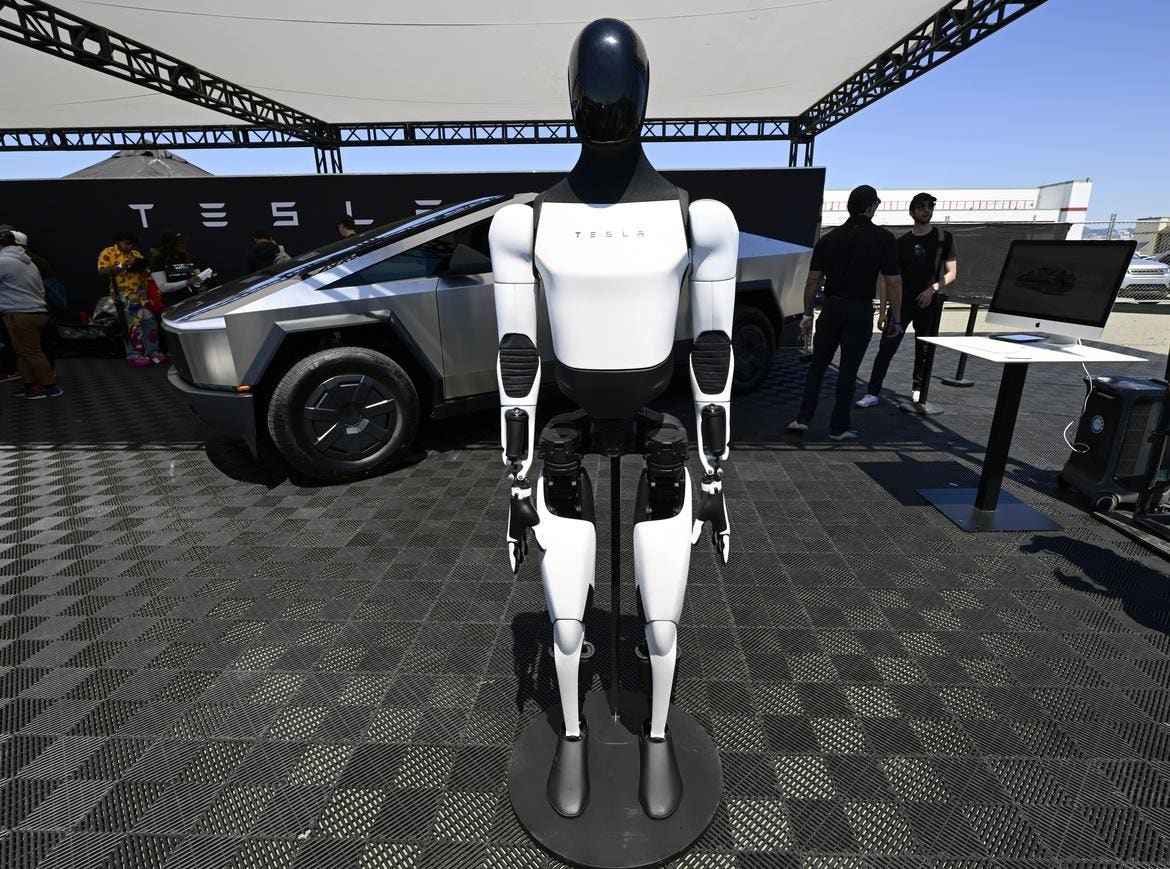
Instead, they see Tesla as an artificial intelligence company, a robotics company, an autonomous-driving company with robotaxis—and perhaps even a future infrastructure provider. Cars, once the main attraction, are beginning to look like merely the vehicles through which Tesla’s broader technological ambitions are delivered.
That transformation raises an intriguing question: Does Tesla have an identity crisis, or has it simply outgrown the automotive industry?
The numbers tell an compelling story
Traditional automakers such as Toyota, Volkswagen, General Motors and Ford continue to be judged largely by familiar metrics: vehicle sales, operating margins, production capacity and market share. Tesla, by contrast, enjoys a valuation that has often dwarfed the combined worth of several major global automakers despite producing a fraction of their annual vehicle volumes.
The explanation lies not in today’s earnings, but tomorrow’s expectations.
Elon Musk talks about Tesla’s Humanoid Robot Optimus Gen 3 at AWE2026 in Shanghai, China, in March 2026. (Photo by Costfoto/NurPhoto via Getty Images)
NurPhoto via Getty Images
CEO Elon Musk has spent the past several years steadily reframing Tesla’s future. Product launches increasingly focus less on horsepower and handling and more on Full Self-Driving software, AI training, Dojo supercomputers, humanoid Optimus robots and autonomous Robotaxis.
Even during earnings calls, discussions about new vehicle models often take a back seat to conversations about neural networks, machine learning and artificial intelligence.
For investors, the implication is clear: Tesla’s future profits may come less from selling cars than from selling software, mobility services and AI-powered technologies.
It’s a radical departure from how the automotive industry has operated for more than a century.
In many respects, Tesla resembles a Silicon Valley technology company that happens to manufacture cars, rather than a traditional automaker embracing software. Its development cycles are faster, its vehicles evolve continuously through over-the-air updates, and its competitive advantage increasingly rests on computing power rather than mechanical engineering.
That strategy may also explain why Tesla’s vehicle lineup has changed relatively little in recent years. While rivals such as BYD, Hyundai, Toyota and BMW introduce a steady stream of new electrified models across multiple segments, Tesla appears more interested in perfecting the digital brains inside its existing products.
Chinese companies are redefining the industry
Meanwhile, Chinese manufacturers are closing the gap where Tesla once enjoyed an overwhelming lead.
Companies including BYD, XPeng, Xiaomi, Li Auto and Geely have rapidly improved battery technology, software integration and autonomous-driving capabilities while expanding aggressively into overseas markets. Industry heavyweights like BYD have also introduced eye-opening world-first technologies including “emergency floating/yachting mode” on its Yangwang 8 SUV, the “dancing and jumping suspension” on its Yangwang 9. And although the ‘360-degree tank turn’ feature was first featured by Rivian in 2019, this tech has also been incorporated into its Yangwang U8 model.
The YANGWANG’s U8 and U9 models at a special area built in Istanbul, Turkiye oin September 2025 to show off its floating mode. (Photo by Muhammed Enes Yildirim/Anadolu via Getty Images)
Anadolu via Getty Images
What this means is Tesla no longer enjoys the technological exclusivity it once did. Ironically, this growing competition may be accelerating Tesla’s shift away from being judged solely as a vehicle manufacturer.
If Chinese rivals can match Tesla on battery range, charging speeds and vehicle quality, then Tesla needs another way to distinguish itself. Artificial intelligence, autonomous driving and robotics offer precisely that opportunity.
The company’s Optimus humanoid robot may eventually prove more valuable than any individual vehicle program if it succeeds in transforming manufacturing, logistics and even household automation. Likewise, a successful Robotaxi network could fundamentally alter how consumers view vehicle ownership.
That possibility helps explain why investors continue assigning Tesla a valuation that appears difficult to justify using conventional automotive metrics alone.
This strategy is not without risk
Many of Tesla’s biggest promises—including fully autonomous driving—remain works in progress. Regulatory approval, technological hurdles and public acceptance all stand between today’s demonstrations and tomorrow’s commercial success.
Meanwhile, Tesla’s core automotive business still faces slowing demand in some markets, intensifying price competition and increasingly capable rivals from China and Europe.
The irony is difficult to ignore. Tesla revolutionized the automotive industry over the last 15 years by proving electric vehicles could outperform gasoline cars. Now, just as the rest of the industry has embraced electrification, Tesla appears determined to push its automotive business down the queue—or at least redefine what it means to be a car company.
Perhaps Tesla doesn’t have an identity crisis after all. Perhaps it knows exactly where it’s headed and we are just catching up.
For more than a century, the world’s biggest car companies have built autos. Tesla increasingly believes it is building intelligence. Whether investors ultimately prove to be right will determine not only Tesla’s future, but perhaps the future definition of the automobile itself.
