
Free for nonsubscribers
By Howard Hardee
July 28, 2026, © Leeham News: Neither half of the global airliner manufacturing duopoly emerged from the Farnborough International Airshow with a totally new trajectory, but Boeing went home with a surprisingly large share of the total aircraft orders secured—reinforcing the perception of growing trust in Boeing during the era of chief executive Kelly Ortberg.
However, overall order totals fell well short of lofty forecasts published by some industry analysts prior to the show, which pushed as high as 800 aircraft.
Narrowbody and widebody aircraft orders combined for a relatively muted total of 327—173 for Boeing and 154 for Airbus. This is a far cry from the 1,100-plus-aircraft order bonanza of the 2018 Farnborough air show, or even the more modest 500-something order totals from other shows in the 2010s.
Perhaps airlines balked at the extremely long backlogs both airframers are working through. At this point, ordering Airbus or Boeing jets amounts to getting in the back of a very long line, with estimated delivery dates stretching into the mid-2030s.
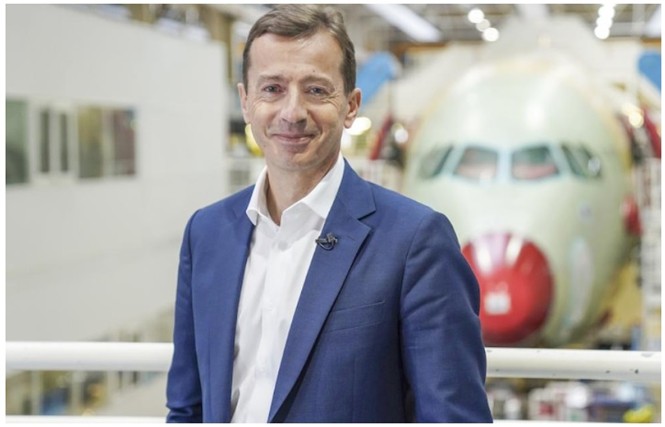
Airbus CEO Guillaume Faury explained to reporters why Airbus has updated its medium-term investor guidance with a more-optimistic outlook. Photo credit: Airbus
If one had to pick a “winner” at Farnborough, it would likely be Boeing because of the changing perception of the company’s commercial business, contrasted with Airbus continuing to tout the advantages of its strong orderbook and dominance in the single-aisle space. In other words, the narrative surrounding Boeing has changed markedly, while Airbus continued projecting confidence in its market position, which is nothing new.
But Airbus still took something of a victory lap at Farnborough, taking the opportunity to boost investor expectations through the end of the 2020s.
Strength in numbers
The French airframer announced a €5 billion share buyback plan over the next three years—a sign of significant surplus cash—and a target of €12-€13 billion in adjusted EBIT (earnings before interest and taxes) for the full year of 2029.
Airbus management expects roughly €10 billion of the 2029 EBIT target to come from the company’s commercial business alone.
During a media briefing in London last week, chief executive Guillaume Faury said the buyback plan and the new mid-term guidance reflected strength across Airbus’ portfolio. On the commercial side, he highlighted Airbus’ 9,200-strong aircraft backlog and plans to reach monthly production rates of 75 A320neo-family jets and 12 A350s.
“Demand is there. The supply chain is prepared; we have the supply chain in a much better place,” he said. “We’re still having issues here and there, and that will probably continue as we continue to go higher. But it is in a much better place than the years coming out of Covid.”
Airbus is still constrained by supply chain tightness, most notably on engine availability. Faury acknowledged that the airframer wants more geared turbofans (GTFs) than Pratt & Whitney is “currently willing to allocate to us”. The engine maker has recently focused on handing engines to airlines struggling with aircraft grounded due to the years-long GTF recall, which has affected A320neo operators most acutely.
Faury asserts that engine-related issues will be fully behind Airbus by 2028, as P&W rolls out its GTF Advantage upgrades and the engine maker finally clears its backlog of GTFs that require extensive time off-wing for earlier-than-expected overhauls.
Echoes of the past
Critics of the share buyback plan interpret it as a sign of Airbus placing greater emphasis on shareholder value. Some observers are wary of Airbus embarking on a path similar to the one taken by Boeing starting in the 1990s, which included cost-cutting measures, leaner staffing, and prioritizing profits—with a clear focus on rewarding investors.
Aerospace historian and LNA editor-at-large Scott Hamilton has chronicled Boeing’s cultural shift following the merger with McDonnell Douglas in 1997. The transition began under former CEO Phil Condit and accelerated under successor Harry Stonecipher; the latter’s management style was often associated with that of former General Electric CEO Jack Welch. Boeing’s business-first management philosophy was then maintained by James McNerney, Dennis Muilenburg and David Calhoun, all of whom oversaw share buybacks. Critics argue that this line of Boeing leaders often placed profit-seeking above engineering goals, contributing to the quality and safety breakdowns that have defined the company’s recent history. (Muilenburg, who was a career Boeing engineer before becoming CEO in 2015, presents a more nuanced case, though he mostly followed business practices established by McNerney.)
Boeing’s cautionary tale does not offer a straightforward comparison to present-day Airbus, which is generating a massive flow of free cash and has plenty available for research and development purposes. While there is evidence to suggest that Airbus is becoming increasingly shareholder-friendly, there is less evidence that the airframer’s engineering rigor is eroding. It is also difficult to fault any publicly traded company for pursuing profits; mature industrial firms often invest heavily in developing future products and return excess cash to investors.
Precedent suggests it is possible for Faury to please Wall Street analysts and oversee the launch of a successful aircraft program, without sacrificing one for the other. Condit, for example, oversaw the McDonnell Douglas merger and began centering Boeing’s strategies around business performance, but he was also a senior leader during development and launch of the 777 Classic—considered by some to be “legacy” Boeing’s last great program.
In fact, the overwhelming industry consensus is that Airbus appears better-positioned to launch a clean-sheet jet, based on Boeing’s shaky-but-improving financial situation and present focus on production stability.
Eyes on the future
Faury is confident that Airbus will be able to launch its next-generation single-aisle program by 2030 because the company has been preparing to do so since 2018.
“We started to look at what needed to be done and how to structure the company to be prepared for the next generation of products,” he said. That includes building a “digital backbone” to design and produce the successor to the A320neo family.
“We are not there yet,” he said. “We are maturing technologies, but we have a roadmap that leads to being fully prepared for the launch in 2030 and entry into service in the back end of the next decade.”
Propulsion remains an area of major uncertainty. Airbus is still unsure if CFM International’s RISE program, which includes a radical open fan engine design, will deliver estimated efficiency gains after accounting for weight added by reinforcing fuselages to protect passengers from blade-out events. Whether that design or a more conventional turbofan will power the airframer’s next jet is one of the most significant questions hanging over the commercial aerospace industry.
Meanwhile, the company is advancing its Wing of Tomorrow program, which is examining the potential of higher-span wings produced with composite materials. Airbus is looking at folding wingtips, similar to those featured on the 777-9, to provide lift on its next narrowbody jet.
Airbus expects almost all of the efficiency gains over the A320neo family to come from next-generation engines and wing advancements, rather than fuselage design.
More immediately, Airbus is reportedly considering stretched variants of the A220 and A350 but did not confirm such plans at the Farnborough air show, rather emphasizing the ramp-up in monthly production rates across its commercial programs. Industry observers will watch closely for signs that Airbus is seeking to stretch the A350 to better compete with Boeing’s still-not-certificated 777-9.

Airbus is extending the wings of an A320neo test-bed aircraft as part of its Wing of Tomorrow program. Photo credit: Airbus
Who’s on deck?
Notably, Faury may not helm Airbus fully into its next era. His current term as CEO ends in April 2028, before the company’s stated timeline for launching its next narrowbody program.
“I am fully available for the board to do what they think is appropriate for the company,” he said. “I enjoy what I’m doing, but as the same time, 10 years down the road I will most probably no longer be in the company, and I will look backward and want to see a good transition at the right time.”
LNA will publish a follow-up story after Airbus reports second-quarter earnings on July 29.
Related
