
From the February 1993 issue of Car and Driver.
Lexus, a name rapidly becoming a synonym for smooth, has slipped a new car into the gap between its most expensive (the $48,733 LS400) and inexpensive (if the ES300, at $27,930, can be called inexpensive) automobiles. The new GS300, which officials of Toyota’s luxury-car division view as a competitor to such roadrunners as the BMW 5-series and Mercedes-Benz 300s, will be priced “in the mid-thirties,” according to Lexus boss J. David Illingworth.
The driving force behind this new driving machine was Hiroyuki Watanabe, whose advanced degree was in aerodynamic and who believes the airplane of Orville and Wilbur Wright to be the 20th century’s most significant discovery. Watanabe, who wound up at Toyota instead of Mitsubishi because the Toyota company cafeteria offered tastier food, maintains that the luxury-car buyer has two basic demands: “an expansive, comfortable interior and a high level of perfomance.” If there remains any doubt that Watanabe is swayed by the siren song of fast movement, consider that he also expresses devotion to “the exhilaration of driving.”
What kind of an automobile, then, has this disciple of rising speed wrought?
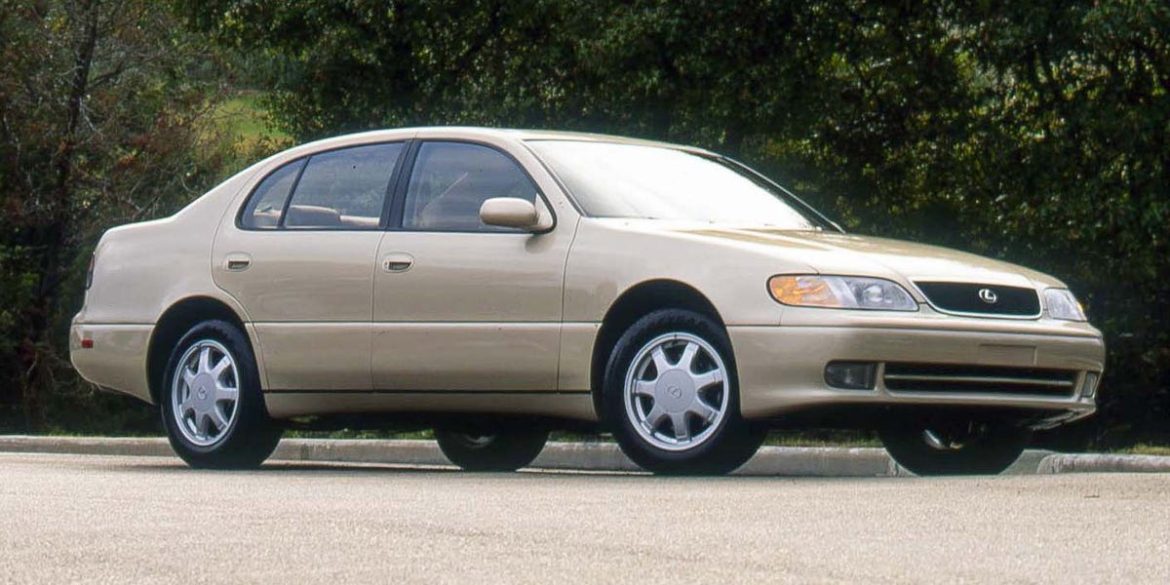
First, the GS300 looks every inch a Lexus, though it displays more visual personality than the LS400. The original design came from Giorgetto Giugiaro’s Ital Design studios and received only minor tuning—primarily at both ends and on the aerodynamic rocker panels—at the hands of Lexus designers. The result is a car that looks expensive and aerodynamic (its drag coefficient is 0.31), and which verges on looking more Italian than Japanese, not surprising considering the design source. Its styling most likely will not offend anyone, but neither will it bring design critics to their Gucci-shod feet shouting, “Breakthrough!”
Once you move to the inside and position yourself in the electronically adjustable leather (optional) seat, a cursory look around could lead you to believe that you’re sitting in an LS400 and not a lesser car. This is not altogether an optical illusion; the GS300’s interior measurements are close to those of its larger relative. It also has the same tilting and telescoping wheel, which automatically retracts itself to allow easy entry and exit. And the console, though differing slightly in button-and-switch design and placement, also looks distinctly like the LS400’s. The same comforting and expensive feel attaching to every surface and control you touch in an LS400 carries over to the new GS300. None of this is a bad thing.
On the more practical side, the interior is blessed with dual front airbags and seatbelt pretensioners, and the ergonomic arrangement of all the controls is what we’ve come to expect from Toyota’s luxury division—which is to say that the ergonomics are excellent. We’re convinced that a being from another planet could sit down in a Lexus and figure out how things are meant to work before you could say Zarathustra. The rear seat can accommodate large persons, two of them anyway, in perfect comfort. A third rear-seat passenger comes under the heading of possible rather than desirable, but that is true of most sedans.
While we’re discussing practical matters, the optional Lexus on-board telephone system merits a mention. It’s a hands-free system designed to remember and respond to as many as twenty oral commands. Though we didn’t have a chance to try it, Lexus tells us that one need simply call out a name, say “Kirstie Alley,” and it dials her number. Assuming you have the number, of course. When a connection is made, a digital filter keeps car noise out of the conversation, and the radio and fan volumes are automatically reduced. The phone can also be removed from the car to become a portable unit that will fit in your pocket.
Driving the GS300 was as smooth as we expected, almost too smooth for a car that aspires to displace the BMW in the hearts of driving enthusiasts. The power (220 hp) comes from the same in-line six that powers the Lexus SC300 coupe (down 5 hp because of the exhaust configuration), but the shifting is automatic only. Though the four-speed transmission could not be more seamless, some driving enthusiasts are sure to lament the absence of a five-speed manual gearbox.
In a limited amount of driving in the Texas Hill Country—including a lunch stop near Fredericksburg at Johnny Nicholas’s Hill Top Cafe, where the car got high marks from parking-lot observers and we got a great meal—we felt that the suspension handled the roads and the car’s available power easily. The rear-drive layout, coupled with an unequal-length control-arm front suspension and a multilink rear setup, lets the car keep its manners under pressure. When the rear end does step out, it does so predictably and smoothly.
Our testers achieved a 0-to-60-mph time of 8.7 seconds, a skidpad number of 0.82 g, and a 70-to-0-mph topping distance of 177 feet. So the GS300 accelerates a bit slower than a BMW 535i, but its handling and braking are certainly comparable.
The ride is superb, every bit in keeping with Lexus tradition. The front and rear subframes—helped along by liquid-filled mounting cushions—keep things inside the structurally rigid cabin extremely quiet and smooth, but the road feel that we like to experience in a BMW or Mercedes is nearly absent. Though the car combines good linear control, good cornering, and comfort, it does not exhibit as much quickness born of power as some drivers will demand.
Were we to divide cars of this class into performance-luxury cars and luxury-performance cars, we would place the Lexus GS300 in the luxury-performance category—entirely because Lexus seems instinctively to put luxury first.

Specifications
Specifications
1994 Lexus GS300
Vehicle Type: front-engine, rear-wheel-drive, 5-passenger, 4-door sedan
PRICE
As Tested: $37,500 (est)
ENGINE
DOHC 24-valve inline-6, aluminum block and heads, port fuel injection
Displacement: 183 in3, 2997 cm3
Power: 220 hp @ 5800 rpm
Torque: 210 lb-ft @ 4800 rpm
TRANSMISSION
4-speed automatic
CHASSIS
Suspension, F/R: control arms/multilink
Brakes, F/R: 11.6-in vented disc/12.1-in vented disc
Tires: Goodyear Eagle GA
215/60VR-16
DIMENSIONS
Wheelbase: 108.4 in
Length: 194.9 in
Width: 70.7 in
Height: 55.1 in
Passenger Volume, F/R: 56/41 ft3
Trunk Volume: 13 ft3
Curb Weight: 3764 lb
C/D TEST RESULTS
60 mph: 8.7 sec
1/4-Mile: 16.6 sec @ 85 mph
100 mph: 24.1 sec
Rolling Start, 5–60 mph: 9.0 sec
Top Gear, 30–50 mph: 4.7 sec
Top Gear, 50–70 mph: 5.3 sec
Top Speed: 134 mph
Braking, 70–0 mph: 177 ft
Roadholding, 300-ft Skidpad: 0.82 g
Interior Sound
Idle: 42 dBA
Full Throttle: 72 dBA
70-mph Cruising: 68 dBA
C/D FUEL ECONOMY
Observed: 18 mpg
EPA FUEL ECONOMY
City/Highway: 18/23 mpg

William Jeanes is a former editor-in-chief and publisher of Car and Driver. He and his wife, Susan, a former art director at Car and Driver, are now living in Madison, Mississippi.
