
It is just after 8:30 on a grey morning in Hamburg when a member of the Volvo team hands me a smartphone instead of a key. There is no key fob or card: the Volvo EX60 uses a Digital Key. It is the first time I have started a Volvo test drive without a conventional key, and the experience feels unfamiliar. Whether it becomes second nature in everyday use is impossible to judge during a four-hour drive. Even so, it is a fitting introduction to a vehicle that takes a different approach in several areas.
Why the EX60 is so important for Volvo
Before setting off, it is worth explaining why the EX60 is such an important model for Volvo. It fills a gap in the Swedish carmaker’s electric portfolio. Until now, the range jumped from compact models such as the EX30 and EX40 and the large EX90 (review here), leaving the brand without the mid-sized SUV segment that has long been one of its core strengths. Measuring 4.80 metres in length, the EX60 is the electric counterpart to the conventionally powered XC60, which will remain on sale alongside it.
I deliberately leave the city behind and head towards the Alte Land. The reason is simple: I want to drive, not spend the journey in stop-and-go traffic. The route covers around 30 kilometres each way, taking in motorways, country roads and a short stretch of urban driving. Each leg takes about 50 minutes. The weather is typical for northern Germany, with temperatures of 18 degrees Celsius, mostly cloudy skies, occasional rain and brief spells of sunshine. I set the seat heating to level two, the steering wheel heating to level one and the interior temperature to a comfortable 22 degrees Celsius. Like all the test vehicles available that day, my car is a P10 AWD Ultra, combining the mid-range powertrain with the highest trim level.
Exceptionally quiet, powerful powertrain
Within the first few kilometres, one thing stands out above all: the silence. The EX60 is exceptionally quiet, and that is no coincidence. The optional Bowers & Wilkins sound system with 28 speakers actively generates anti-noise, making the cabin feel even more serene than it already is. The result is an interior that resembles a soundproofed room. The effect is particularly noticeable on the motorway, where wind noise would normally dominate.
The motorway also highlights the character of the P10’s dual-motor powertrain. Delivering 375 kW (510 PS), it provides strong acceleration without feeling aggressive or artificially sporty. The performance is always available, but never demands attention. Volvo has deliberately avoided turning the EX60 into a performance SUV. Instead, the suspension smooths out uneven surfaces with ease, while the steering offers sufficient feedback and can be adjusted across several settings. After around 20 minutes behind the wheel, the EX60 feels like a refined long-distance cruiser that prioritises comfort over drama.
Driver assistance systems leave room for improvement
The country roads towards the Alte Land also reveal where the EX60 still has room for improvement. The traffic sign recognition and speed limit detection systems are only moderately reliable and do not always identify the correct limits. In a vehicle in this price segment, these functions should simply work. At least the warnings remain unobtrusive and are less intrusive than those of some competitors.
Along the way, I also test the Google Gemini voice assistant, which makes its debut in the EX60. The results are mixed. When asked about the multi-adaptive seatbelts, the system provides a detailed, vehicle-specific answer. However, when I ask about the availability of a roof rack, the response is so generic that it offers little practical value.
Spacious interior with Scandinavian design
After the first leg of the journey, I stop to take a closer look at the EX60 while stationary, focusing on the interior, luggage compartment and practical details. This is where the almost three-metre wheelbase makes a noticeable difference. I first adjust the driver’s seat for a person measuring 1.90 metres, then climb into the rear at my height of 1.65 metres. There is more than enough space, and even someone around 1.70 metres tall would still have ample legroom.
The interior combines a premium feel with the typically Scandinavian design language expected from Volvo. The large panoramic glass roof can be dimmed via the central display, while the storage compartments are practical and well designed. The boot offers 523 litres of luggage capacity, increasing to 1,647 litres with the rear seats folded down. A 58-litre front trunk provides additional storage. Details such as a removable bucket, a carry bag and the split-load floor may seem minor, but they are the kind of practical features that prove useful in everyday driving.


When stepping out, one detail stands out in particular: the door handles. Volvo has introduced a so-called Wing-Grip design that resembles a small fin or serrated edge. I was initially sceptical, as unconventional door handles often take some getting used to. In the EX60, however, they sit exactly where I instinctively reach, so no adjustment is required.
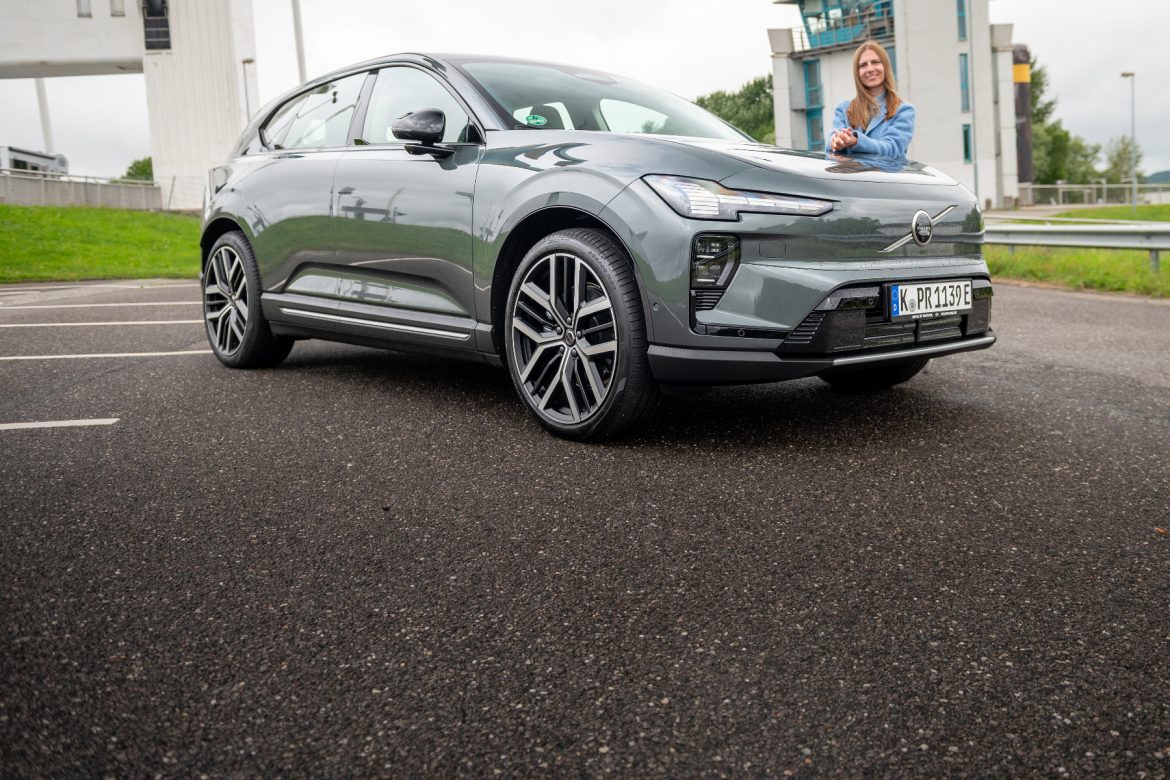
The exterior also stays true to Volvo’s design language. That is meant as a compliment. The EX60 has a clean, understated appearance shaped by Scandinavian minimalism, without looking bulky. Its proportions are closer to those of an estate than a tall SUV, giving it a more elegant stance than many rivals in the segment.
My test car is finished in the new Forest Lake paint, a semi-dark metallic green that shifts between forest green and turquoise depending on the light. It is my personal highlight of the exterior. Overall, however, the colour palette remains restrained. Buyers who appreciated the EX30’s Moss Yellow or Cloud Blue will find the EX60’s paint options considerably more subdued.
Too much reliance on the touchscreen
On the return journey, I turn my attention to the controls. Almost all vehicle functions are operated via the central touchscreen, including features that would arguably benefit from dedicated physical controls, such as the exterior mirrors, headlights and air vents. At least the mirror adjustment and steering wheel controls are accessible via clearly identifiable shortcut buttons. Less convincing is the placement of the hazard warning lights in the lower right corner of the display, making them easier for the passenger to reach than the driver. Volvo has at least retained a physical hazard light button at the top centre of the dashboard.
The steering wheel is another distinctive feature. It is unusually compact, flattened at the top and bottom, and uses a two-spoke design. According to Volvo, the smaller steering wheel ensures an unobstructed view of the driver display, which is positioned high up near the windscreen, allowing the driver to see both the instruments and the road more easily. The concept makes sense, and the steering wheel feels better in the hand than I had expected. Even so, it remains a matter of personal preference. In a vehicle of this size, I would have preferred a slightly larger, more substantial steering wheel. It is one of the first details that stands out when getting into the car.


Another aspect of the cockpit that stands out is the driver display, which shows only a limited selection of driving data. Information such as energy consumption or trip distance is available, but only via the central touchscreen menu. That feels unnecessarily complicated and less intuitive than displaying the data directly in the instrument cluster.
The EX60 also does not offer a head-up display, even as an option. Personally, I did not miss it, as the driver display provides the most important information. Even so, it is worth noting that many competitors in this price segment offer a head-up display.
Back at the starting point, I take a closer look at the figures. Ironically, the one feature I could not test is the EX60’s most technically significant highlight. Built on an 800-volt architecture, the SUV supports DC charging at up to 370 kW. According to Volvo, charging from 10 to 80 per cent takes as little as 16 minutes under ideal conditions, depending on the version. The test vehicles, however, started the day with a 95 per cent state of charge, and my 60-kilometre drive reduced the battery to only 83 per cent. Under those conditions, a meaningful fast-charging test was simply not possible. That is something I will have to assess on another occasion.
18.2 kWh/100 km under realistic conditions
The consumption and range figures are more revealing. At the start of the drive, with the battery at 95 per cent, the EX60 displayed a remaining range of 420 kilometres. At 88 per cent state of charge, the estimate increased to 430 kilometres before returning to 420 kilometres at 83 per cent. The temporary increase was not a fault but the result of efficient driving, with the onboard computer continuously recalculating the projected range.
The final energy consumption was 18.2 kWh/100 km. For the P10 AWD Ultra, Volvo quotes a WLTP consumption of 16.2–19.2 kWh/100 km. Considering the conditions—18 degrees Celsius, rain, motorway driving, and the use of the seat and steering wheel heating—the measured figure falls well within the expected range for an SUV of this size.
For context, my P10 AWD test car is equipped with a 95 kWh battery (gross), of which 92 kWh are usable. The dual-motor powertrain delivers 375 kW (510 PS), accelerates from 0 to 100 km/h in 4.6 seconds and offers a towing capacity of up to 2,400 kilograms. Volvo quotes a combined WLTP range of up to 613 kilometres, rising to 757 kilometres in urban driving. As with all Volvo models, the top speed is electronically limited to 180 km/h.
The Volvo EX60 starts at 62,990 euros, undercutting the XC60 plug-in hybrid by 5,000 euros. According to Volvo, a more affordable Core trim will follow at a later date, which is expected to bring the entry price below the 60,000-euro mark. My test car, fitted with optional equipment, had a list price of 77,800 euros.
Conclusion
After four hours behind the wheel, one impression stands out above all: the EX60 prioritises composure over spectacle. It delivers its performance effortlessly, adopts an understated design rather than a provocative one, and avoids overwhelming the driver with technology. Its biggest weakness is the operating concept, which relies too heavily on the central touchscreen and requires a degree of acclimatisation.
Those willing to adapt, however, will find a battery-electric SUV that successfully transfers Volvo’s traditional strengths into the electric era. The EX60 combines generous interior space, high levels of comfort, an exceptionally quiet cabin and driving characteristics that are clearly geared towards long-distance travel. Overall, it ranks among the most well-rounded battery-electric mid-sized SUVs currently available.
volvocars.com (Configurator)
