
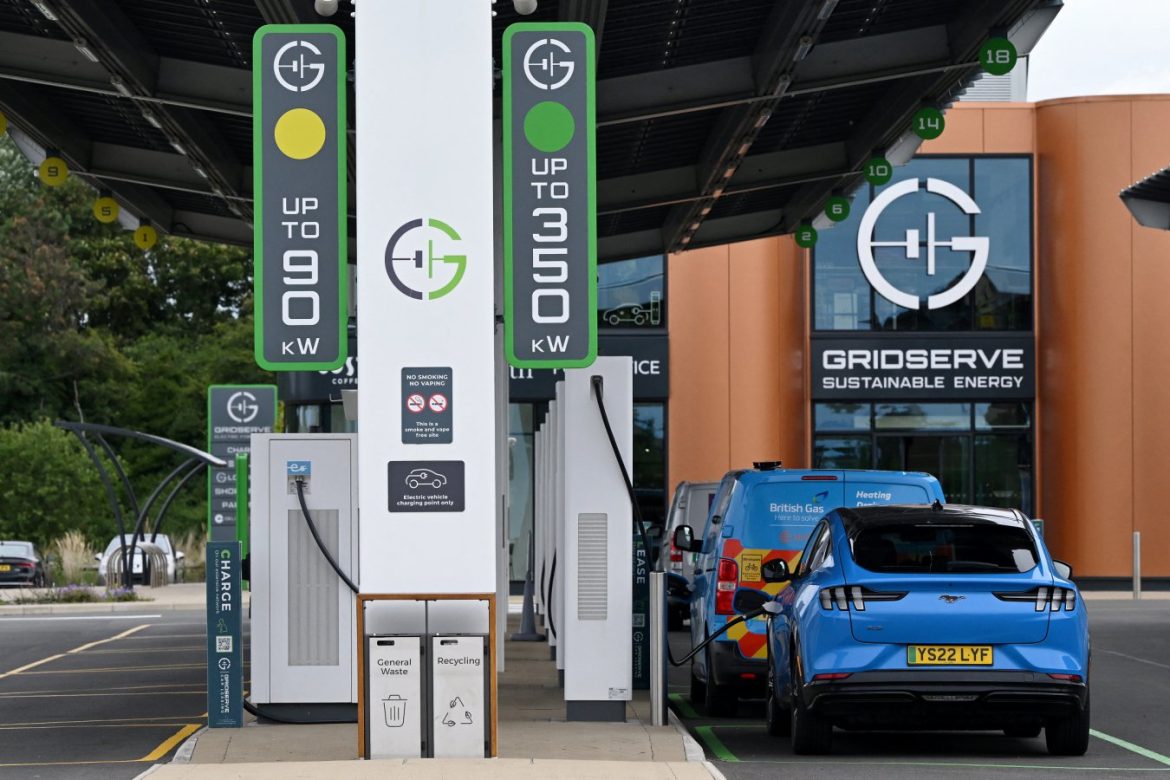

Electric cars are far better for the climate than traditional petrol vehicles
JUSTIN TALLIS/AFP via Getty Images
In a straight choice between a new petrol car and a new electric car, on climate grounds the electric car wins easily.
But what if your existing petrol car is still working fine – or is even only a year or two old? Contrary to popular belief, the overall climate impact is lower if a new petrol car is scrapped in favour of an electric vehicle (EV), new research reveals.
Studies show that although EVs produce more carbon emissions when they are manufactured, they are responsible for much lower emissions when they are being driven compared with a petrol or diesel car. Overall, the whole-life emissions for an electric car are almost 90 per cent lower than for combustion engine vehicles.
Elliott Campbell at the University of California, Santa Cruz and Roland Geyer at UC Santa Barbara wanted to find out whether drivers should wait until their current combustion engine car is ready for the scrapheap before moving to electric.
Using US data, they analysed the emissions impact of scrapping a fossil fuel car and replacing it with an EV at different points, from scrapping a car that is just a year or two old to one at the end of its life. Their modelling accounts for the emissions associated with producing and running a new electric car, and other factors including variability in the grid electricity mix, vehicle efficiency, manufacturing emissions and mileage.
“We found that in the vast majority of cases, and even for a brand new gas vehicle, you would be far better off scrapping the gas vehicle and switching to electric,” says Campbell. “It takes more energy to build an electric vehicle, but the savings from driving the vehicle swamp all the upfront costs.”
Campbell stresses he doesn’t expect people to immediately scrap their brand new cars. Instead, the study aims to show that there is zero environmental benefit in keeping a fossil fuel car on the road until the end of its life.
The findings hold true for almost any scenario, except where an electricity grid is very reliant on coal power, or when a fossil fuel car is driven less than about 7000 km per year.
“The idea here is just to simply show what a huge advantage electric vehicles offer, so that when the opportunity to make the transition [is] something that people are ready and excited to do, by all means go for it,” says Campbell. “There’s no environmental concern to hold you back.”
Kenneth Gillingham at the Yale University says the paper takes a “clever angle”. “I think what they’re talking about makes perfect sense. I’ve thought about this before [but] I’ve never thought to write a science paper on it, and I’m impressed.”
But Gregory Keoleian at the University of Michigan points out that the study is considering an “extreme case”. “It’s unlikely somebody’s going to purchase a combustion engine vehicle and retire it after a year,” he says.
Instead, those cars will likely hit the second-hand market, which could have knock-on economic and behavioural impacts, such as lowering the price of second-hand cars so dramatically that it convinces more people to switch from public transport to car use. More research is needed to model those potential impacts, says Campbell.
But the study’s authors say their findings lend support to the idea of subsidised scrappage schemes, to encourage people to scrap older fossil-fuel cars in favour of electric vehicles. Such policies could accelerate the EV transition in the US and help to cut transportation emissions, which are now the single largest source of carbon emissions in the country.
