
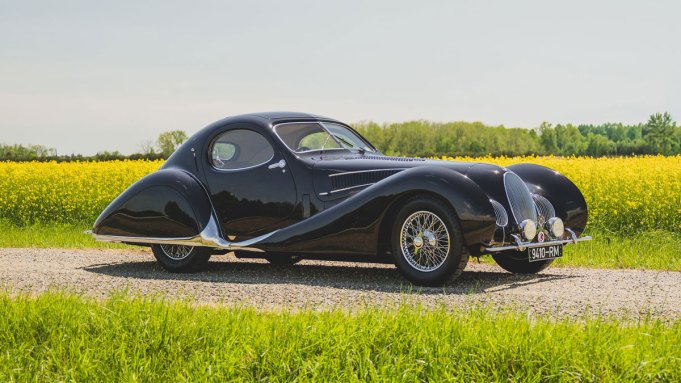
They’re known for their Art Deco aesthetic defined by flowing curves and teardrop styling. But of the 11 examples of the Talbot-Lago T150-C SS Teardrop Coupé built in 1938, with achingly gorgeous Figoni & Falaschi coachwork, one was different. It was built to race. And not just in any race. This one lined up on the grid of the 1939 24 Hours of Le Mans, and was running strongly in ninth position until lap 88, when it was forced to retire.
“See the car and you immediately picture it on the field at Pebble Beach taking top concours d’elegance honors. It’s hard to imagine it, with numbers on the doors, racing at Le Mans. That’s what makes it so unique,” Harvey Stanley, director of private sales at RM Sotheby’s, tells Robb Report.

The 1938 Talbot-Lago T150-C SS Teardrop Coupe, with coachwork by Figoni et Falaschi, being auctioned through RM Sotheby’s on August 15.
Darin Schnabel, courtesy of RM Sotheby’s
“It’s amazing to think that the next owner could enter the car in any of the world’s leading concours events, then go on to drive it hard in something like the Le Mans Classic, Mille Miglia Storica, or Goodwood Revival,” adds Stanley. RM Sotheby’s will be offering buyers that chance when this intriguing Talbot-Lago, chassis No. 90117, is auctioned on August 15 during Northern California’s Monterey Car Week.
The car itself was commissioned in 1937 by French nobleman and gentleman racer, Duke Phillippe Régnier de Massa, who wanted a car capable of competing at Le Mans. Yet the model already varied from earlier versions. The aluminum bodywork was stretched four inches and lowered two inches, so as to further reduce drag. A flush-fitting sunroof was added along with an opening rear window, so as to aid ventilation. The front end got extra driving lights, while inside, a bucket driver’s seat was designed to offer more support. The standard speedometer was replaced with a 250 kph (155 mph) unit. Additional tubing and brackets went into the engine compartment to add extra strengthening.

Inside, a bucket driver’s seat was designed to offer more support.
Darin Schnabel, courtesy of RM Sotheby’s
Under the hood, the race car was fit with Talbot-Lago’s newly enlarged 4.0-liter six-cylinder engine that was equipped with hemispherical combustion chambers and a trio of Zenith-Stromberg carburetors. To go the distance, a larger fuel tank was given, along with a race-style oversize filler.
The engine itself was rated at just 140 hp and powered the rear wheels through a four-speed Wilson pre-selector transmission. This unusual mechanism allowed the driver to pre-select the next gear before pushing the clutch. Interestingly, when de Massa and the Talbot-Lago entered the 24 Hours of Le Mans—the car wearing No. 8 on its doors and front grille—neither the man nor machine had previously competed in a major race. Thankfully, de Massa had picked French racer Norbert-Jean Mahé as his copilot; he’d finished ninth at Le Mans the previous year.

The 140 hp, 4.0-liter six-cylinder engine is equipped with hemispherical combustion chambers and a trio of Zenith-Stromberg carburetors.
Darin Schnabel, courtesy of RM Sotheby’s
While some race reports blame the retirement on a broken valve spring, others suggest the car spun when it hit a patch of oil on the track and began traveling in the wrong direction, which resulted in disqualification. Regardless, following its retirement in the contest, the car’s entire racing career came to an end just 10 weeks later, owed to the outbreak of World War II. The car is believed to have been confiscated by German forces and shipped back to Berlin. It surfaced in 1942 when it was acquired, in a rather neglected state and missing its engine, by a Herr Becker, of Rangsdorf, near Berlin.

The 2002 Pebble Beach Concours d’Elegance was chassis No. 90117’s first public exhibition since it dropped off the radar in World War II.
Darin Schnabel, courtesy of RM Sotheby’s
According to the RM Sotheby’s research team, the car was subsequently stored in East Berlin and disappeared completely during the Cold War. Records show that, when the Berlin Wall came down in late 1989, Becker sold the car to German enthusiast Peter Schmitz, who kept the car until Dutch dealer Jan Bruijn persuaded him to sell it in 1995.
A year later, San Diego-based book wholesaler, Georg Lingenbrink, bought the car, shipped it back to California, and commenced a six-year restoration that included sourcing a correct replacement engine from the U.K. The car was painted in deep aubergine, a color scheme complemented by tan pigskin leather for the interior. The exterior paint color was reportedly inspired by shiny ripe eggplants that Lingenbrink picked up at his local farmers’ market. The restoration was showcased at the Pebble Beach Concours d’Elegance in 2002—the car’s first public exhibition since it initially dropped off the radar in World War II.

In 2022, the car sold to its current owner for $7.265 million.
Darin Schnabel, courtesy of RM Sotheby’s
In 2006, renowned New Jersey–based car collector Oscar Davis bought the vehicle at Gooding & Company’s Pebble Beach auction, paying $3.905 million. Davis immediately dived into a $100,000 mechanical and cosmetic restoration of the car, commissioning Classic and Sport Auto Refinishing, of Edinburg, Va., to do the work. In 2007, it went back to Pebble Beach, and then on to Italy’s Villa d’Este in 2011, where it won the Trofeo BMW Group Best in Show award. That same year, it was displayed at the Louis Vuitton Concours d’Elegance in New York City. Following the death of Davis in 2021, the Talbot-Lago was offered at the RM Sotheby’s Monterey auction in 2022, where the current owner paid $7.265 million.

“It’s hard to imagine it, with numbers on the doors, racing at Le Mans. That’s what makes it so unique,” says Harvey Stanley, director of private sales at RM Sotheby’s, regarding this auction lot.
Darin Schnabel, courtesy of RM Sotheby’s
“This is truly a French, Art Deco–styling masterpiece, but one with a fascinating Le Mans race history,” says Stanley. “Think of it as a bridge between two worlds.” The car’s unique provenance is reflected in its estimated value of between $7 million and $8 million.
Click here for more photos of this 1938 Talbot-Lago T150-C SS Teardrop Coupe.

This 1938 Talbot-Lago T150-C SS Teardrop Coupe will be offered through RM Sotheby’s on August 15.
Darin Schnabel, courtesy of RM Sotheby’s
