
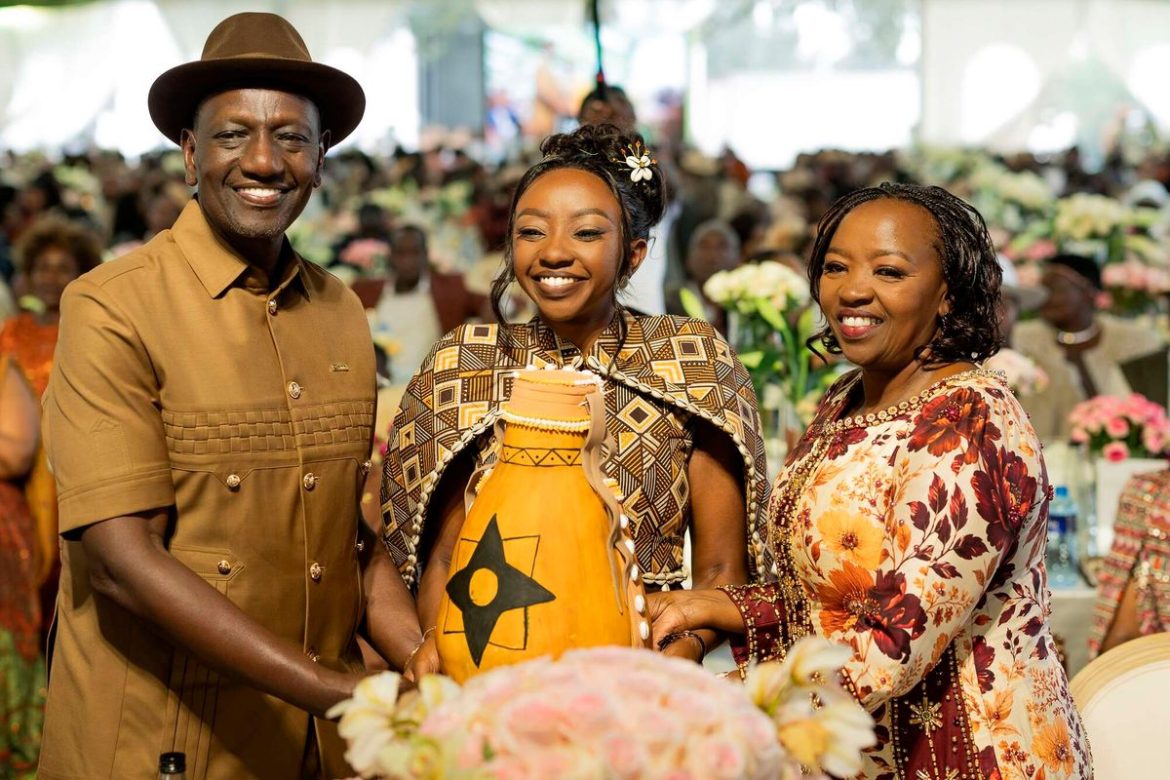
President William Ruto’s daughter Charlene Ruto and her fiancé, Tanzanian innovator Isaya Yunge, have been thrust into the limelight for their colourful traditional wedding ceremony on Saturday.
President Ruto and First Lady Rachel Ruto were the central figures during the koito ceremony at the family’s 900-acre Intona Farm in Kilgoris, Narok county.
The farm was originally owned by Kenya’s second Vice-President Joseph Murumbi, but was repossessed by the Agricultural Finance Corporation (AFC) over a debt, and later acquired by President Ruto in 2015.

Charlene Ruto serves her dad President William Ruto a piece of cake during her traditional engagement ceremony in Kilgoris, Narok County on August 9, 2026.
Photo credit: Pool
“Today, Mama Rachel Ruto and I celebrate with a grateful heart as our daughter, Charlene begins a beautiful new chapter with her fiancé, Isaya,” President Ruto wrote on his official social media accounts.
“Congratulations to you both on your engagement. May God bless your union, deepen your friendship and fill the home you build together with love, joy and enduring peace. As your parents, we are proud of you, we rejoice with you, and we will always stand beside you,” the President said.
The First Lady was full of praise for her daughter as the official engagement and subsequent marriage kicked off.
“My dear Charlene, today I bless you with a heart full of love, gratitude, and joy. Watching you grow into the beautiful woman you are has been one of my greatest blessings” Mama Rachel said.
“As you begin this new chapter, may God go before you, guide your steps, protect you, and bless the home you are about to build. May your marriage be filled with love, patience, wisdom, peace, and lasting joy,” the First Lady stated.
“May the Lord bless you, keep you, and make His face shine upon you. I love you dearly, my daughter. Congratulations,” she added.
The ceremony was reminiscent of a similar one when President Ruto and the First Lady handed over their eldest daughter June Ruto to Nigerian law scholar, Dr Alexander Ezenagu.
Dr Ezenagu and June would thereafter tie the knot in an invite-only wedding ceremony on May 27, 2021 when Dr Ruto served as the Deputy President. A year later Dr Ruto became the President of Kenya.

President William Ruto, First Lady Rachel Ruto with Charlene Ruto and Isaya Yunge, along with bride’s maids during their engagement ceremony at Ntonna Farm, Naserian Village in Narok County on August 8, 2026.
Photo credit: PCS
In Kalenjin, the term koito means giving out or handing over one’s child to start a union with an accepted partner.
Mr Weldon Oriop Kirui, an historian who is well-versed with Kalenjin traditions and culture, said in the case of Charlene, despite the social and political status of her parents, the President and the First Lady are only entitled to get a token of appreciation from the bridegroom’s family as pride price, and not the millions of shillings being bandied around in social media.
He said the bride price is set at six cows, a standard that was set several generations back, and one that has not changed to date.
“This number was set to enable every man to get a wife,” Mr Kirui explained.
The bride’s father, is also expected to receive some cash from the bridegroom as an appreciation which may be as little as Sh5,000, but is not supposed to be exorbitant as the community does not commercialize the marriage of their children, irrespective of their level of education or standing in the society.
On social media, there have been speculations that President’s family had pocketed millions of shillings in bride price.
However, Mr Kirui maintains that that is not the case, as traditions don’t allow it.
He explains that irrespective of the position held by any family member, the dowry negotiation goes through the same process, with titles not a consideration.
The bride’s mother is also supposed to be given a she-goat from the bridegroom, all of which are negotiated and itemized during the koito ceremony attended by members of the two families, their relatives and invited friends.
“All Nilotic and Cushitic people gave out cows as dowry while Bantus gave out goats. There are other communities that also give out cows” Mr Kirui said.
“The traditional wedding ceremony disappeared in most parts of Kenya in the 1980s due to modernization, since culture is dynamic,” he said.
Dowry negotiations
Dowry payment is supposed to be done before a wedding, and is conducted depending on whether it is traditional or religious.
“After the koito ceremony, the groom and his bride are allowed to proceed to the next stage called ratet (tying), which signifies that the woman now belongs to her suitor’s clan or community. They will then be free to marry begin living together as husband wife,” explained Mzee Philip Cheruiyot, an elder from Chepalungu, Bomet County.
“Marriage traditions and rites unite people and equalizes irrespective of the educational or family background. The rules and the yardstick are the same,” he explained further.
“However, there have been cases where the bride’s parents attempting to commercialize the process in the pretext of recovering the cost of educating their child. In reality, that is extortion as the man’s parents have also spent money in raising and educating him,” he says.
Some other families have also chosen to quantify the cost of the livestock that they feel entitled to. But such practices are generally frowned in the Kalenjin community.
During koito, it is the men who negotiate for dowry, while the women escort their daughter once an agreement and the timelines for payment have been arrived at.
Men do not engage in marriage negotiations empty-handed as they must have traditional sticks which they hold through the process.
The special sticks are also used ceremonially when herding cows – but not as weapons during conflicts.
The ceremony must be held at the bride’s family home, with the wedding ceremony being hosted by the bridegroom’s family.

Charlene Ruto and her fiancé Isaya Yunge with President William Ruto and First Lady Rachel Ruto during their traditional engagement ceremony in Kilgoris, Narok County on August 9, 2026.
Photo credit: Pool
Women in attendance also have traditional sticks – a branch of a palm tree (Sosiot) that are mostly decorated, and are used to clean milk gourds, signifying their gender and place in the family structure.
Isaya Yunge, 36, was born in Mwanza, Tanzania. In 2028, he was feted by Queen Elizabeth II for enhancing the way young Africans obtained scholarships.
In 2019, he was named among Tanzania’s 50 most influential young people. Prior to that, in 2017, he was listed among Forbes Africa’s 30 under 30. He has also held the position of Unicef Africa Youth Ambassador.
Yunge, who holds a Bachelor’s degree from the Institute of Finance Management, is an alumnus of Harvard Ministerial Leadership Programme. He also studied at the University of Cambridge and Swedish Institute.
Yunge is the Chief Executive and founder of SomaApps Technologies, which connects African students with available scholarships opportunities.
The Tanzanian whose names is in the lips of Kenyans is also a founder of KAYA, a smart speaker that uses artificial intelligence.
Charlene, who is 33 years old, holds a Bachelor’s degree in Mass Communication from Daystar University and a Master of Business Administration in Hospitality from Les Roches International School of Hotel Management in Crans-Montana, Switzerland.
As it is now, Yunge has pulled a fast one on Charlene’s potential suitors. The President’s daughter is officially taken.
Follow our WhatsApp channel for breaking news updates and more stories like this.
