
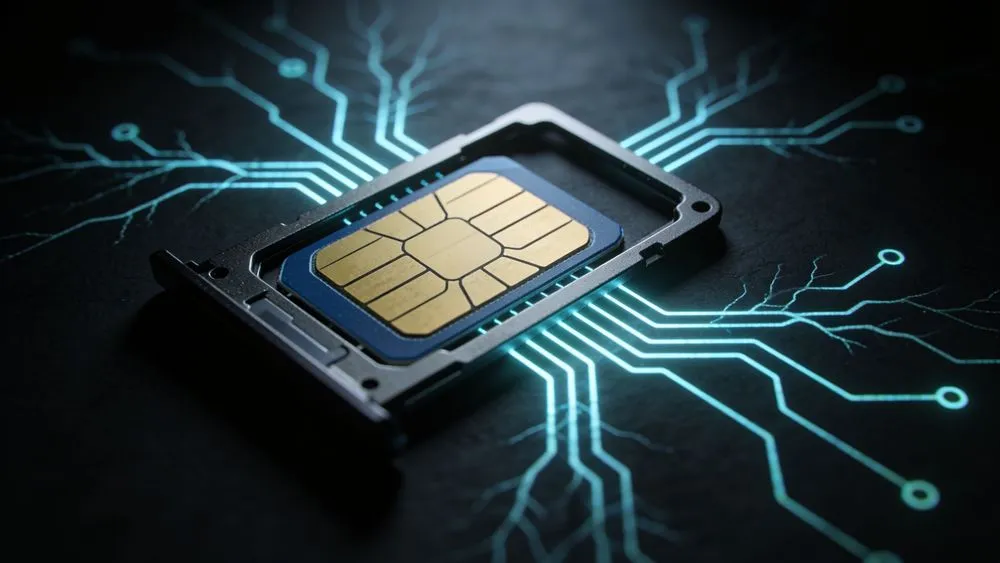
The SIM card inserted into a smartphone has long been treated as the “root of trust” in cellular networks. Subscriber authentication, storage of cryptographic keys, permission to connect to the network—all of this falls under the SIM’s jurisdiction, and devices are not designed with the premise of doubting the SIM.
Research that puts a systematic crack in this premise will be published in August 2026.
A research team consisting of Tomasz Piotr Lisowski and Marius Muench of the University of Birmingham, along with Kristian Covic of Fuzzware, focused on a specification-level mechanism called “Proactive SIM,” which allows a SIM card to send commands directly to a device’s modem. Specifically, this is the RUN AT COMMAND feature defined in Section 6.4.23 of 3GPP TS 31.111, which enables a SIM card to request that a device execute an AT command.
AT commands were designed in 1981 by Dennis Hayes and Dale Heatherington for the Hayes Smartmodem, as a set of modem control commands. Dialing a call, hanging up, changing connection parameters—this command set has continued to serve as the modem’s control language for over 40 years, and the fact that it can be executed via a SIM card is a legitimate specification explicitly documented in the telecom standard. The toolkit developed by the research team, called “CATana,” systematically verified just how far this specification could actually be exercised on modern devices.
Demonstrated Back in 2019 — So Why Does It Still Remain?
This is not the first attempt to weaponize SIM cards. In 2019, AdaptiveMobile Security (now ENEA) disclosed an attack named “SIMJacker.” This technique silently exfiltrated a user’s location and IMEI by sending a specially crafted binary SMS to an application called S@T Browser running on the SIM card. It was confirmed that 89.19% of the attacks were aimed at obtaining location data, with thousands of devices tracked, primarily in Mexico.
In 2025, Citizen Lab revealed in a report titled “Bad Connection” that variants of SIMJacker remain actively in use. Attacks routed through SS7 addresses belonging to mobile operators in Rwanda, Sweden, and Liechtenstein were observed, demonstrating that SIM cards continue to function as “sensors for spies.”
However, these prior studies targeted external attacks against the SIM card’s “software.” CATana, by contrast, targeted the direction in which the SIM card itself actively sends commands to the device—that is, the “SIM-to-device” vector. Muench stated in a press release: “The SIM’s proactive capabilities, and the attack surface arising from them, are explicitly defined in the cellular technical specifications. As a result, a ‘spec-compliant’ attack becomes possible.”
What this indicates is that the vulnerability originates not from an implementation bug, but from the design philosophy itself.
Six Attack Scenarios Exposed by CATana
The research team conducted testing on 26 devices: 18 smartphones and 8 cellular-connected IoT modules. The IoT modules included those embedded in EV chargers, industrial equipment, and connected vehicles. There was no bias toward any particular manufacturer or OS.
As a result of the testing, the team confirmed that multiple devices execute AT commands originating from the SIM, and using CATana, demonstrated the following attacks.
Of particular note is the discovery of a lock-screen bypass on recent Android devices. A malicious SIM card was able to force the device to open a website controlled by the attacker, even while the device was locked and without any user interaction. This vulnerability is tracked as CVE-2025-48618 and affects Android 13 through 16. According to NVD records, its CVSS 3.1 score is 6.8 (MEDIUM); it assumes physical access but requires no additional execution privileges and no user interaction.
CVE-2025-59440, related to Samsung’s Exynos chipsets, is also a denial-of-service vulnerability caused by improper handling of proactive SIM commands, affecting more than 20 chipsets ranging from Exynos 980 to the latest Modem 5400. Its CVSS score is 7.5 (HIGH).
Why IoT Devices Are the Most Dangerous
While smartphones can achieve some mitigation at the OS layer, the situation differs for IoT devices. EV chargers, industrial routers, and in-vehicle telematics units are designed with a minimal set of externally exposed interfaces. There’s no USB port, no debug serial connection.
But there is always a SIM slot. This is because cellular connectivity is a given.
According to slides presented by the research team at TROOPERS 26, the EV charger hardware analyzed at Pwn2Own Automotive has a documented SIM slot. For devices with almost no external interfaces, the SIM-derived AT command interface becomes an “unexpected intrusion vector.” The picture that emerges is one in which the only gap in an otherwise locked-down device is the SIM card—the very component meant to be the root of trust.
The research team presented four scenarios, each with precedents from actual incidents, by which a malicious SIM could reach a victim’s device.
- Remote attacks exploiting vulnerabilities in SIM software
- Physical attacks involving physically swapping the victim’s SIM card or installing a hardware implant
- Attacks by operators abusing remote SIM management capabilities
- Supply chain attacks that tamper with SIMs during manufacturing or distribution
In July 2025, GSMA published an application note (AN-2025-07) concerning the prevention of eUICC profile abuse and the installation of malicious Java Card applications, reflecting growing industry-wide interest in SIM security. However, this has not yet extended to restricting or abolishing proactive capabilities at the specification level.
Who Fixes an Attack That Complies With the Specification?
The fundamental problem with this research is that the attack originates not from a “bug” but from the “specification” itself. In Muench’s words, even though other researchers, cybersecurity experts, and leaked intelligence documents have previously pointed to the dangers of adversarial SIMs, “the resulting risk has not been fully mitigated—likely because adversarial SIMs are absent from most threat models.”
Rather than stopping at merely reporting the findings, the research team directly contacted GSMA as well as the affected chip and device manufacturers. Muench stated: “The reports were taken seriously, and major manufacturers are providing software updates and hardened configurations to their customers. This will benefit billions of SIM-enabled devices worldwide, including smartphones, connected vehicles, payment terminals, routers, critical infrastructure, and EV charging systems.”
However, fixes have only caught up for the products of vendors who received reports. The specification itself—namely, the RUN AT COMMAND defined in 3GPP TS 31.111 and the proactive UICC framework defined in ETSI TS 102 223—remains in effect. The research team argues that many of these proactive SIM features are “legacy technology built with only benevolent SIMs in mind,” and that they create unnecessary security risks in today’s threat landscape.
“We’ve Only Scratched the Surface,” the Researchers Themselves Say
Regarding future research, Lisowski stated: “The attacks we’ve discovered only scratch the surface of what’s possible with an adversarial SIM card.” The research team is also developing, under the SIMurity project, a set of open-source tools (SIMuscope, SIMshield, etc.) for verifying the security of SIM interfaces, with funding support from NLnet’s NGI Mobifree Fund.
Many questions remain unanswered. The vulnerabilities confirmed across the 26 tested devices cover only a small fraction of the SIM-enabled devices on the market. With the growing adoption of eSIM, there is now also the possibility that SIM profiles can be rewritten via remote provisioning. Specification-level countermeasures—such as abolishing RUN AT COMMAND or introducing an authentication mechanism for proactive commands—are left to the standardization processes of 3GPP and ETSI. There is currently no clear roadmap for when that discussion might even begin.
