
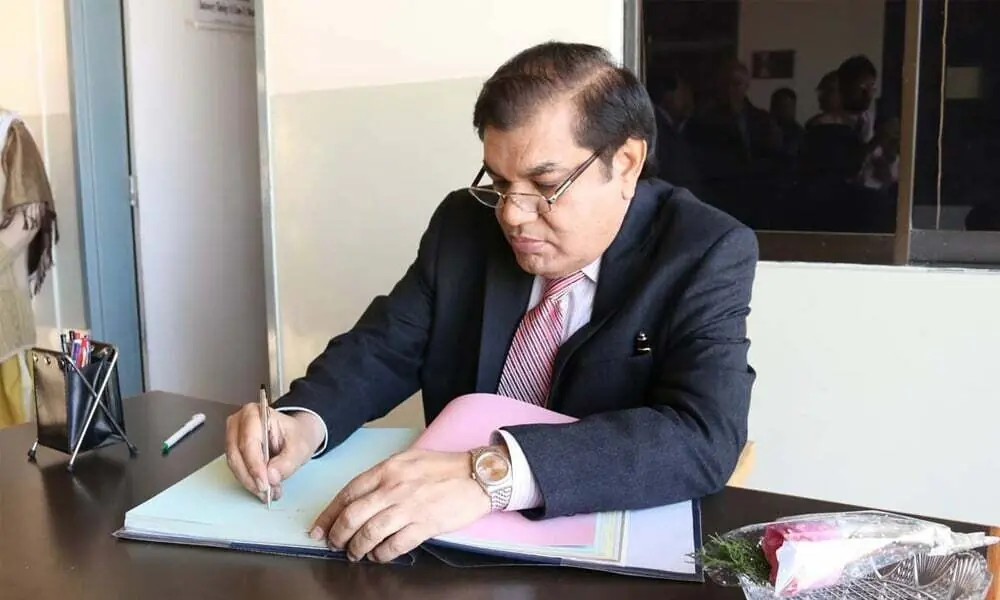
KARACHI: Mian Zahid Hussain, who is the president of the Pakistan Businessmen and Intellectuals Forum as well as the All Karachi Industrial Alliance, has urged the government to immediately finalise the delayed Automobile Industry Development and Export Policy 2026-31 after meaningful consultation with assemblers, parts manufacturers, consumer representatives, FPCCI and independent economic experts.
He said that continuing policy uncertainty is already delaying investment decisions, production planning, technological upgrading and expansion across the vendor industry.
Mian Zahid Hussain said that Pakistan needed a balanced automobile policy that protected consumers from excessive prices while also protecting the country from premature de-industrialization.
Tariffs should be reduced gradually when domestic manufacturers achieve scale, productivity and export competitiveness.
Pakistan must move from simple vehicle assembly toward engineering, component manufacturing, electric-vehicle technology and regional exports; otherwise, tariff liberalization would merely exchange local employment for higher imports and greater pressure on the country’s foreign exchange reserves.
He warned that abrupt tariff reductions on completely built-up vehicles (CBUs) could weaken local manufacturing, discourage investment and accelerate de-industrialization.
He said that competition and affordable vehicles were important for consumers, but Pakistan cannot achieve sustainable economic development by replacing locally assembled products with imported finished goods. The objective of tariff reforms should be to reduce inefficiencies, improve quality and encourage exports – not to discourage local factories, eliminate vendor industries and increase dependence on foreign exchange-intensive imports.
He further added that the National Tariff Policy envisages gradually reducing the maximum customs-duty slab and bringing tariffs on completely built-up vehicles down from 20 percent to 15 percent over five years.
He cautioned that such reductions must be synchronized with a comprehensive automobile policy based on localization, technology transfer, export development and consumer protection.
Mian Zahid Hussain pointed out that Pakistan’s automobile market had recently shown a strong recovery. According to the Pakistan Automotive Manufacturers Association, car sales increased from 112,203 units in FY2024-25 to 155,631 units in FY2025-26, representing growth of approximately 38.7 percent.
However, the recovery remains fragile because the industry is still operating substantially below its installed capacity. Additionally, he noted that automobile manufacturers have an estimated annual installed capacity of around 500,000 vehicles, but the sector is reportedly operating at less than 50 percent of this capacity. Industry representatives have also stated that approximately 45,000 completely built-up vehicles enter the country annually, accounting for nearly 18 percent of the domestic market. Lowering tariffs without improving production volumes and competitiveness could therefore make imported vehicles more attractive than locally manufactured alternatives.
He also highlighted that the automobile industry is not limited to a few vehicle-assembly plants. It supports an extensive network of parts manufacturers, engineering companies, dealerships, workshops, transporters and other service providers.
A sector assessment by VIS Credit Rating Company estimates that the automobile industry contributes around 2.8 percent to GDP, provides approximately 215,000 direct jobs and is connected with a vendor base of nearly 2,200 firms.
He further added that the Competition Commission of Pakistan has identified more than 1,200 registered automobile-parts manufacturers operating mainly in Karachi, Lahore, Gujranwala and other industrial centres. These companies represent an important source of domestic value addition, technical skills and employment. Once such supply chains are dismantled, rebuilding them requires years of investment, training and technological development.
Mian Zahid Hussain observed that the threat is particularly serious from uncontrolled imports of used vehicles. The Competition Commission’s automobile-sector study stated that more than 38,000 used cars were imported during FY2024–25, accounting for nearly one-fourth of passenger-vehicle sales. The study estimated that these imports resulted in approximately Rs60 billion in revenue losses for the local industry and more than 40,000 potential jobs being forgone.
He further clarified that the business community is not demanding unlimited protection for inefficient manufacturers. Protection without measurable performance has previously encouraged assembly operations without developing sufficiently competitive engineering, research, component manufacturing or export capabilities.
Any tariff differential provided to local manufacturers should therefore be temporary, transparent and linked with binding targets for localisation, exports, technological upgrading, fuel efficiency and vehicle safety.
Mian Zahid Hussain said that assemblers receiving tariff advantages must be required to publish model-wise localisation levels, reduce dependence on imported kits, establish local research and development facilities and provide long-term procurement opportunities to Pakistani parts manufacturers. Incentives should be connected with actual production, exports and technology transfer instead of the mere establishment of assembly plants. He also added that consumers must also receive the benefits of industrial protection.
Copyright Business Recorder, 2026
