
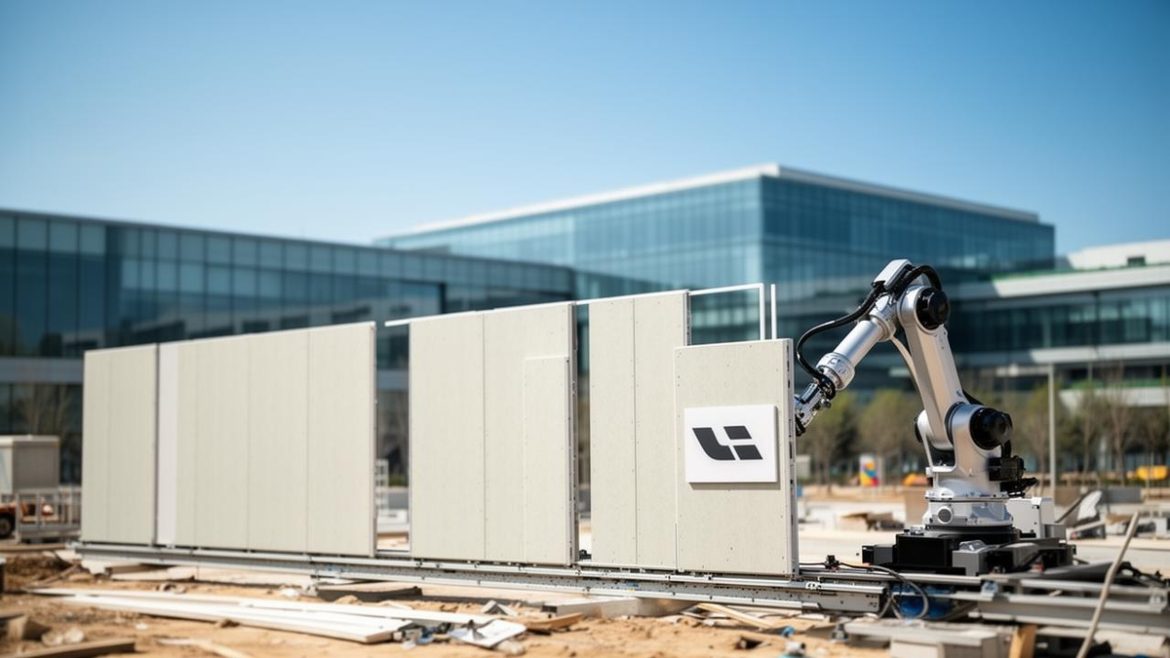
Habitat, a smart home brand founded by Li Auto co-founder and former president Shen Yanan, announced the completion of its Series A funding round totaling 700 million yuan (approximately $104.1 million). The round was led by the Changzhou Xinbei District Science and Innovation Fund, marking the largest single financing in China’s primary-market home furnishing sector in three years.
Habitat said the proceeds will be primarily used to build a global headquarters and R&D center for smart housing in Changzhou, along with an embodied intelligence laboratory and a production-grade AI design and delivery system, accelerating the deep development of AI-native intelligent housing and the rollout of its ecosystem platform growth strategy.
Shen Yanan founded Habitat in 2022 after leaving Li Auto. The company systematically transplants forward engineering, high-level integration, and productization thinking from the smart vehicle sector into the residential space, with the core logic of “building homes the way you build cars.” Shen previously served as vice president of global supply chain at Lenovo Group and chairman of Motorola (China), and was deeply involved in building Li Auto’s supply chain and product systems. He has said publicly that the home renovation market is theoretically larger than the auto market, and Habitat’s goal is to drive the home improvement industry through an iteration akin to the shift “from assembling desktop PCs to laptops.”
In April 2024, Habitat announced the completion of angel and Pre-A rounds totaling 653 million yuan (approximately $97.1 million), with the Pre-A round led by Li Auto and participation from Roborock, the Xinbei Science and Innovation Fund, and other institutions.
In March 2025, Habitat launched the L32, the world’s first smart home product equipped with a home intelligence agent, with the standard version priced at 399,800 yuan (approximately $59,000). Positioned as a three-bedroom smart residence, the product is now available through company-operated direct-sales networks in seven Chinese cities—Beijing, Shanghai, Hangzhou, Shenzhen, Guangzhou, Chengdu, and Wuhan—with annual contracted sales exceeding 1 billion yuan (approximately $148.7 million).
The lead investor, Changzhou Xinbei District Science and Innovation Fund, is a guidance fund established by the Changzhou National Hi-Tech District (Xinbei District) government and state-owned entities including Changgaoxin Group, with a total size of 10 billion yuan (approximately $1.5 billion), operating under a “fund-of-funds” structure. In late July this year, Habitat’s AI smart home global headquarters project signed an agreement to settle in the Changzhou Hi-Tech District, with a total investment of 1 billion yuan (approximately $148.7 million).
The industrial logic of smart housing
Habitat positions itself as a lifestyle intelligence technology company, with a product philosophy emphasizing the leap from “passive intelligence” to “active intelligence.” The company says it will apply the industrial R&D and manufacturing mindset of smart vehicles to the residential sector, building software-hardware integrated AI-native smart home products that transform living spaces into intelligent living organisms capable of proactive perception, proactive thinking, and proactive service.
The core of this model lies in replicating the automotive industry’s mature forward engineering and high-level integration capabilities in the residential domain. The traditional home renovation industry has long faced pain points including low standardization, inconsistent delivery quality, and fragmented user experiences. Habitat seeks to provide complete smart home services through a productized approach, rather than simply stacking building materials or devices.
From an industrial chain perspective, Habitat’s industrialized R&D and manufacturing system is expected to drive coordinated upgrades across upstream and downstream segments including embodied intelligence, smart hardware, and flexible construction, fostering a smart housing industrial cluster that spans R&D, manufacturing, and services. This is also a key consideration behind Changzhou’s state capital betting heavily on the company—the technology stack behind smart housing has strong synergies with Changzhou’s existing new energy and intelligent manufacturing industrial base.
A two-way choice between capital and industry
The Changzhou Xinbei District Science and Innovation Fund’s lead investment is not purely a financial play. Habitat’s global headquarters and R&D center landing in the Changzhou Hi-Tech District means the company will concentrate its core R&D capabilities, embodied intelligence lab, and production-grade AI design and delivery system in Changzhou. For a city building itself into a new energy capital and intelligent manufacturing hub, bringing in a smart housing company founded by a core figure from a leading EV startup helps extend the industrial chain and enables cross-scenario technology transfer from automobiles to living spaces.
For Habitat, backing from a state-capital fund brings not only capital but also resource support in land, policy, and industrial infrastructure. Smart housing involves multiple segments—construction, renovation, smart hardware, and AI software—with significant asset-heavy characteristics. Deep involvement from local government helps reduce friction in implementation.
With this round completed, Habitat’s cumulative financing has exceeded 1.35 billion yuan (approximately $200.8 million). Against a backdrop of slowing overall funding momentum in the smart home sector, a primary-market raise of this scale stands out. The company said this round “marks market validation and recognition of the model of building homes the way you build cars and reshaping the home living experience through AI-native smart home products.”
From Li Auto to Habitat, Shen Yanan’s second venture reflects a broader trend of smart vehicle talent spilling over into residential technology. The supply chain management, software-hardware integration, and user operations capabilities accumulated during the automotive industry’s electrification and intelligent transformation are being systematically transplanted into broader living scenarios. Whether this cross-industry migration can truly succeed will hinge on Habitat’s subsequent product iterations and delivery performance—a key window to watch.
