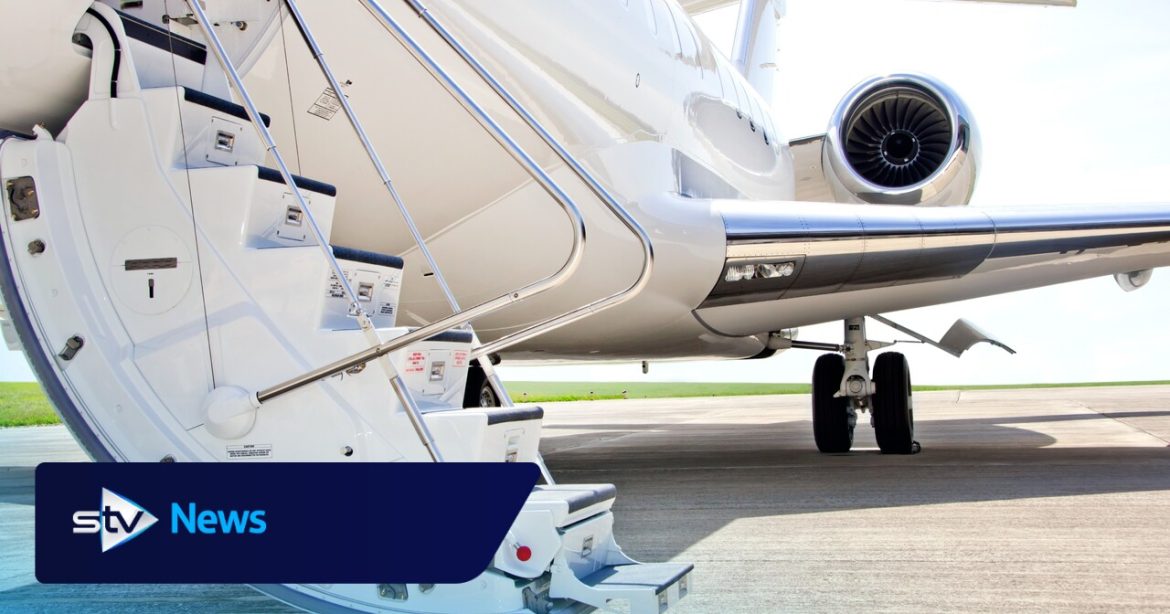
Scottish ministers are being urged to introduce a tax on private jets a year ahead of schedule – and to set the charge at a “punishingly high” rate.
Campaigners said if the tax is brought in in April 2027, instead of the following year as planned, and set at a high enough level, it could raise almost £400m by 2031.
Oxfam Scotland campaigners made the plea as American Stephen Prince, the vice-chairman of the Patriotic Millionaires group, described travelling by private jet as “addictive”, adding that for the new levy to “bite” it must “be set high enough to make people think twice”.
With the Scottish Government having already consulted on taxing private jet flights out of Scotland, Mr Prince added that by “punishing people’s pockets” Scotland could help “inspire other countries to rein in private air travel and forge a new path in saving our shared planet”.
The millionaire businessman was speaking as modelling from Oxfam suggested a private jet tax set at 10 times the level of the higher rate of Air Passenger Duty (APD) could raise almost £122m by the time of the next Holyrood election in May 2031.
However if the charge is set at 30 times the existing higher rate of APD, as proposed by Possible – which campaigns for “climate solutions which make low-carbon lifestyles the best way to live” – that total could rise to £392m.
Those figures are based on private jet use remaining at its existing level, with Oxfam having calculated there were 11,896 private jet flights either taking off or landing from Scottish airports in 2025.
Calling for action from John Swinney, Oxfam Scotland advocacy adviser Katherine May said: “The First Minister has promised action on private jets, now he needs to prove he means business.
“A weak tax, delayed or diluted, will change little – not emissions, not behaviour, not the money needed for climate action.
“Scotland’s private jet tax must start in 2027, be set punishingly high to make passengers think twice and hit those who prioritise luxury travel over lives.
“At the moment, we see white trails in the sky, and climate destruction on the ground. The gap between excess and consequence is exactly what this policy has to close.”
Mr Prince, the founder of Card Market, said while private jet travel is “truly a luxury’s luxury”, he sold his plane three years ago amid concerns over its environmental impact.
He said: “There are many perks to being rich, but chief among them is private air travel. It’s truly a luxury’s luxury, and while I’ve never used cocaine, I’d bet it’s less addictive than having a jet on standby.
“Three years ago, after seeing the damage it causes, I made the difficult decision to sell my jet.
“But we can’t rely on goodwill to cut emissions.
“What we can do, though, is make sure that private air travellers pay at least the cost they create through their selfish extravagance, but preferably more, as they can more than afford it.
“That’s why I’m excited by the move in Scotland to make private jet passengers pay a new tax.
“But for it to bite, the price has to be set high enough to make people think twice. By punitively punishing people’s pockets, Scotland can inspire other countries to rein in private air travel and forge a new path in saving our shared planet.”
Alethea Warrington, of the climate charity Possible, said: “It’s outrageous that ordinary people struggle and vital public services suffer while the wealthiest few keep flying around in virtually untaxed, ultra-polluting private planes.
“The Scottish Government now has an opportunity to fix this and start properly taxing the ultra-rich for the harm they’re causing to our climate.
“Why should a billionaire on a private jet pay a lower rate of tax than an ordinary person on their only holiday of the year?”
SCCS coalition manager Fraser Sutherland said: “Allowing the super-rich to jet about the globe without care for the people suffering the consequences of their luxury lifestyles is not only unfair but also a missed opportunity to raise crucial funds for action to protect the planet.
“The latest data shows greenhouse gas emissions from international aviation and shipping are growing rather than declining. Meanwhile, ordinary people are struggling to afford basic household bills, farmers and crofters are facing increasing challenges from climate breakdown.
“It’s time for the polluters to pay for their privilege, with taxes raised to be spent on vital measures that will protect communities, jobs, health, energy and food security.”
The Scottish Government has been contacted for comment.
Follow STV News on WhatsApp
Scan the QR code on your mobile device for all the latest news from around the country